
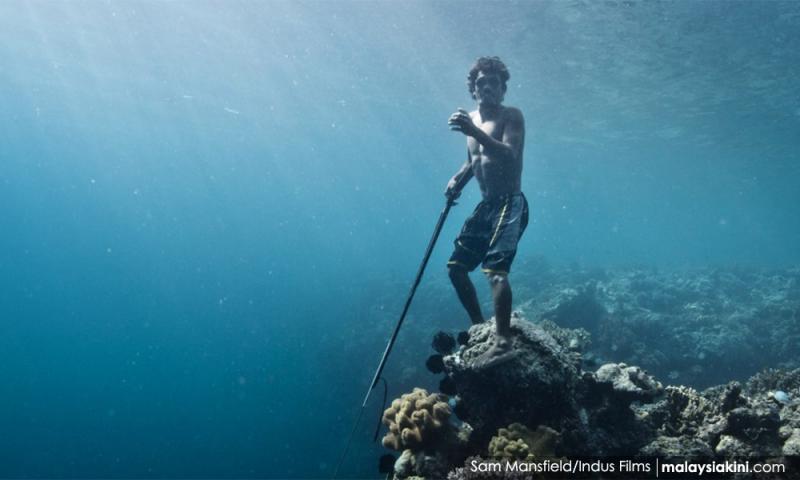
The Bajau Laut people indigenous to the coastal waters of Borneo, Mindanao, and Eastern Indonesia are famed for their ability to hold their breaths for long periods of time as they dive underwater to gather seafood.

Now, authors of a new study published in the journal Cell on Thursday claim to have uncovered their secret to diving longer and deeper.

The researchers say they have identified a number of anatomical and genetic differences in a Bajau population they studied in Sulawesi, Indonesia, compared to a nearby village that is dependent on agriculture rather than free-diving for subsistence.

These differences, they say, are adaptations that have enabled the Bajau Laut to endure long periods on a single breath of air.

"Overall, our results suggest that the Bajau have undergone unique adaptations associated with spleen size and the diving response, adding new examples to the list of remarkable genetic adaptations humans have experienced in recent evolutionary history.

"Similar to other of the most extreme adaptations humans have experienced, such as adaptation to diet associated with pastoralism or shifts in environmental availability of food resources, these genetic adaptations have emerged as a consequence of new cultural practices, illustrating that human culture and biology have been co-evolving for thousands of years," the authors said.

The study was conducted by an international team of 17 researchers, headed by Melissa A Ilardo, then with the University of Copenhagen's Centre for GeoGenetics.

Among others, they found that the Bajau people they studied had a spleen about 50 percent larger than the farming-dependent Saluan people living nearby.

This held true whether or not the individuals were divers, and with age, sex, and height taken into account.

This would mean, the researchers said, that the enlarged spleen is may be due to genetic or other unknown factors – but cannot be solely attributed to physiological responses to repeated diving.

In contrast, a previous study on Thai Sea Nomad children published in 2003 found that their diving abilities were due to training via repeated diving, and had been replicated with a European group in a separate study published in 2006.

The larger spleen provides a larger reservoir of oxygenated blood, which can then be injected into the bloodstream to allow a prolonged diving time.

The study also unveiled other insights, such as the gene that is linked to larger spleen sizes – that has been identified in mice – is more common amongst Bajau people, as is another gene linked to stronger ‘diving reflexes’, that squeeze blood from the limbs to the brain, heart, and lungs when a person is submerged.

A previous study published in 2014 found that the Bajau fishers typically dive repeatedly to depths of about 10 metres, and spent about 50 percent of their working time underwater, or to a shallower depths and spend 60 percent of their time underwater. This lasts between three to nine hours a day.

Next stage of evolution

Yale University ecology and evolutionary biology professor Stephen Streans, who is not involved in the study, reportedly told UK's The Guardian that the new study adds to existing evidence of recent human evolution.

He reportedly said that previous examples had included genes for lactose tolerance that appeared with the advent of the domestication of dairy animals, and genes that enable Tibetans and Native Americans endure the thin air of high altitude in the Himalayas and the Andes.

“What we lack at this point, and badly need, are samples large enough to allow us to infer when the selection (in the Bajau) started to happen.

“We know that the Bajau have been leading this lifestyle for at least a thousand years, but we do not know when they started it – perhaps much earlier," he was quoted as saying.

Similarly, University of Toulouse anthropologist François-Xavier Ricaut told the New York Times the that it is still unclear how quickly the Bajau evolved to adapt to a life of diving.

The NYT noted that some researchers suspect that the Bajau only started diving when a market for sea cucumbers opened up in China in the 1600s, while others speculate that it began thousands of years earlier at the end of the Ice Age, when rising sea levels turned the region around Indonesia into a group of Islands.

“This study acts as a cornerstone for exciting questions to follow,” Ricaut said.

Meanwhile, authors of the study on the Bajau noted that previous studies on how Tibetans adapted their the oxygen-poor environments have led to insights in intensive care treatment and the growth of tumours.

They said they hope their study on how the Bajau coped with a different kind of oxygen-poor environment can also leading findings that are medically relevant.