


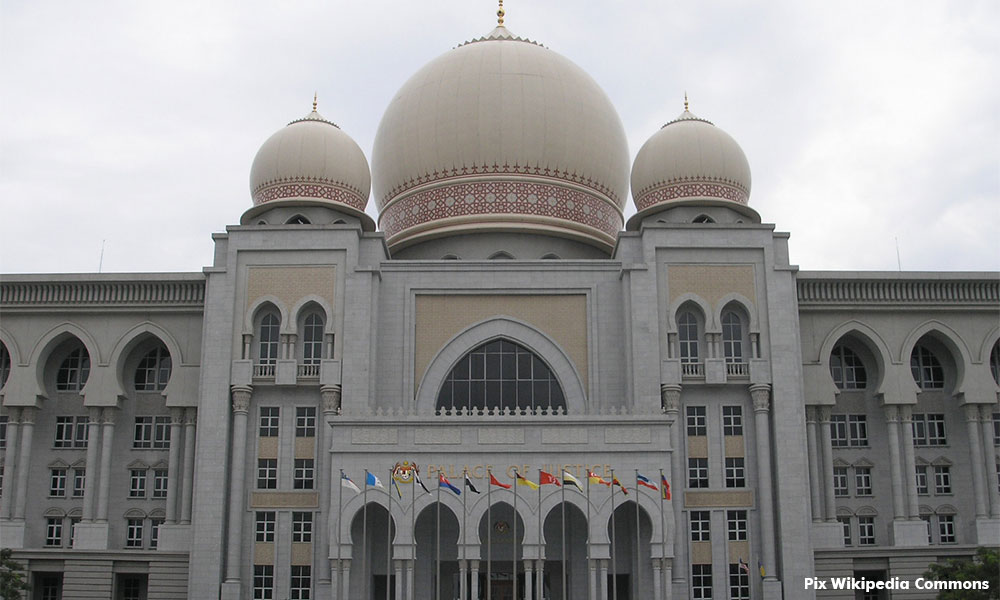

Nine-member apex bench to hear cases of stateless children
For the first time in the country's history, a nine-member Federal Court bench will hear appeals from three families whose children are classified as stateless.
Previously, the largest number of Federal Court judges employed to hear constitutional cases was seven.
Lawyers N Surendran and Latheefa Koya, representing two of the families, said this was decided following case management today...
For the first time in the country's history, a nine-member Federal Court bench will hear appeals from three families whose children are classified as stateless.
Previously, the largest number of Federal Court judges employed to hear constitutional cases was seven.
Lawyers N Surendran and Latheefa Koya, representing two of the families, said this was decided following case management today.
"Initially it was fixed to be heard at the end of this month, but now the nine-member bench will sit on Aug 30 for this case.
"In light of chief justice Richard Malanjum's directive that a nine-member bench will hear constitutionally important cases, this would be such a case," said Latheefa.
The outcome of these three cases will have a major impact on the rights of stateless individuals.
Surendran had previously claimed that there are thousands of stateless individuals in Peninsular Malaysia alone.
Last year, then-home minister Ahmad Zahid Hamidi told Parliament that between 2012 and January 2017, 15,394 children born in Malaysia were denied citizenship, despite their fathers being Malaysian citizens.
It was previously reported that the three families were granted leave to appeal their cases, while the Home Ministry and government were similarly allowed to appeal another case which they had lost.
The hearing of the appeal had been postponed several times in the past.
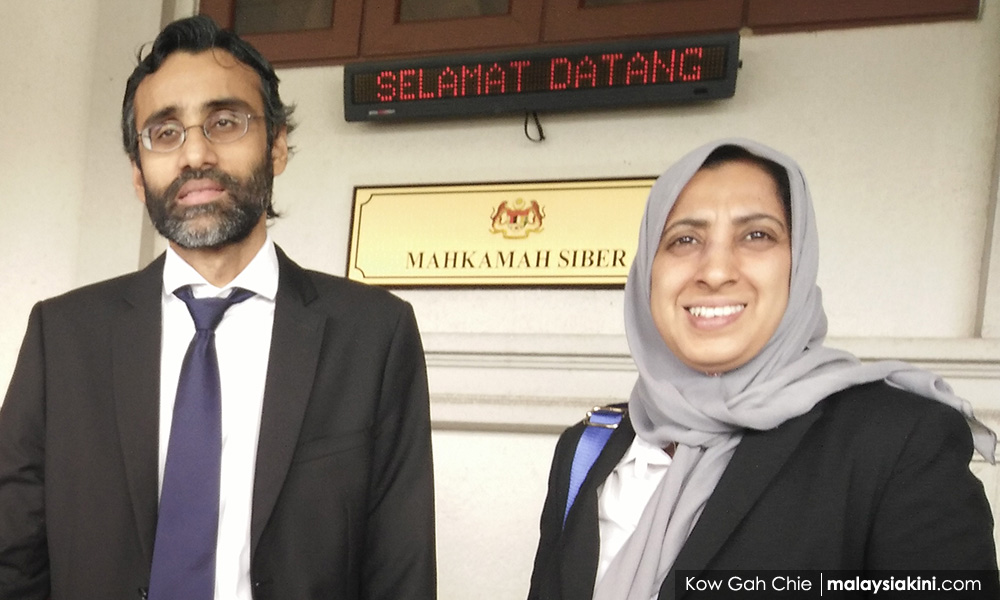
Both Surendran and Latheefa, along with former Federal Court judge Gopal Sri Ram, are appearing in the case of Lim Jen Hsiang and that of another applicant – who now wants to remain anonymous – in which the court allowed one question of law to be posed.
The question from the two cases is whether the principle of jus sanguinis, the reference to blood or lineage, is a requirement under Section 1(e) of Part II of the Second Schedule of the Federal Constitution.
Section 1(e) of Part II states that "every person born within the Federation who is not born a citizen of any country" is a citizens by operation of law.
In Lim's case, he is the biological father of a child who was not given citizenship because the boy's mother is a Thai national.
The second case, being handled by Surendran, involves adoptive parents who were unsuccessful in registering their child as a citizen.
Both these appeals had been dismissed by the High Court and Court of Appeal.
In the third case, being handled by lawyers Cyrus Das and Raymond Mah, the apex court has allowed seven questions of law to be decided.
Some of the questions are:
-
Whether a child who was born in Malaysia and did not acquire citizenship of any other country, within one year from his birth date, is a citizen of Malaysia by the operation of law pursuant to Article 14(1)(b) and Section 1(a) and 1(e) and Section 2(3) of Part II of Second Schedule.
-
Whether the words “not born a citizen of any country” in Part II Section 1(e) of the Second Schedule of the Federal Constitution requires a child to prove the identity of his or her biological parents and that they are not foreign citizens or whether, pursuant to Part II Section 2(3) of the Second Schedule, it is sufficient for the child to prove that he/she does not require citizenship.
The case was brought by lawyer Ranee Sreedharan, who is representing parents who were successful in their citizenship bid for their eldest child after the appellate court allowed their appeal.
The government has filed an application to be allowed to appeal the outcome, however.
In this case, the father is a Malaysian while the mother is a foreigner, and they were married two months after the child was born. Unlike her siblings, the child did not get Malaysian citizenship until the Court of Appeal decision was made.
Federal Court deputy registrar Syahrin Jeli Bohari was present for today's case management.


Are you sure you want to delete this comment?
This action cannot be undone.