



GST and SST – What’s the difference and why it matters
KINIGUIDE | The federal government has been releasing more details about the Sales and Services Tax (SST) as the deadline for its reinstatement on Sept 1 draws near.
Abolishing the GST and replacing it with the SST has been a key election plank of the Pakatan Harapan coalition and one that it promised to deliver in its first 100 days in power.
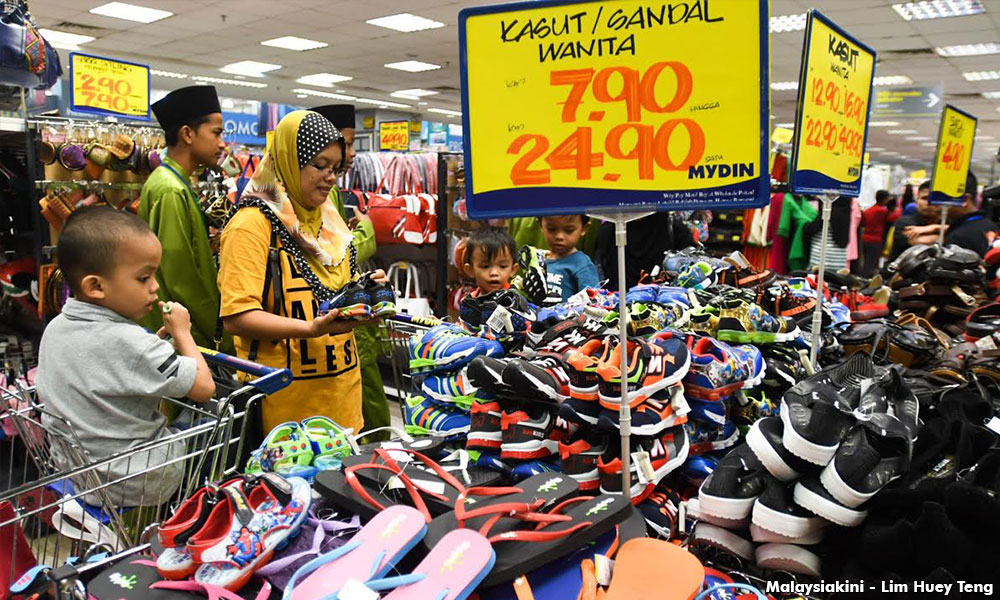
As an interim measure, starting on June 1, it has zero-rated all goods and services that were previously standard-rated at six percent under the GST scheme.
Now, with Parliament in session, plans are afoot to table legislation to scrap the GST altogether and reintroduce the SST. These new laws are expected to come into force on Sept 1.
But what is the SST and how is it different from the GST? That is the question this instalment of KiniGuide will tackle.
What is the GST?
The GST was introduced in Malaysia through the Goods and Services Tax Act 2014, which came into force on April 1 the following year.
The standard rate for GST is six percent and it is collected at every stage of a supply chain.
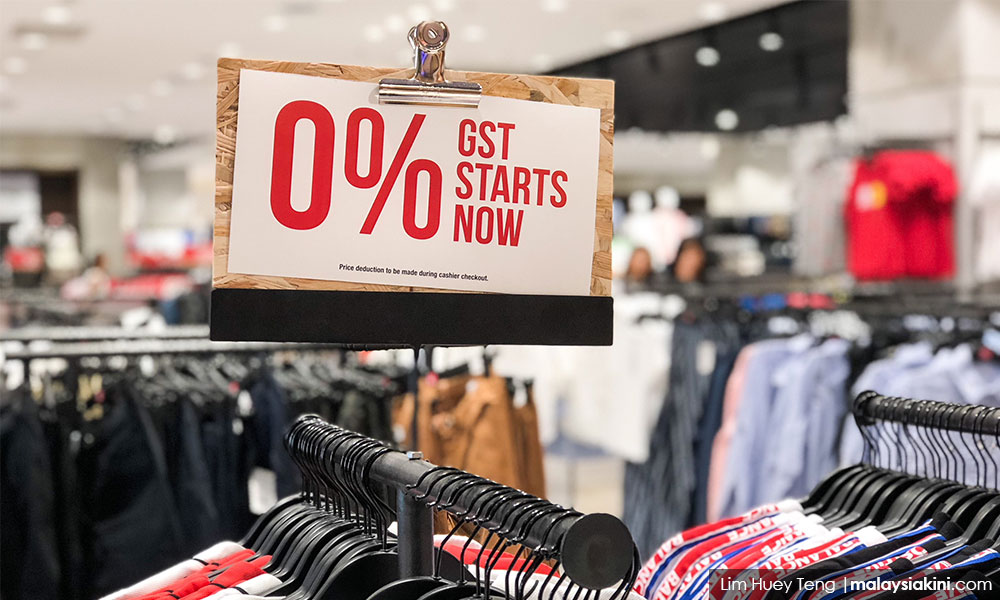
However, some goods are zero-rated whereas others are GST-exempt. In addition, businesses can claim a tax credit (i.e., a refund) for GST collected from them by their suppliers.
The government had raised RM44 billion through GST last year and had originally targeted RM43.8 billion for this year.
And what is the SST?
The SST was introduced through the Sales Tax Act 1972 and the Service Tax Act 1975. They were in force until replaced by GST on April 1, 2015.
KINIGUIDE | The federal government has been releasing more details about the Sales and Services Tax (SST) as the deadline for its reinstatement on Sept 1 draws near.
Abolishing the GST and replacing it with the SST has been a key election plank of the Pakatan Harapan coalition and one that it promised to deliver in its first 100 days in power.
As an interim measure, starting on June 1, it has zero-rated all goods and services that were previously standard-rated at six percent under the GST scheme.
Now, with Parliament in session, plans are afoot to table legislation to scrap the GST altogether and reintroduce the SST. These new laws are expected to come into force on Sept 1.
But what is the SST and how is it different from the GST? That is the question this instalment of KiniGuide will tackle.
What is the GST?
The GST was introduced in Malaysia through the Goods and Services Tax Act 2014, which came into force on April 1 the following year.
The standard rate for GST is six percent and it is collected at every stage of a supply chain.
However, some goods are zero-rated whereas others are GST-exempt. In addition, businesses can claim a tax credit (i.e., a refund) for GST collected from them by their suppliers.
The government had raised RM44 billion through GST last year, and had originally targeted RM43.8 billion for this year.
And what is the SST?
The SST was introduced through the Sales Tax Act 1972 and the Service Tax Act 1975. The laws were in force until replaced by GST on April 1, 2015, and are now slated for reinstatement on Sep 1.
The sales tax rate for goods will be set at five percent, 10 percent or at some other rate specified by the government.
Meanwhile, the services tax rate is six percent and will be levied on food and beverage services, insurance, communications services, private clubs, hotels and others.
Unlike the GST, the tax is only levied on manufacturers and importers rather than on the entire supply chain. In addition, there is no provision for claiming input tax credits.
The government said it hopes to raise RM21 billion annually through the SST.
So how does the maths work out?
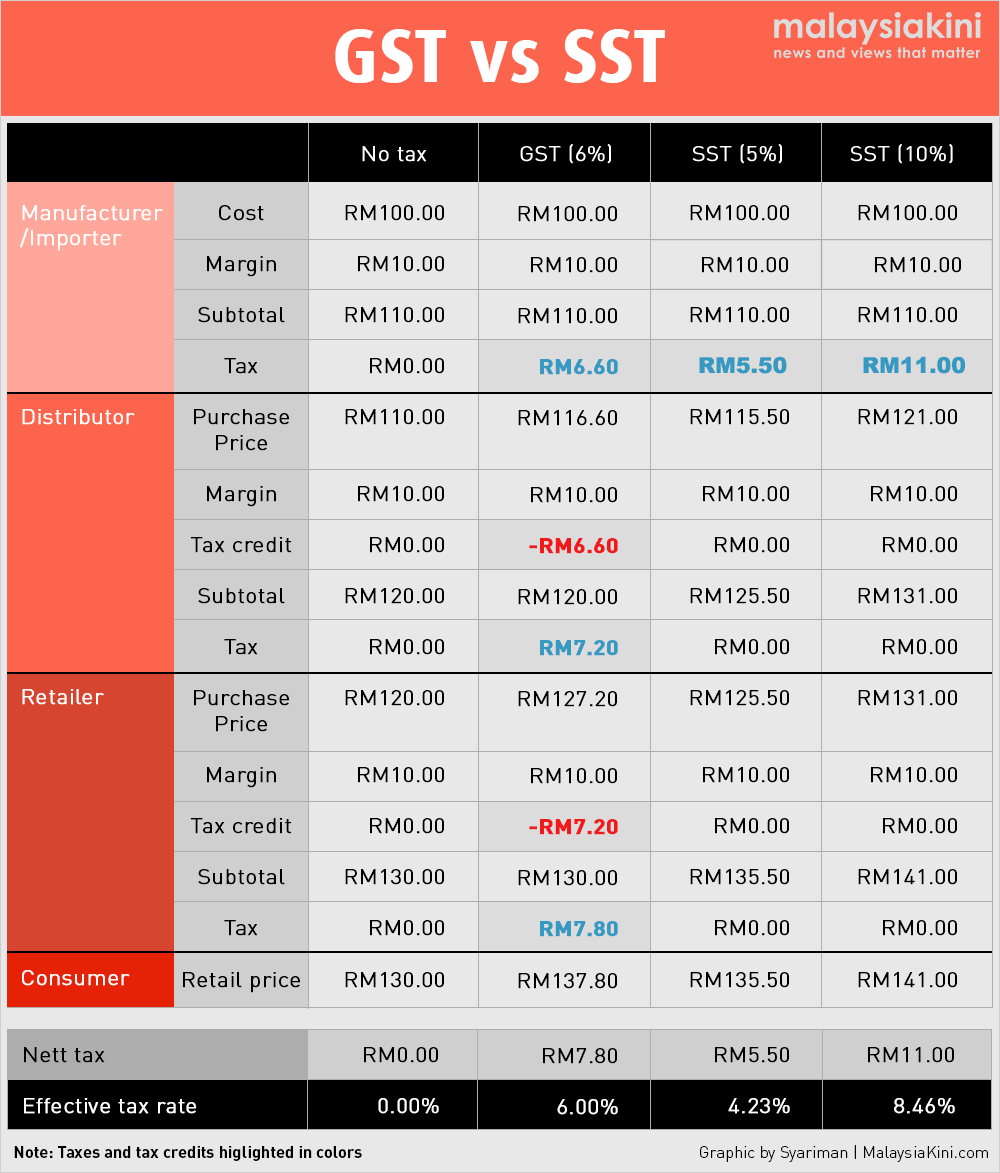
The example below assumes simple supply chain involving a manufacturer or importer that produces or imports a product for RM100 and then sells it for a RM10 profit margin.
Each business further down the supply chain – namely the distributor and the retailer – also seeks a RM10 margin to cover their own expenses, and hopefully turn a profit before the product finally ends up with the consumer.
If there is no consumption tax involved, then the consumer will end up buying the product for RM130 (RM100 initial cost, RM30 margins).
Under the GST however, the manufacturer collects a six percent GST (RM6.60) from the distributor on the government’s behalf.
The distributor does the same when it sells the product to a retailer. However, the distributor can also claim tax credits for the RM6.60 GST it paid the government through the manufacturer.
In a perfect world, this would be reflected in the price such that the increased cost associated with the tax is not further passed down the supply chain.
The same applies to the retailer, which claims RM7.20 in tax credit for the GST paid through the distributor, and then charges six percent GST to the consumer.
The final price comes to RM137.80. Throughout the process, the government collects RM21.60, but refunds RM13.80 in tax credits leaving RM7.80 (six percent of retail price) for the Federal Consolidated Fund.
In the case of the SST however, the tax is only levied once when the product is sold from the manufacturer or importer to the distributor at a rate that varies depending on the type of product involved.
That is the only tax involved and there is no provision for tax refunds.
For the GST, note also that the total collected is exactly six percent of the retail price, which is also the standard rate levied.
But this is not the case with the SST. In the examples above, the tax collected is 4.23 percent or 8.46 percent of the retail price respectively, rather than the five or ten percent that the government collects.
This figure will vary depending on the margins collected by each player in the supply chain and hence it is difficult for consumers to know how much is being paid to the government.
Why do the differences matter?
The GST was often touted as being more efficient and transparent than the SST, and the key to understanding the latter is appreciating the amount of paperwork involved for businesses to collect GST for the government and claiming tax credits for themselves.
It creates a paper trail that cuts through the entire supply chain, and makes it more difficult for businesses to evade paying taxes compared to the SST.
It is also acknowledged to be more transparent. This is true in the sense that consumers/ taxpayers know exactly how much they are paying to the government in the form of GST.
Under the SST, consumers are likely to still see “service tax” on the receipts for the services they pay for, but not “sales tax” on the receipts of the goods they purchase.
However, the GST scheme was not without its shortcomings. For one, keeping track of all that paperwork adds to the cost of doing business which is ultimately passed down to the consumer.
There have also been persistent complaints that GST refunds often came late, which again drives up prices.
What else should I know?
Finance Minister Lim Guan Eng has said that the SST will be levied on fewer items compared to the GST. In particular, he said the SST would only cover 38 percent of goods that form the consumer price index's (CPI) “basket of goods,” compared to the GST’s over 60 percent.
The CPI “basket” comprises goods and services that an average consumer might buy or pay for based on the findings of the of the Statistic Department’s Household, Income and Expenditure Survey. The prices of the goods and services in the basket are used to calculate the CPI.
Apart from these, Lim said fisherfolk will no longer need to pay SST to buy their boats, while farmers will not need to register under the GST to be able to claim tax credits for tractors and fertiliser purchases, since these would no longer be taxed.
Healthcare services such as medical consultation and ambulatory services and construction materials, such as sand, bricks, and cement, will also no longer be taxed.
This instalment of KiniGuide is compiled by Koh Jun Lin.


Report this comment
Are you sure you want to delete this comment?
This action cannot be undone.