



Survey: M'sians still don't get liberalism despite supporting liberal ideas
A new survey conducted by pollster Merdeka Center has reaffirmed its previous finding that Malaysians generally support liberal ideas – though many are unsure what liberalism means.
Like the previous survey, the latest also found that respondents also seem to support contradictory ideas. According to a political scientist, this may be because respondents provided “politically correct” responses to some questions and misunderstood others.
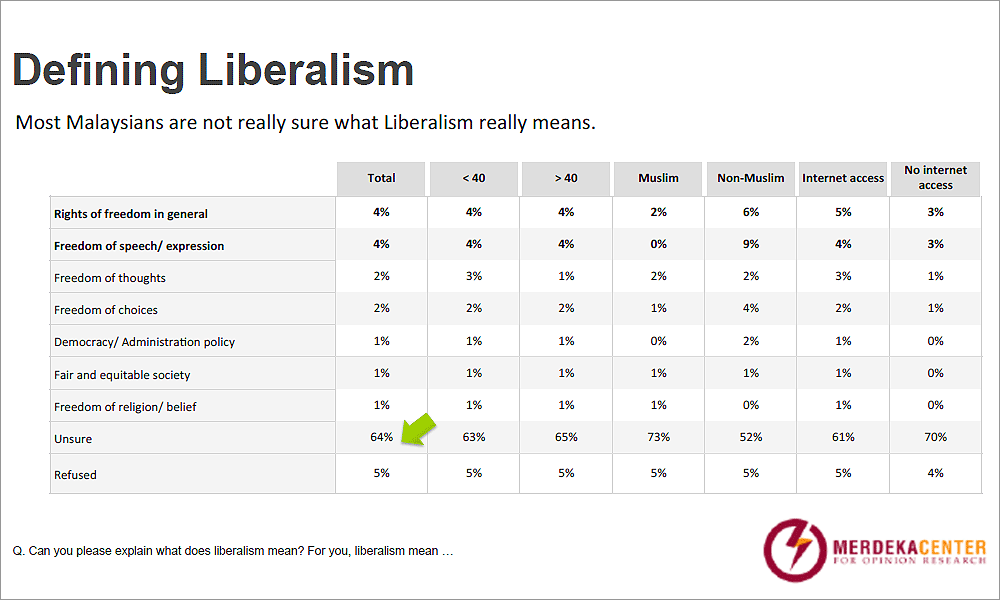
For instance, the survey found that 64 percent of respondents said they are unsure what liberalism means, and that the figure is highest amongst Muslims (73 percent)...
A new survey conducted by pollster Merdeka Center has reaffirmed its previous finding that Malaysians generally support liberal ideas – though many are unsure what liberalism means.
Like the previous survey, the latest also found that respondents also seem to support contradictory ideas. According to a political scientist, this may be because respondents provided “politically correct” responses to some questions and misunderstood others.
For instance, the survey found that 64 percent of respondents said they are unsure what liberalism means, and that the figure is highest amongst Muslims (73 percent).
Most were uncertain if liberalism is “good” or “bad.” Twenty-four percent of respondents said it is good, and 22 percent bad.
The difference is most pronounced along religious lines. Only eight percent of Muslims consider liberalism a good concept, compared to 46 percent of non-Muslim respondents.
The top three reasons cited in support of liberalism is that it means freedom of speech and expression, freedom in general, and freedom of choice.
Meanwhile, 28 percent of Muslims say liberalism is a bad concept, compared to 14 percent of non-Muslims.
The top three reasons cited in opposition to liberalism is that it has negative effects towards religion or Islam, that it would sow chaos in the country, and that the ideology itself is against Islam.
The survey was commissioned by the German NGO Friedrich Naumann Foundation (FNS) and was conducted by Merdeka Center.
It was conducted by surveying 1,206 voters via fixed line and mobile phones in all 222 parliamentary constituencies in Malaysia, between Nov 26 and Dec 4, 2017, and was conducted using the language of the respondent’s choosing.
The older survey was conducted in 2016 used a similar method and sample size.
Keeping Sedition Act
The responses from the survey respondents were much less polarising when survey questions addressed specific concepts related to liberalism, although in some cases the respondents appeared to support contradictory policies.
For example, when asked about concepts related to political liberalism, 82 percent of respondents in the latest survey agreed that Malaysia is ready for freedom of speech and a free media, and 93 percent of respondents said the rule of law must be upheld.
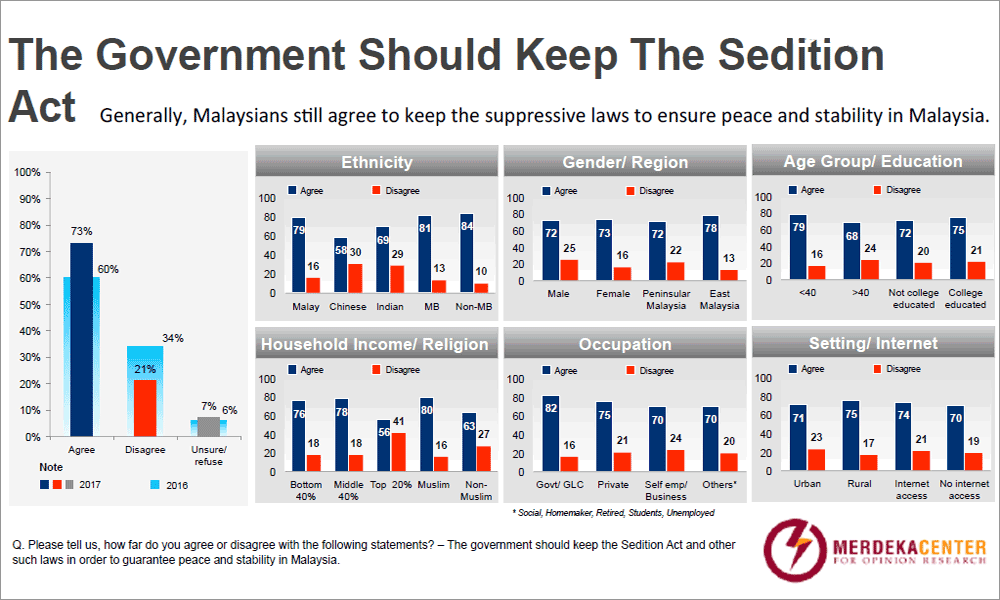
Despite overwhelming support for such statements, 73 percent of respondents also agreed with the statement, “The government should keep the Sedition Act and other such laws in order to guarantee peace and stability in Malaysia”.
The Sedition Act 1948 has been criticised as being draconian for imposing broad and vague restrictions on free speech and expression. It is among the laws Pakatan Harapan promised to repeal in their election manifesto.
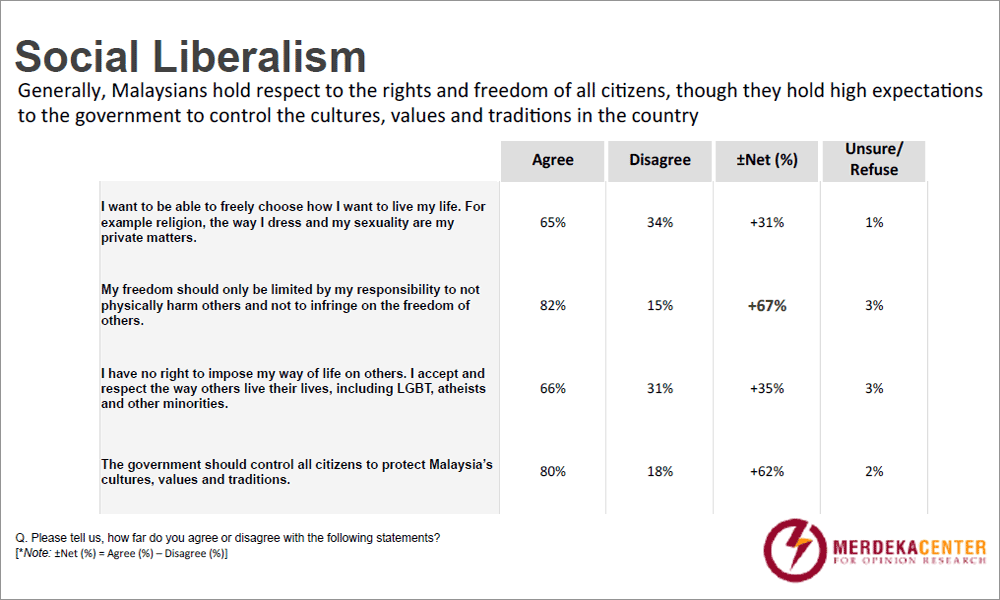
Meanwhile, when examined for their attitudes towards social liberalism, 82 percent said their freedom should only be limited by their responsibility not to harm others or infringe upon others’ freedoms.
At the same time, 80 percent agreed that the government should control all citizens to protect Malaysia’s cultures, values, and traditions.
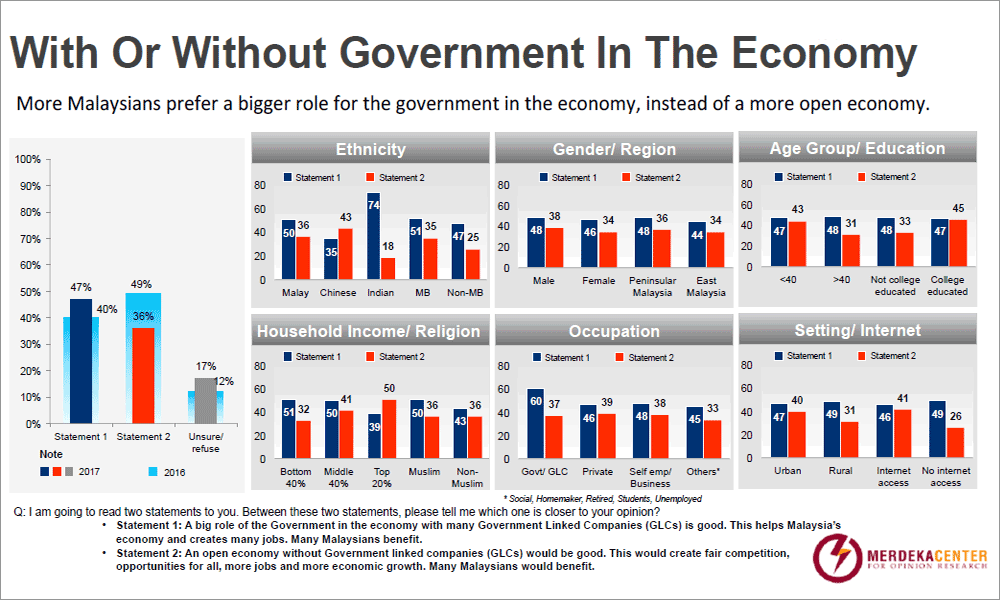
When it comes to economic liberalism, most respondents provided responses that correspond to illiberal ideas.
Most respondents said the government and government-linked companies should play a major role in the economy, rather than having an open economy with limited government.
They also said the government should control trade and provide subsidies, instead of allowing free trade and not providing subsidies.
An overwhelming 94 percent also said the government should help the needy irrespective of race.
Political correctness
Explaining the apparent contradiction, political scientist Wong Chin Huat said this is because respondents may have provided “politically correct” responses to some survey questions, while other questions may have been misunderstood.
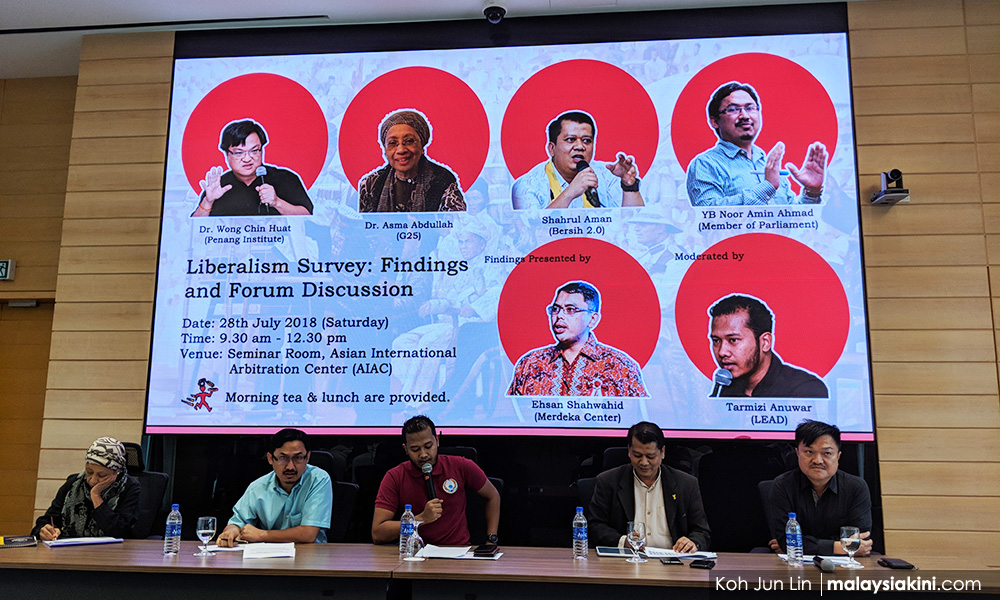
Speaking at a forum in Kuala Lumpur today after Merdeka Center researcher Ehsan Shahwahid presented the survey findings, Wong pointed out responses such as those supporting free speech and rule of law could be construed as among those considered “politically correct.”
He argued that there were a number of questions that ought to be thought as “defining questions” in determining whether a respondent is liberal or not: Questions about the Sedition Act; whether a person has the right to impose his way of life upon others including LGBTs, atheists, and other minorities; and whether the government and GLCs ought to play a big role in the economy.

Given the contradictory nature of the results, Wong said there were two alternative ways to gauge whether Malaysians are liberal or not, based on the survey.
The first is whether they gave liberal responses to all questions pertaining to each of the three forms of liberalism presented in the survey.
Alternatively, Wong said another way to gauge whether Malaysians are liberal was by their responses to the “defining questions.”
‘Problematic’ survey
Also on the panel with Wong were G25 member Asma Abdullah, Kangar MP Noor Amin Ahmad, and Bersih chairperson Shahrul Aman Mohd Saari.
Asma, who is an anthropologist, said the survey was problematic because the word “liberalism” created unnecessary fear due to its negative connotations. Earlier speakers at the forum had attributed the negative connotations to fearmongering through government propaganda.

Asked how the survey could be improved, Asma said Merdeka Center should consider conducting qualitative studies to complement its surveys.
This is to find out what laypeople mean by the word “liberalism,” she said.
“I think this is very important when we discuss concepts that didn’t originate from our culture. I think we need to rethink that,” she said.
Meanwhile, Wong said it was important for Merdeka Center to analyse the respondents’ responses based on the language they chose for the survey to be conducted in.
This is to see if language preference influenced their responses.
“This is because our worldview is not necessarily determined by race especially what it comes to large racial groups, but more towards educational background and the media and information we get and that’s where language can make a big difference.
“If we look at language, we may get a clearer picture,” he said.
Merdeka Center could also analyse the respondents by dividing them into clusters based on their responses, he added.


Are you sure you want to delete this comment?
This action cannot be undone.