




Resistance to police watchdog body
Since the 71-second video clip of a Chinese woman apparently ordered to do ear-squats in the nude was exposed last week, public pressure has been mounting for an independent commission to handle police misconduct.
Since the 71-second video clip of a Chinese woman apparently ordered to do ear-squats in the nude was exposed last week, public pressure has been mounting for an independent commission to handle police misconduct.
But the police have strong reservations to certain provisions in the draft of the Independent Police Complaints and Misconduct Commission (IPCMC) Bill 2005, going by views aired at the 13th Malaysian Law Conference earier this month.
Kuala Lumpur Senior Police Officers College Investigation and Prosecution Studies Centre head A Paramasivam, while lauding the report as good, denounced the proposed body as "draconian".
"It is draconian because an officer may not even know that an investigation is going on or is being conducted in absentia. The decision is also final with no avenue for appeal," he said.
"Furthermore, the categories of complaints under section 16 (of the draft bill) are ambiguous particularly the unclear definition of misconduct."
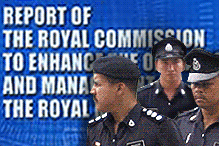 Paramasivam was responding to a panel discussion during the conference on the report by the Special Commission to Enhance the Operations and Management of the Royal Malaysian Police which was released to the public in May.
The IPCMC is the most radical among the 125 recommendations made by the special police commission which released the damning 600-page report after a 15-month study.
He pointed out that the proposed body would not be bound by the rules of evidence or the usual lawyer-client privileges.
"We are compelled to disagree," said Paramasivam, who was widely credited with reducing serious crimes and gangsterism during his tenure as the Klang district chief.
Not law court
Citing complaints against the police discretion to grant permits for public assemblies under section 27 of the Police Act 1967, he said this was needed as "certain operational and security reasons" have to be considered.
 "Only the (district police chief) is privy to (such information or intelligence) which cannot be revealed to the public."
Kuthubul Zaman Bukhari, member of the now-disbanded commission chaired the conference panel comprising human rights lawyer Ramdas Tikamdas and law lecturer Dr Abdul Aziz Bari.
Replying to Paramasivam, Kuthubul, a former Bar president, and said the proposed IPCMC was designed to function as a tribunal and not a court of law.
"That is why there is no need for an avenue to appeal because legal redress is still available," he explained when contacted.
 "The tribunal is not an adversarial system but a body that conducts investigations, collects evidence and then presents its findings before the 'suspected officer' for his or her explanation. The police are wrongly comparing tribunal procedures with a court."
Kuthubul had told the panel discussion the draft was drawn from models such as the Police Integrity Commission of New South Wales and Queensland, Australia as well as those of Hong Kong and the UK.
"They too, have no avenue for appeal and we found that they worked well," he said, urging the police to have open mind and consider the draft closely before proposing any amendment they think necessary.
"If they (the police) are unhappy with what they perceive to be a breach of the rules of natural justice, the courts are always there to uphold it. But the fact remains the government has no choice but to set up an independent commission to handle complaints against the police."
Provision 'unconstitutional'
Another police participant at the discussion, Supt Razali Basri, echoed Paramasivam's concerns saying the models Kuthubul cited were either very new, in draft form and were at the state, not federal, level.
"There should be a wider discussion on the draft bill since it is particularly discriminatory against the police on the basis of human rights. How come the Bar Council has failed to see this but was quick to note the (alleged abuse of) powers under section 27 thoroughly?"
Razali said he was also concerned over the retrospective effect of the proposal which allows for a dismissal upon being found guilty.
"Under Article 135 of the Federal Constitution, you can only fire if you hire. Therefore, the draft bill contains provisions that directly contradicts the constitution."
Contacted yesterday, former commission chairperson Mohamed Dzaiddin Abdullah dismissed police concerns of unfair treatment as "unfounded".
 The former chief justice also said recent incidents have proven the necessity for creating the body.
He cited the swift response by British that followed the fatal shooting of Brazilian Jean Charles de Menezes, 27, by police who mistook him for a suicide bomber in the aftermath of the July 7 London Underground bombings.
The UK Independent Police Complaints Commission is reportedly investigating the shooting after the family filed a complaint.
"This is the kind of prompt response the public expects. The way the British authorities responded to that incident is excellent. It was swift," said Dzaiddin.
Five working committees headed by Prime Minister Abdullah Ahmad Badawi were set up after the police commission's report was released.
Attorney-General Abdul Gani Patail chairs one of the working committee which has Deputy Inspector-General of Police Musa Hassan sitting as a member.
When contacted, Abdul Gani said the committee was looking into the recommendations and declined to comment further.


Are you sure you want to delete this comment?
This action cannot be undone.