
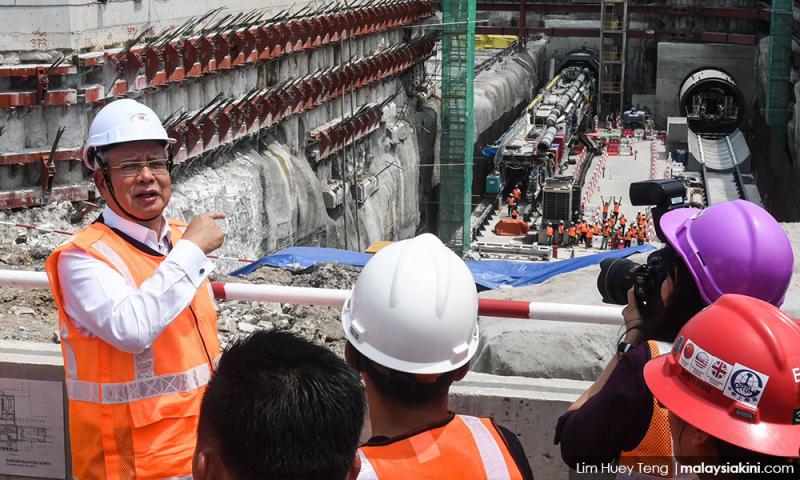
KINIGUIDE | The Finance Ministry's recent attempt to pare down the cost of the MRT2 project has raised questions as to how the initial price tag for the projects was decided.

The ministry also appears to be transitioning from the project delivery partner (PDP) model for the above-ground portion of the MRT2 project to the traditional turnkey model.

This instalment of KiniGuide attempts to deconstruct the original MRT2 deal to understand the genesis of the PDP model in Malaysia, the PDP's role and the original cost of the projects.

What are the MRT projects?

Three MRT projects were initiated during the administration of former premier Najib Abdul Razak.

The first is the Sungai Buloh-Kajang line (SBK, commonly known as MRT1) which was completed in July 2017.

In 2014, Putrajaya initiated the Sungai Buloh-Serdang-Putrajaya line (SSP, commonly known as MRT2). As of July this year, the project is 30 percent complete.

Putrajaya had also planned a third MRT project known as the Circle Line, but the present administration shelved this.

What is MMC-Gamuda’s role in the MRT projects?

MMC-Gamuda KVMRT (T) Sdn Bhd (MMC-Gamuda) is a joint venture between construction giants MMC Corp Bhd and Gamuda Bhd established in March 2012 on a 50-50 basis.

In February 2011, Minister of Finance Incorporated’s wholly-owned company Mass Rapid Transit Corporation Sdn Bhd (MRT Corp) appointed MMC-Gamuda as the project delivery partner (PDP) for MRT1.

By 2014, MMC-Gamuda was appointed the PDP for the MRT2 project. In both instances, there was no open tender.

What is a PDP?

PDP is a new concept in Malaysia and the MRT projects were the first to adopt it. The Star had described Gamuda as the “PDP king” and credited its founder and managing director Lin Yun Ling as the chief architect behind the model.

Like a turnkey contractor, the PDP is the sole company responsible to the client (MRT Corp). However, the PDP, in this case, must deliver the project within the stipulated time and cost to enjoy the incentives agreed upon and avoid penalties.

“(This is) something which a pure engineering consultancy has no financial capacity or management capability to bear,” according to the then Land Transport Commission (Spad) CEO Mohd Nur Kamal in March 2011.

Even though the PDP is responsible for virtually everything, Putrajaya, according to him, would still have the final say on tender awards, as well as scrutinising reports from the value management study (VMS) consultants and the independent checking engineer (ICE).

Since the beginning of the MRT projects, several other big-ticket infrastructure projects adopted the PDP model as well, including the Pan Borneo Highway project, the Penang Transport Master Plan and the LRT3 project.

The present administration is no longer using the PDP model for LRT3 to save cost.

What is the PDP's job scope?

MMC-Gamuda's commitment was to be the all-in-one rail builder-cum-supercontractor. According to the Spad in 2011, MMC-Gamuda’s jobscope included:

  • Project manager;
  • Packaging of works;
  • Calling for tenders;
  • Evaluation of bids;
  • Recommending contractors to the client;
  • Jointly awarding the contracts with the client; and
  • Ensuring the performance of each contractor.

Additionally, MMC-Gamuda drew up the rail alignments, identified land to be acquired and set the technical specifications.

According to Spad, Putrajaya would make the final decision on the awarding of contracts.

In MRT Corp's own words in 2011, MMC-Gamuda's responsibility is to deliver MRT1 “within the agreed KPI of target cost and set completion date”. MRT Corp said the PDP model absolved the client of risks such as delays and cost overruns.

“Appointing a turnkey contractor to build the MRT project might prove to be costly should there be any variation in plans or cost. The PDP model will prevent this from happening,” said then MRT Corp CEO Azhar Abdul Hamid when the deal was signed.

So what was the 'target cost' set for the PDP?

The Najib administration did not make this figure public. While MRT Corp's website lists the awarded contracts, the value is not stated.

The total value of the contracts for MRT1 remains unknown. However, as for MRT2, the Finance Ministry, on Oct 7, revealed that the total bill is at RM56.93 billion, which the government is attempting to trim.


Didn’t Najib say the cost of MRT1 was RM21 billion?

When MMC-Gamuda presented Phase 1 of MRT1 on December 2016, Najib had claimed that the project was delivered on time and “about RM2 billion” below budget at RM21 billion.

This was misleading, however.

According to MMC-Gamuda, the RM21 billion referred only to the construction cost.

It did not include fees for engineering consultancy, quantity surveyors, system integration works, site investigations, topographical surveys, overheads, contingencies, rolling stock and land acquisition, among others.

The total amount that MRT Corp was billed for MRT1 was not made public.

What was the PDP's fee for the MRT projects?

According to MRT Corp in 2011, the PDP's fee for MRT1 would be six percent of the “total aggregate work package contracts award values.”

If the total cost of the project is less than or equal to the target cost, the PDP shall be entitled to the full fee.

If the project cost is more than the target cost, the PDP fee shall be reduced based on an agreed formula.

In 2014, then MRT Corp CEO Azhar Abdul Hamid (photo) said his company would pay MMC-Gamuda RM3.65 billion. This includes RM900 million in fees and reimbursable sums capped at RM2.75 million if the project was delivered on time and within the target cost.

For context, at the time of writing, MMC Corp and Gamuda's combined market capitalisation is RM9.44 billion.

How is turnkey different from PDP?

A turnkey is the colloquial term used for contractors who bid for government projects.

Their profit is normally built into the price of the project, instead of a fixed percentage fee used for the MRT project PDP.

Typically, turnkey contractors engaged by the government do not need the government to be involved in the tender process for subcontractors.

Sometimes, the contractors would encounter problems which require changes or delays to the project, resulting in cost overruns.

An example of a turnkey developer is Kuala Dimensi Sdn Bhd, which was tasked with developing the Port Klang Free Zone (PKFZ) project for the Port Klang Authority in the 2000s.

The initial bill for PKFZ was RM1.957 billion, but eventually the cost ballooned. The total project outlay is now estimated at RM12.453 billion.

How was MRT Corp funded?

Najib told Parliament in July 2017 that MRT1 was a “success story” because of a “direct funding process” and not through concessionaires.

Malaysiakini has established that Danainfra Nasional Bhd, the Finance Ministry's special vehicle to fund national infrastructure projects, had issued 79 bonds since 2012 specifically to fund MRT Corp.

This 79 government-backed facilities amounted to RM46 billion, with maturity dates ranging from 2019 until 2048.

It is uncertain if this would be enough to pay for both MRT1 and MRT2.

Why the turnkey model was adopted for MRT3?

With regard to MRT3, the Najib administration realised that the standard turnkey model was cheaper and probably wanted the contractor to handle its own financing.

The Najib-administration decided that the potential contractors for MRT3 must prove that they are capable of securing 90 percent of the financing on their own, a 30-year financing period, a drawdown period of up to 2028 and a moratorium period of eight years.

This was unlike the MRT1 and MRT2, where the PDP does not have to raise their own funds and relied on Putrajaya, which borrowed from the bond market.

MRT Corp CEO Shahril Mokhtar, who took over the reins in 2015, claimed that the turnkey model was preferred for MRT3 because it was cheaper because there were no fixed PDP fees involved, which would help save “billions”.

Four consortiums – Sapura–TIEC Consortium; MMC-Gamuda–George Kent Joint Venture; Pacific–Mudajaya–JEC Consortium and China Communications Construction Company Ltd–China Communications Construction Company (M) Sdn Bhd JV - participated in the bid for MRT3. The status of the bid is unknown.

How did the PDP, project designer, win MRT2's underground portion contract?

Putrajaya believed MMC-Gamuda produced the cheapest bid and met all the technical requirements.

In April 2016, Putrajaya's One-Stop Procurement Committee chaired by Najib awarded the underground portion of MRT2 to MMC-Gamuda after an international open tender process which adopted the “Swiss challenge” format.

This was the biggest work package - valued at the time at RM15.47 billion – for MRT2 and it attracted two other bidders – China Railway Group Ltd (CREC) and China Communications Construction Co Ltd.

In 2011, Spad had specified that MMC-Gamuda was only allowed to bid for tunnelling works. It is uncertain if this stipulation was eventually changed.

“The government felt that an exception should be made as the PDP is the only local construction company that has experience in major tunnelling works such as in the Smart Tunnel project in Kuala Lumpur, and the Kaohsiung MRT project in Taiwan.

“Nevertheless, the PDP will still have to compete for the work package with other companies and the award will be given on the basis of merit,” said Spad in a statement at the time.

MRT Corp CEO Shahril (photoexplained that MMC-Gamuda's bid had “the best score for the technical evaluation and also the lowest price”.

The underground portion of MRT2 is currently in limbo after the Finance Ministry's recent renegotiations to reduce the cost of the underground portion with MMC-Gamuda collapsed.

Is there a conflict of interest in allowing MRT2's designers to bid for the underground portion?

Perhaps, because the PDP designed and set the specifications for the MRT2 project.

However, Putrajaya, from the onset, dropped hints that the PDP was allowed to do so and that it was in the nation's interest.

“If the PDP bids, it cannot be part of the evaluation committee. The PDP would have the opportunity to bid as it is the only Malaysian group with the expertise and track record to do so.

“To bar the PDP from bidding, though it has the capability, would mean that only foreign contractors will be involved, which is not necessarily in our national interest,” said Spad in 2011.

Will MRT1 and MRT2 recoup its cost through fares?

No, by the Najib administration's own admission. Then minister Nancy Shukri told Parliament last year that Putrajaya was not looking for a direct return of investment through fares.

“The MRT project is part of long-term plans in line with the government’s efforts to improve the public transport service in greater Kuala Lumpur.

“As the government, we are aware that we won’t obtain back the funds spent for the MRT projects through the fares collected,” she had said.

This instalment of KiniGuide was compiled by Andrew Ong and Annabelle Lee.


RELATED REPORT

Rail nice - All bidders for MRT2 underground got a slice of the pie