



The sex DVD - who were the culprits?
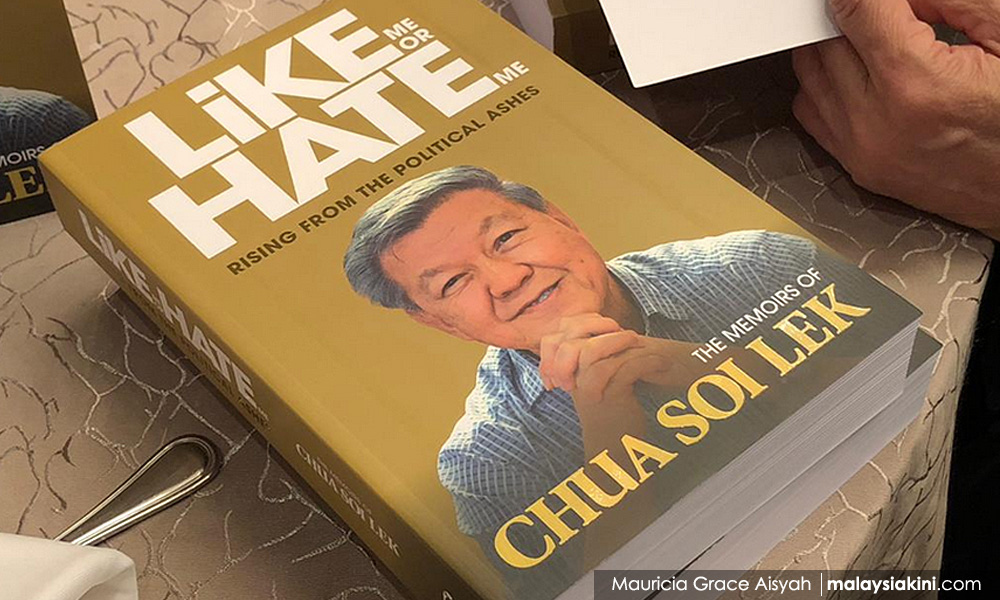
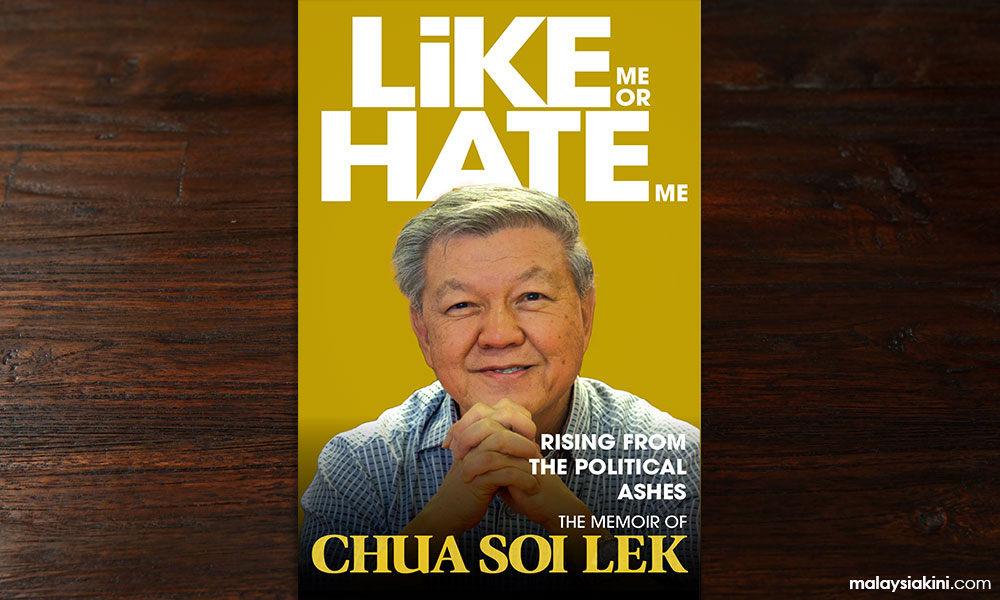
Editor’s note: This is the second part of a series of excerpts from former health minister and MCA president Chua Soi Lek’s book, ‘Like Me or Hate Me: Rising from the Political Ashes’.
BOOK EXCERPT | There was a lot of speculation about who could have secretly installed a hidden camera in the privacy of my hotel room.
The hotel concerned was the only three-star hotel in Batu Pahat. Every time I was in Labis or Batu Pahat for functions, I would stay in that hotel. Hence, the hotel always put me in the same room.
When the police interviewed me, I told them that political rivalry was the most likely motive of those involved.
My bodyguard, my driver, and secretaries in my office were all interviewed by the police from Bukit Aman. But after about a month, the investigations had not turned up any leads.
A senior police officer in Bukit Aman told me that after two weeks of intensive investigations, they ruled out any business rivalry as a motive. They also disclosed that it was a sophisticated operation, with the camera installed inside the television in the room. They also believed the camera was probably operated by remote control from a car parked in the hotel.
The perpetrators secretly taped me in my room at least three to four months before distributing the DVD at the end of December 2007.
At that time, speculation was that the 2008 general elections would be held after Chinese New Year. There was also speculation within the party that I was eyeing the post of president, or at least the deputy president’s post, in the upcoming MCA elections. These rumours were rife, and I did not deny or confirm them.
In terms of the secret and targeted distribution of the DVD, the police concluded that it was likely done by my political rivals. However, they were unable to find any hard evidence.
The police, it seems, could do no more than arrest a few ordinary people found to be distributing copies of the video. For example, in early January they arrested a beauty parlour owner and a farmer in southern Johor after seizing a laptop, a DVD and three VCDs. “We are investigating how the woman obtained the recordings and who is behind it,” state police chief Hussin Ismail was quoted as saying.
For me, however, the search for the perpetrators soon began to seem more and more like an academic exercise. After my resignation, I was confronted with other problems, and it was clear that I should be looking to the future rather than to the past.
One very positive outcome, however, was the way in which the incident triggered a lively debate about the right of a citizen to privacy. Former Bar Council president Yeo Yang Poh noted there was no law in Malaysia to protect people’s privacy, saying it was high time such legislation was introduced. Political analyst Wong Chin Huat added: “I do not think Malaysians would want to see Chua penalised for whatever he did with another consenting adult.”
Sadly, other reactions were just plain silly, revealing just how superficially people could respond to such a serious matter. Illegal betting syndicates were reportedly refusing to accept bets on hotel room number 1301 where the DVDs were shot. According to the New Straits Times, syndicate bosses had issued instructions not to accept such bets after the information was revealed in photographs printed on the front page of several Chinese-language dailies...
Editor’s note: This is the second part of a series of excerpts from former health minister and MCA president Chua Soi Lek’s book, ‘Like Me or Hate Me: Rising from the Political Ashes’.
BOOK EXCERPT | There was a lot of speculation about who could have secretly installed a hidden camera in the privacy of my hotel room.
The hotel concerned was the only three-star hotel in Batu Pahat. Every time I was in Labis or Batu Pahat for functions, I would stay in that hotel. Hence, the hotel always put me in the same room.
When the police interviewed me, I told them that political rivalry was the most likely motive of those involved.
My bodyguard, my driver, and secretaries in my office were all interviewed by the police from Bukit Aman. But after about a month, the investigations had not turned up any leads.
A senior police officer in Bukit Aman told me that after two weeks of intensive investigations, they ruled out any business rivalry as a motive. They also disclosed that it was a sophisticated operation, with the camera installed inside the television in the room. They also believed the camera was probably operated by remote control from a car parked in the hotel.
The perpetrators secretly taped me in my room at least three to four months before distributing the DVD at the end of December 2007.
At that time, speculation was that the 2008 general elections would be held after Chinese New Year. There was also speculation within the party that I was eyeing the post of president, or at least the deputy president’s post, in the upcoming MCA elections. These rumours were rife, and I did not deny or confirm them.
In terms of the secret and targeted distribution of the DVD, the police concluded that it was likely done by my political rivals. However, they were unable to find any hard evidence.
The police, it seems, could do no more than arrest a few ordinary people found to be distributing copies of the video. For example, in early January they arrested a beauty parlour owner and a farmer in southern Johor after seizing a laptop, a DVD and three VCDs. “We are investigating how the woman obtained the recordings and who is behind it,” state police chief Hussin Ismail was quoted as saying.
For me, however, the search for the perpetrators soon began to seem more and more like an academic exercise. After my resignation, I was confronted with other problems, and it was clear that I should be looking to the future rather than to the past.
One very positive outcome, however, was the way in which the incident triggered a lively debate about the right of a citizen to privacy. Former Bar Council president Yeo Yang Poh noted there was no law in Malaysia to protect people’s privacy, saying it was high time such legislation was introduced. Political analyst Wong Chin Huat added: “I do not think Malaysians would want to see Chua penalised for whatever he did with another consenting adult.”
Sadly, other reactions were just plain silly, revealing just how superficially people could respond to such a serious matter. Illegal betting syndicates were reportedly refusing to accept bets on hotel room number 1301 where the DVDs were shot. According to the New Straits Times, syndicate bosses had issued instructions not to accept such bets after the information was revealed in photographs printed on the front page of several Chinese-language dailies.
Laying low
After my resignation, I decided to lay low at my home in Kuala Lumpur. The following weekend, however, I went back to Batu Pahat with the intention of apologising to the MCA members who had supported me throughout my political career.
On that night, about 3,000 members, as well as several leaders from the Barisan Nasional component parties, were present to show their support. The size of the crowd surprised me, and I spent a considerable amount of time shaking hands with supporters. A lot of them gave me words of encouragement and asked me not to give up politics. It was an emotional gathering among friends and supporters.
A reporter from a Chinese lifestyle magazine asked me point-blank during a press conference whether I intended to make a political comeback. When I said I didn’t know, she predicted that I would return.
A week later, I visited my constituency in Labis. The MCA comrades there expressed the same sentiments as those as Batu Pahat: that I should not give up politically. The turnout of MCA members and component party members was about 3,000 people. Those present explained their support by saying that it was not common for politicians to have the moral courage to admit a mistake and resign from all positions.
I had accepted a lot of invitations in my capacity as minister of health and vice-president of MCA. When I resigned, these invitations lapsed.
But there were also invitations extended to me in my personal capacity from various NGOs as well as several MCA divisions and branches. I was unsure whether I should attend or decline. At the same time, I was eagerly waiting to see which NGO or MCA would withdraw their invitations. As time passed, however, it became clear that none seemed interested in doing so.
My first public function was from the Motor Vehicle Associations in Muar on 12 January 2008, about eight days after my resignation. I was worried about the sort of reception I would receive from the committee members and the public.
I was therefore surprised when I reached Muar Chinese Independent School, the venue of the event, and saw many members of the public and MCA members carrying placards urging me to make a comeback. In all such functions, I took the opportunity to apologise for my indiscretions and accept responsibility for my actions.
My second function was with the BN in Labis on 19 January. Again, I was well-received. I was also surprised by the turnout of Umno and MIC members. They were unanimous in asking me continue to serve and expressed no hesitation in proposing me as their preferred candidate for the constituency.
I made no commitment as I felt it was too early to make a final decision. I gave an undertaking that all the peruntukan (financial allocations) that I promised would be fulfilled. I also said I would support any candidate chosen by the MCA’s Labis division. This division was under the chairmanship of Tan Kok Hong, a Johor exco member.
Now that I was no longer a minister, I had to think carefully about how I was going to deliver on the promises and announcements I made as a minister to my constituency and to various NGOs. I decided to see the prime minister in his official residence in Putrajaya.
When I met Pak Lah (Abdullah Ahmad Badawi), he was friendly and fatherly. In fact, he seemed happy that I was trying to fulfil the promises I had made. Without hesitation, he approved the list of the grants I asked for. It came as a great relief to me because I did not want to leave politics with a legacy of unfulfilled promises. He spent more than an hour sharing with me how Dr Mahathir (Mohamad) dropped him as a minister and how he soldiered on to become the deputy prime minister and finally prime minister.
During Chinese New Year, I had to officiate at a Chinese New Year celebration organised by the Tangga Batu division of MCA in Malacca. As in the case of the earlier events in January, it was an invitation I had accepted prior to my resignation. But in this case, it involved the MCA directly.
About two weeks before the function, I received a call from a senior party figure informing me that he was under tremendous pressure by another senior leader to persuade Tangga Batu division to invite another MCA vice-president to officiate at the celebration instead. The reason, apparently, was because I was regarded as tainted and discredited.
I told the caller I had no objection to being replaced as the guest of honour, but I advised him to consult the divisional committee before making a decision.
A few days later, I received a call from the Tangga Batu divisional chairman informing me that the division’s committee members were unanimous that I should be the guest of honour. It was a very significant decision on their part. As I was then only an ordinary MCA member without a government position of any sort, I could not announce any funding for the function. And committee members were fully aware of it.
On 23 January, the Ministry of Health hosted a farewell dinner for me. When I prepared my farewell speech and parting words, I was overwhelmed with sadness, since I had left so suddenly. I was lucky I had a very good team: secretary-general Dato’ Sri Mohd Nasir bin Mohd Ashraf, director-general of Health Tan Sri Dato’ Seri Dr Hj Mohamed Ismail bin Merican, Deputy Minister Datuk Dr Abdul Latiff Ahmad, and parliamentary secretary Lee Kah Choon.
I was also lucky to have some dedicated doctors and supporting staff, including Datuk Dr Noor Hisham bin Abdullah, Datuk Dr Jeyaindran Tan Sri Sinnadurai, Datuk Dr MS Pillay, Lee Lay Choo, Dr Chua Hong Teck, Dato’ Che Mohd Zin Che Awang, Dr Teng Seng Chong and many others.
I reproduce my speech, as the crisis is still fresh in my mind.
“First of all, please allow me to thank all of you for taking the trouble to organise tonight’s dinner in my honour. I am really touched by your kind thoughts. I would like to take this opportunity to express my regret if my recent problems have caused inconvenience to any of you.
“However, as a responsible member of the government and a public personage, I feel that I have to take responsibility for whatever lapses I may have committed, for which a cross-section of the public appears not to have taken kindly to. This is despite the fact that the present so-called lapse was a very personal matter and a very malicious intrusion into the sanctity of my private life.
“If this heinous and criminal invasion of my right to privacy is condoned by society, then it will happen again to someone else.
“As I have said, I am not the first, neither will I be the last, to be caught in this vicious trap. I have been made the fall guy for the perpetrators behind the real crime. But I have decided without any hesitation to take the blame for it so that this unfortunate event will not be taken political mileage of to put the party and the government in a bad light.
“In this respect, I am gratified to note that the vast majority of people have responded very kindly to my move, and I have received hundreds of messages praising me for my courage to own up and admit to my private lapse, ask for forgiveness, and resign from my party and government posts. So much so that I have come to the conclusion that should society forget all the good that I have done for them as the minister of health, at least they will remember me as the first minister to have the guts to admit to a mistake, apologise for it, and resign from all his posts.
“Those who know me and have worked closely with me know that I have always been a blunt and straightforward person. I have never regarded myself as an angel in my thoughts and actions, neither have I acted as one in my expectations of others and in my interactions with them. As a human, I know only too well that I have the usual blemishes and imperfections. To those of you who have stood by me, and especially my wife and children who have been of my immense support to me throughout this difficult period, let me say a big ‘thank you’.
“To those who regard themselves as the moral guardians of society and who insist that I must be punished for not being on the high moral ground that they expect of me, I can only find comfort in what some of the great religions have to say. According to Hinduism, ‘The vile are ever prone to detect their faults of others, though they be as small as mustard seeds, and persistently shut their eyes against their own, though they be as large as Vilva fruit.’ (Hinduism: Garuda Purana, Chapter 112)
“The Bible says: ‘Judge not, that you be not judged. For with the judgement that you pronounce you will be judged, and the measure you give will be the measure you get. Why do you see the speck that is in your brother’s eye? Or how can you say to your brother, ‘Let me take the speck out of your eye,’ when there is the log in your own eye? You hypocrite, first take log out of your own eye, and then you will see clearly to take the speck out of your brother’s eye.’ (Matthew 7.1-5)
“According to Buddhism: ‘Easily seen are others’ faults, hard indeed to see are one’s own. Like chaff one winnows others’ faults, but one’s own one hides, as a crafty fowler conceals himself by camouflage. He who sees others’ faults is ever irritable - his corruptions grow. He is far from the destruction of the corruptions.’ (Dhammapada 252-53)
“Finally, Islam says: ‘Happy is the person who finds fault with himself instead of finding fault with others.’ (Hadith)
“Back to the question of what you should do now that I am no longer at the helm - it is my earnest hope that you will continue to implement all the policies that I have introduced for the good of the people.
“Some of you may know that throughout my tenure in the cabinet, I have always fought for a well-balanced and equitable civil service for all ethnic groups. Some, if not all, of you here have benefited from this move within the cabinet. It is my fervent hope that you will live up to our expectations. Please continue to work hard for society and for the civil service so that you will remain relevant to them.
“Finally, let me take this opportunity to thank you for all the help and cooperation that you have given me during my tenure as minister of health. Now that I have given up all my party and government posts, I am technically jobless. Should I need any help from any of you, please do not turn me away. Once again, thank you for honouring me tonight with such a sumptuous dinner.”
Weeks later, just before nomination day for the March 2008 general elections, I was invited to speak at a private college about HIV and the reason I initiated the Harm Reduction Programme in the Ministry of Health. The event was organised by the college to raise awareness about HIV among undergraduates and raise funds for another NGO that was involved in the HIV prevention campaign.
When I arrived at the function, the organising chairwoman told me she was under tremendous pressure not to invite me as the guest of honour. She disclosed that a female MCA leader had asked why she invited a discredited and a tainted ex-minister to her function. The chairwoman’s reply was that it was a unanimous decision by the organising committee. No stone was left unturned to frustrate me so that I should not entertain the thought of ever making a comeback.
Part 1: My resignation and its aftermath
Part 2: The sex DVD - who were the culprits?
Part 3: Finding my replacement for GE13 and the PKFZ scandal
Part 4: Opponents’ attempt to bury me made me work harder
Part 5: How MCA came to own The Star
Part 6: I ensured transparency in MCA's purchase of office tower
Part 7: ‘Avoid factionalism, embrace unity’ - Soi Lek’s parting words to MCA
Part 8: Setting aside personal feelings in 2013 MCA elections
Part 9: 'Muhyiddin told MCA to make a stand on 1MDB'
Part 10: The eclipse of Najib's achievements by 1MDB scandal
Part 11: Broken trust: The Chinese community’s frustration with MCA
Part 12: The hypocrites in the MCA
CHUA SOI LEK is a former health minister and MCA president. Like Me or Hate Me: Rising from the Political Ashes is now available in all good bookstores at RM59 (paperback, English and Chinese) and RM99 (hardcover, English only). It is also available at MPH Online.
The views expressed here are those of the author/contributor and do not necessarily represent the views of Malaysiakini.


Are you sure you want to delete this comment?
This action cannot be undone.