




Everest hero: 7 years of sorrow ... unnoticed
Denial, delusion and chronic depression. Enter the dark world of M Moorthy, who according to a friend, never saw the light of religious organisations when it mattered most.
Denial, delusion and chronic depression. Enter the dark world of M Moorthy, who according to a friend, never saw the light of religious organisations when it mattered most.
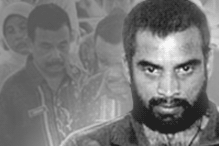 The former army commando was in need of serious psychological counseling after becoming a quadriplegic - paralysed from the neck down - in August 1998.
Francis Siva, who heads the Independent Living and Training Centre (ILTC), knew the Everest hero since the training accident that left him confined to a wheelchair seven years ago.
It was at the Rawang-based ITLC where Moorthy, 36, fell and hit his head on the cement floor last November, resulting in serious head injuries.
The former member of the Malaysian expedition team that conquered Mount Everest in 1997 subsequently slipped into a coma three days later at Hospital Kuala Lumpur (HKL) and died on Dec 20.
His demise saw a tussle between his widow S Kaliammal who insisted that her husband was a practicing Hindu and Islamic religious authorities who maintained that he had died a Muslim.
While it is not clear when Moorthy embraced Islam, the Federal Territory Islamic Religious Affairs Council had claimed that he became Muslim two years ago, and changed his name to Mohammad Abdullah.
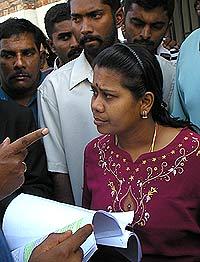 Apparently, few people knew of Moorthy's religious conversion. Not his wife. Not Francis.
Kaliammal ( right ) said she was only informed about the conversion by an army colleague of Moorthy when her husband was already in coma.
Following the legal wrangles and his subsequent burial as a Muslim, a non-Muslim interfaith body has urged for changes to ensure that their rights are protected.
Already a campaign to amend the constitution has been launched.
'He just could not accept'
But amidst all the hot air, Francis said his friend's problems were rooted more in psychology than religion.
"Moorthy didn't know how to handle his slide from national hero to a 'low level' disabled person like us. He couldn't accept. He didn't understand his disabilities.
"He was a very active person who had achieved a lot in life and wanted to achieve much more. Losing the use of his arms and legs meant losing all hope.
"At first, he thought that exercise could return him to a normal life. But after a while, he became very depressed," he added when met yesterday.
Francis and his wife, Gurdip Kaur, who is the ILTC secretary, first met Moorthy about six years ago when he was in HKL's spinal injury ward.
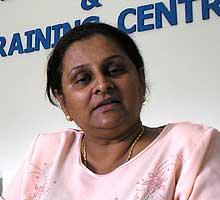 Gurdip, who is a paraplegic, said Moorthy talked about how easily humans can be bandied about and snuffed out by forces beyond their control.
"After the Dec 26 tsunami struck, he told us how scared he was and how easily we could be made to go, especially the disabled," she added.
Moorthy had at times spoke of the financial constraints brought on by the additional expenses of his physical condition and worried for the future welfare of the family, said Francis.
"He told me the constraints were heavy on him and that there would barely be enough for all the expenses, including his medical treatment and his nine-year-old daughter's education," he added.
According to the couple, it was the combination of emotional pressures and his physical condition, that really ate away at him.
One family member recalled how Moorthy uttered hurtful remarks to his loved ones, something that he never did before the accident.
"He's called me things, awful things, that I know he never would have said before the accident. From that, I knew that he was not the same person as before," said an elder brother.
Susceptible to promises of miracles
Commenting on this, Francis said Moorthy himself was aware of the changes and sought answers for his erratic behavior.
"I don't know why I do such things, Francis, I know I do them, but I don't know why,' he would confide in me," he said.
In such a condition, Francis said Moorthy was susceptible to claims of this and that religion being able to cure his ailments.
"Whether it was Hindu, Christian, Buddhist or Muslim healers, he tried everything. When something got a little better, when he could sleep with less pain, he would say, 'You see, Francis, that treatment worked. You see! You see!"
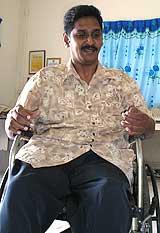 Francis (
left
) alleged that it was the influence of one such 'healer' that had persuaded Moorthy of how Islam could 'cure' him.
Francis (
left
) alleged that it was the influence of one such 'healer' that had persuaded Moorthy of how Islam could 'cure' him.
It also explains why Moorthy was just as enthusiastic in performing Hindu prayers and the devotional rites of other religions, he claimed.
According to Francis, religious organisations of all creed should improve efforts in counseling and rehabilitating the newly-disabled.
"In his condition when he was not capable of making rational decisions, when his physical condition was critical, where were these people who are now fighting for religious rights?" asked Francis.
"Which religious group came to offer him counseling? To cool his body that often became very hot? To give him food? To clean him? There was only his wife. Who taught him to drive as a disabled and gave him a sense of independence?" he said.
And when these same questions were posed to the armed forces' Islamic religious corp (Kagat), it said that the agency's national headquarters will only help to solve "religious matters" of the soldiers if the lower units in the force could not handle them.
However, Kagat director Brigadier-General Jamil Khir Baharom said he would enquire with Moorthy's unit to determine his financial and personal situation before commenting on the matter.
"People can say things, but we have to go back to the unit he was in to find out exactly what was his situation or condition," he added when contacted.


Are you sure you want to delete this comment?
This action cannot be undone.