




Seeing red over snipped tudung
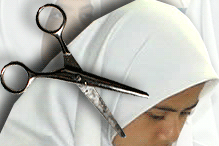
Snipping the tudung (headscarves) of students because it did not conform to school regulations is an affront to their basic right, said the Human Rights Commission of Malaysia (Suhakam) today.
Snipping the tudung (headscarves) of students because it did not conform to school regulations is an affront to their basic right, said the Human Rights Commission of Malaysia (Suhakam) today.
"The overt act of assembling the students and cutting their headscarves are tantamount to humiliating and embarrassing these girls," said commissioner Dr Chiam Heng Keng in a statement.
She was responding to the recent case where three female teachers of SMK Teluk Sentang in Kuala Krau, Pahang had cut the headscarves of 65 students.
Role models
Chiam said it is the primary responsibility of teachers not only to ensure that students are given the best environment to develop their potential but also to protect and uphold the dignity of every child.
 "One fails to understand how these teachers think that humiliation of these 14, 15 and 16 year olds is the best way to discipline them," she added.
In view of this, she said Suhakam urges the Education Ministry to ensure that these teachers are made to respect the rights of every student.
Teachers, she added, should ensure that the fundamental rights enshrined in the Federal Constitution are upheld.
"Teachers are role models to students and they should not use humiliation if they want their students to treat others with courtesy and uphold the dignity of others.
"Children's rights are human rights and hence it is the obligation and responsibility of all to ensure that the dignity of children are protected at all times, in all environments," said the commissioner.
Personal choices
Also expressing regret over the incident was non-governmental organisation Sisters in Islam (SIS).
The organisation said it opposed any attempt by any government, public institution or the private sector to force anyone to cover or uncover their heads.
SIS also mentioned another recent case where an employee of a five-star hotel in Kuala Lumpur was barred from wearing the headscarf.
"SIS maintains that the personal choices of the girls and women must be respected and no punitive measure or harsh treatment should be imposed.
"Even amongst Muslims who choose to wear the headscarf, the style of the headscarf varies and it should not be regarded as a reflection of the degree of their piety," it said in a statement.
According to SIS, several verses in the Quran that talk about women's dress do not explicitly espouse a specific type of dress.
"Thus, to legislate or regulate women's dress based on a single perceived 'Islamic' standard is a misguided attempt at representing the breadth of thought and scholarship in Islam," it said.


Are you sure you want to delete this comment?
This action cannot be undone.