




Daim forced me to sell my company: Fawziah
Former finance minister Daim Zainuddin was today accused of using his former position to corner a toll concessionaire company into selling its entire stake to another company which later received millions in compensation from the government.
Former finance minister Daim Zainuddin was today accused of using his former position to corner a toll concessionaire company into selling its entire stake to another company which later received millions in compensation from the government.
The concessionaire was Syarikat Teratai KG Sdn Bhd (STKG) which later changed its name to Metramac Corporation Sdn Bhd after it was bought over by prominent businessman Halim Saad, known to be closely allied to Daim.
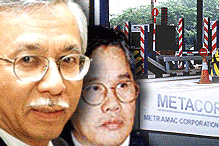 Fawziah Abdul Karim - director of Fawziah Holdings which owned STKG - made this startling declaration in her affidavit dated yesterday in response to the former minister denials that he played an active role in the
controversial business deal
involving Metramac as the Cheras toll concessionaire.
Fawziah Abdul Karim - director of Fawziah Holdings which owned STKG - made this startling declaration in her affidavit dated yesterday in response to the former minister denials that he played an active role in the
controversial business deal
involving Metramac as the Cheras toll concessionaire.
Fawziah said Daim had instructed her to persuade STKG shareholders to sell their stake to United Engineers Malaysia Bhd (UEM) and their failure to do so would result in her "loss of business opportunity in Malaysia."
The affidavit was filed in response to applications made by Daim and Halim to expunge certain remarks made against them by Court of Appeal judge Gopal Sri Ram in his judgment which ordered Metramac to pay Fawziah Holdings RM65 million compensation for loss of advertising rights.
Fawziah said the remarks made the judge were relevant and necessary and were justified based on the evidence placed before the court. In his judgment, Gopal among others remarked that:
- Halim and his ex-business partner Annuar Othman siphoned RM32.5 million from Metramac thereby committing an aggravated form of criminal breach of trust. This was under the patronage of Daim.
- It was puzzling as to why Daim would use his power in favour of Halim, instead of chanelling the funds to benefit taxpayers, and that this was a personal favour from Daim to Halim as a result of their close ties.
Halim and Daim have since denied the all allegations.
Rejected bids
In the 44-page affidavit, Fawziah also said Daim and Halim had shown interest in STKG even before the company was awarded the Cheras toll concession project and that negotiations between the company and United Engineers Malaysia (UEM) Berhad began as early as May 7, 1987.
She however rejected the offer to sell as STKG was already a successful 'class A contractor' with completed projects valued over RM200 million then. She said the two again expressed their interest in STKG at a meeting on April 21, 1988 but she rebuffed them for the second time.
In the meantime, STKG successfully entered into a concession agreement with Kuala Lumpur City Hall (DBKL) and this proceeded smoothly until Sept 12, 1990 when DBKL instructed STKG to suspend its toll collection following public demonstration.
 "On the same day at 2pm, Daim called STKG chairperson Hanafiah Ahmad of Tabung Haji (one of STKG's investors) offering to purchase 100% of STKG's shares. This phone call from Daim to Hanafiah occurred on the same day STKG had complied with DBKL's instruction to suspend toll collection.
"Surely the cabinet could not have possibly decided in so short a span of time to force STKG shareholders to sell their shares to UEM on the very day that toll collection was suspended.?"
Following this, she met then Works Minister Leo Moggie on Sept 27, 1990 who said Daim had informed him that UEM had made an offer to buy STKG at RM1.50 per share but he (Daim) had made no mention that the cabinet had instructed this offer be made.
She said the rationale for the offer given to her was that UEM being a stronger company would be able to absorb the loss from toll collection considering the government had no funds to compensate STKG for its termination.
Daim's directive
"On Nov 16, 1990 I received a phone call from Daim who directed me to meet with him immediately. At that meeting, the discussion centred on the issue of selling all of STKG shares.
"Daim instructed me to persuade two shareholders namely Cekal Sejahtera Sdn Bhd and Itjih Sjamsul Nur Salim to sell all their STKG shares to UEM at the price of RM1.50 per share stating that my failure to do so would result in loss of business opportunity for me in Malaysia."
Determined that UEM should take over STKG, Daim had also exerted pressure on other shareholders including insurance giant American International Assurance (AIA), she added.
"Rahmat Abdullah - one of the board members of STKG representing AIA - reported to the board that he had sent a fax on Nov 21, 1990 informing AIA Hong Kong that Daim had summoned AIA's Kuala Lumpur principle officer Hashim Ismail and instructed him to sell AIA shares in STKG to UEM."
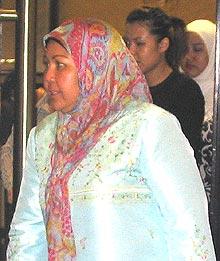 Fawziah (
pix, right
) said eventually all shareholders in STKG surrendered their interest to UEM-nominated company Metro Juara Sdn Bhd.
Fawziah (
pix, right
) said eventually all shareholders in STKG surrendered their interest to UEM-nominated company Metro Juara Sdn Bhd.
"The duration of the entire negotiation process for the purchase of STKG shares at a cost of RM97.5 million was done between November 1990 and January 1991. It was rapidly executed within an estimated time frame of two months.
"Halim and Daim finally and successfully acquired STKG by force having failed to persuade me to sell my STKG shares or to enter into any joint-venture with UEM over a period of three years and eight months since their first attempt on May 7, 1987," said Fawziah adding that she then had no choice but to sell her own shares in STKG.
She said in order to expedite the sales and purchase agreement, Metro Juara waived the due diligence process and agreed to purchase the shares without any representation or warranties.
"It is inconceivable how a company like Metro Juara with a paid-up capital at only RM1 million was able to mount a takeover of a RM65 million paid-up company."
She said Daim's resignation as the finance minister on March 14, 1991 did not totally exonerate him of his role in the Metramac controversy as subsequent to the resignation, the government had appointed him as an "economic adviser".
Metramac's money
Fawziah also refuted Halim's statement that the RM32.5 million he extracted from Metramac did not belong to the company.
She said that Gopal was right when he held that the share premium of RM32.5 million had no nexus whatsoever to the concession agreement and was a highly questionable feature in the compensation payment to Metramac.
 There was also no reason why the government would have to pay anything to parties in a private investment especially when the ex-shareholders were told that the government had no money, said Fawziah.
"The payment of RM32.5 million is consequent of the termination of the first concession agreement and is a payment to Metramac. Metro Juara is not a party to the agreement between Metramac and DBKL and has no right to the sum".
As such, Gopal was right to have concluded that the sum was "siphoned" from Metramac's account, she said.


Are you sure you want to delete this comment?
This action cannot be undone.