




Suhakam 2005 report: Govt did reasonably well
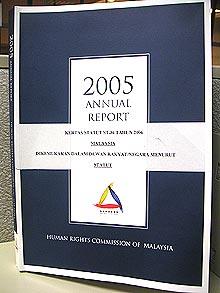
 The government conducted itself 'reasonably well' in the field of human rights but there is still a gap between word and deed, said Human Rights Commission of Malaysia (Suhakam) in its 2005 annual report.
 The government conducted itself 'reasonably well' in the field of human rights but there is still a gap between word and deed, said Human Rights Commission of Malaysia (Suhakam) in its 2005 annual report.
The report - tabled to Parliament on Monday - concluded that the human rights condition in the country was generally 'adequate' compared to developed and other developing countries.
"However, human rights violation continue to occur, there is still a gap between word and deed. Greater commitment is needed if we are to get closer to the ideals enshrined in the Universal Declaration of Human Rights 1948," read the 293-page report.
The report, contrary to practice, did not include the government's response to its previous annual report.
 It, however, contained the government's response to the 2003 report. This led an opposition leader to question the government's commitment to human rights.
Encouraging developments
In its 2005 report, Suhakam noted several encouraging developments which reflected the increase of awareness in individual rights and issues relating to human rights, gauging by the willingness of the public to speak up on relevant issues and question alleged violations.
This development in turn prompted 'heartening responses' from the government and legislature to move towards greater transparency, said the commission.
This included the disclosure of the Air Pollution Index for the first time last year and the Approved Permits (AP) holders list, the establishment of an inquiry commission into the nude ear-squat scandal and the formation of a parliamentary human rights caucus.
The report also touched on the issue of religious freedom, citing the controversies surrounding the death of M Moorthy as well as self-styled spiritual leader Ayah Pin.
"Religion is an extremely personal matter and it governs only that person's belief and behaviour. The Federal Constitution guarantees the rights of every person to profess and practise his or her religion and to propagate it," it said.
"To comment or criticise a religion even by someone professing the same religion or more so by someone of another religion may cause uneasiness and lead to disruption of public order," it added.
Recommendations ignored
The human rights watchdog also criticised the government for ignoring several of its previous recommendations, including to repeal the Internal Security Act (ISA) and replace it with clearer legislation on security matters.
Another recommendation ignored was the call to enact a Freedom of Information Act to allow public access to official information, which the commission said will indirectly assist the government in its fight against corruption.
"Next to political will, freedom of speech and the right to information are essential to the elimination of corrupt practice," it noted
The commission was also disappointed that its recommendations in the 'trafficking of women and children' report have 'yet to be considered by the government'.
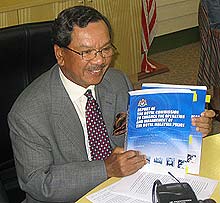 As for the police force, Suhakam expressed concern over the finding by the Royal Police Commission that 80 custodial deaths had occurred between 2000 and 2004 while only eight inquests were carried out.
It also noted that the royal commission's recommendations were 'still pending'.
There is an urgent need for the police to gain public trust and confidence by improving their methods, read the report.
The commission also lauded the government's decision that religious authorities must obtain police approval before conducting any raid.
Suhakam also wanted concerted efforts to be taken on the delayed disposal of court cases as this could be deemed as impinging on the right to justice.
Regarding the crackdown on undocumented migrants last year, it said the operation led to negative results. It received complaints that two migrant workers were wrongly imprisoned as their valid work permits and passports were held by their employers at the time of arrest.
Suhakam also 'shared' the reservations of Muslim women's groups in relation to the Islamic Family Law (Federal Territories) (Amendment) Bill and urged that the 'disadvantages' be redressed.
Not a good example
In a related development, Parliamentary Opposition Leader Lim Kit Siang (DAP-Ipoh Timor) said the conspicuous absence of the government's response to the 2004 annual report reflected adversely on the government's commitment to protect and promote human rights.
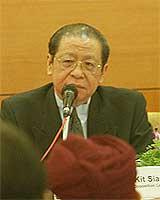 "Who made the decision that there was no need for the government to submit a response. Was it a top government servant or cabinet minister? Was there cabinet sanction to ignore the report altogether?"
"This is not a good example of accountability, transparency, good governance and human rights-sensitivity as pledged by the Abdullah (Ahmad Badawi) premiership," he said in a statement today.
Lim also said he asked Abdullah yesterday to set aside one day in the Dewan Rakyat sitting to allow the Suhakam report to be debated. According to him, the premier promised to consider this.
In the past, opposition parliamentarians had repeatedly made attempts in vain to debate Suhakam's reports.


