




KL, Singapore move to cool bridge row
Malaysia and Singapore moved to cool a row over a scrapped proposal for a new bridge today, saying they hoped their relationship would improve despite an array of disputed issues.
Malaysia and Singapore moved to cool a row over a scrapped proposal for a new bridge today, saying they hoped their relationship would improve despite an array of disputed issues.
Malaysia caused shockwaves by dumping its plans to replace an ageing causeway linking the neighbours, saying it could not accept a trade-off that would have given Singapore access to its airspace and sand for land reclamation projects.
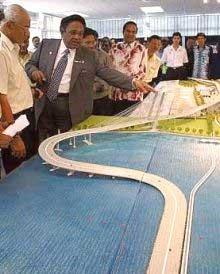 "I hope things will cool down now and that people will see the wisdom of the government decision. I think it is something that we have to revisit," said Malaysian Foreign Minister Syed Hamid Albar.
"Yes, we may succeed in building it, but the best way of doing it is not through unilateral action but negotiations. Unilateral action will create some confrontation from the beginning," he said.
Syed Hamid said all was not lost for the relationship between the neighbours, who have bickered almost non-stop since Singapore separated from Malaysia in 1965 after a brief union.
"Nobody thought that the Berlin Wall would be brought down but now we don't have a Berlin Wall. Now we have the reunification of Korea... and India and Pakistan are very close to each other now," he said.
"Let us wait for the future."
His counterpart across the Johor Strait, George Yeo, said the city-state respected Malaysia's sudden move to scrap the bridge and that he hoped ties between the neighbours would remain on course.
"There are so many areas we are cooperating in, and I have a very good working relationship with Syed Hamid Albar," he said in remarks published in the Today newspaper.
"I hope between the two of us, we can continue to promote good relations between our countries."
Mutual consent needed
Singapore, which was evicted from the Malaysian federation in 1965, has maintained that replacing the causeway would be costly and of little value, but agreed to negotiate on a full bridge if there was a "balance of benefits".
Malaysia had originally insisted it would go ahead with a "half-bridge" without Singapore's approval, and if needs be link its new structure up to the old causeway at the sea border.
Singapore turned up the rhetoric in recent days, insisting that Malaysia could not unilaterally build its own half of the bridge as international law requires mutual consent by affected parties.
Malaysian Premier Abdullah Ahmad Badawi said the public was deeply opposed to Singapore being granted overflight rights for air force training missions, and to reclamation projects which are seen as encroachment on the strait.
He also said they anticipated legal problems if they intended to cut the causeway once the new "half-bridge" was completed.
Singapore and Malaysia have squabbled for years over a variety of issues. But while many other bilateral feuds have been settled amid a recent thaw in relations, the bridge has remained a thorny topic.
Other outstanding issues include the price of water that Malaysia supplies to resource-scarce Singapore, the future of Malaysian-owned railway land inside Singapore and rival claims to a rocky islet.


Are you sure you want to delete this comment?
This action cannot be undone.