




Campaign pushes for local council elections
While politicians are busy campaigning with party slogans in the East Malaysian state of Sarawak for the May 20 polls, a grassroots campaign is taking root on the peninsula.
While politicians are busy campaigning with party slogans in the East Malaysian state of Sarawak for the May 20 polls, a grassroots campaign is taking root on the peninsula.
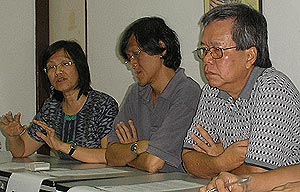 A seven-member organising committee is preparing a citizens' campaign to
reinstate local elections
and has invited Malaysians countrywide to offer their views for a charter on local government.
A seven-member organising committee is preparing a citizens' campaign to
reinstate local elections
and has invited Malaysians countrywide to offer their views for a charter on local government.
The committee comprising representatives from residents associations (RAs), women's movement, human rights and students groups is hell-bent on seeing elected representatives sit on the country's 140-odd local councils.
The first local election was held for the KL council in 1952. It was later suspended following an emergency declaration on Sept 3, 1964, which is still in force today.
Led by the Women's Development Collective (WDC), the grassroots initiative sprouted three weeks ago from the idea of a public consultation to formulate a charter based on people's expectations.
 Speaking at a press conference in Petaling Jaya today, WDC executive director Maria Chin Abdullah said the time has come to seriously re-evaluate local council operations.
"Local elections are not new but there has been little progress on getting it re-instated. We feel the time is ripe to take this a step further, which is why we are organising a public consultation," she said.
"For to long, local councillors are not subject to scrutiny and not made accountable to residents.
"Local councils are not obliged to furnish the housing and local government ministry with their accounts nor do they need to seek approval for their budget allocation. Their records are also not transparent."
Community network
Stressing on the importance of local elections, she said citizens must have a say in decisions that affect their surroundings if prevailing problems are to be avoided in the future.
"We want to link up with other RAs and community groups in other states for a stronger voice.
"At the same time, we'll be considering laws complete with mandatory penalties for violations that will enable local councils to be transparent."
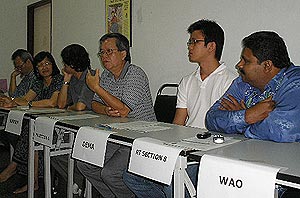 Chin said the status quo of local councils must be challenged because ratepayers are funding successful projects as well as paying for failed ones.
Flyers about the 'Good Governance is Our Business - Bring Back Local Council Elections' event on May 6 at the Section 4 Community Hall in PJ are being distributed by hand and through civil society networks.
Noting the significance of the WDC spearheading the campaign, Section 5 RA president Edward Lee said women played a important role in governance, both in and out of their homes.
"It's good to have them on board such a campaign because they have more control than men and have a calming effect on controversial and heated debates which we are expecting to have with local governments."
Lee said the role of citizens in local council affairs would enhance efficiency because they can form the "eyes and ears of the government".
"We could monitor how projects are carried out and how policies are implemented at our level, whether it is being done properly or being done at all."
He also noted the unknown fate of local councillors once PJ is declared as a city, scheduled for June 20.
"Will they become redundant?"
Questionable conduct
PJ Selatan Residents Society president Mohamed Umar Peer Mohamed said the idea first came up in in PJ in 1997 but was effectively killed by politicians who felt threatened.
"The fact is, state assemblypersons are unaware of the decisions taken by local councils, such as in the case of PJ Municipal Council because they don't live in their constituencies neither do they stay until council meetings end."
He said there were way too many questionable decisions and rubber-stamping of financial accounts for residents to ignore.
"We're loyal to the government of the day, which is why we want local elections in order to help the smooth implementation of government policies."
 Suaram executive director Yap Swee Seng proposed for the city halls in the Federal Territories (FTs) to be elected.
"The mayor should be elected. The lack of representation is more acutely felt in FTs because we are deprived of it at the state assembly level. We only have MPs."
He said the best way to ensure that democracy works at the basic level is to have public participation in the decision-making process.
Kah Hing, representing the Malaysia Youth and Students Democratic Movement, said they saw a need to partake in the campaign because students were a part of the community.
"We believe that change will only come from the grassroots, not from the leaders."
The Taman Mayang Jaya and Taman Megah RA was represented by Liew Wei Beng while the representative for Women's Aid Organisation was not present.
The clamour to have local elections reinstated have grown louder in recent years due to an increasing number of reports on alleged financial mismanagement and maladministration.
The Athi Nahappan Report, the outcome of a royal commission in June 1965 to study the local government operations, strongly supported elected councils.
Among others, the report recommended for the election of all local authorities with district councils having the additional provision to have 30 per cent being nominated from special interests such as trade, culture, trade unions, professions and even sports.
But the government rejected the proposed system on grounds that it would be costly, too democratic and had structural complications which would do nothing to resolve malpractices.
On March 1 last year, the DAP launched 'The Restoration of the 3rd Vote' campaign, where six were nabbed by police for unlawful assembly.
They had also submitted a memorandum to Housing and Local Government Minister Ong Ka Ting.


Are you sure you want to delete this comment?
This action cannot be undone.