


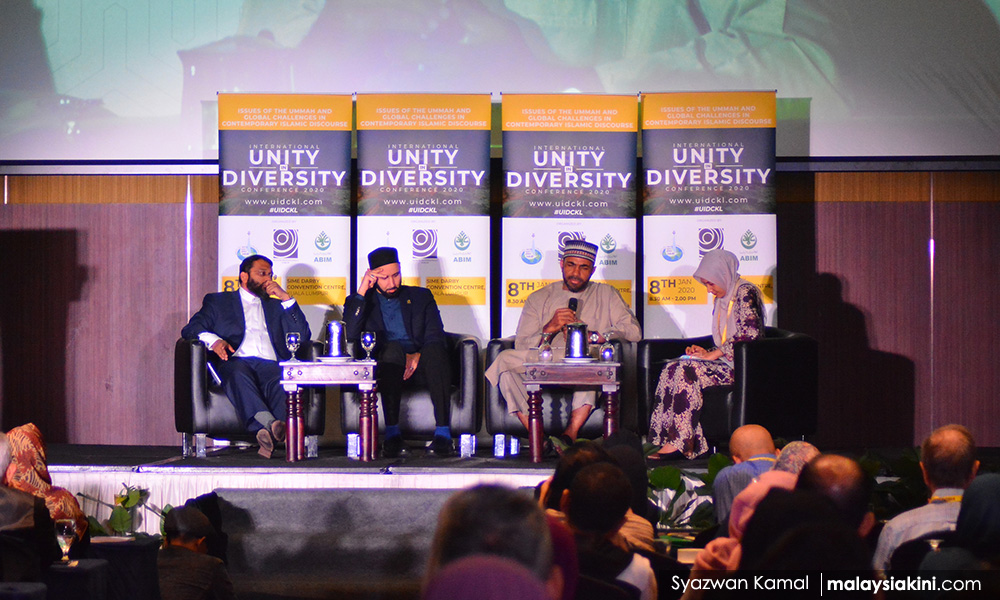

Scholar urges Muslims to question extremist call made in name of Islam
People should move to question calls made in the name of Islam but devoid of elements of justice, mercy and wisdom, for the common good, according to a Muslim scholar.
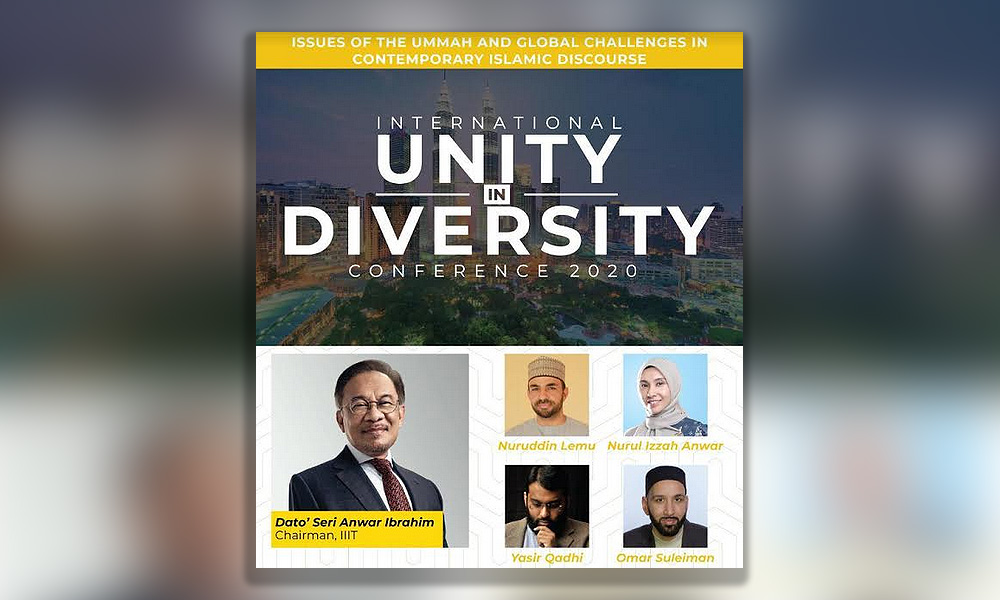
Opening the International Unity in Diversity Conference, Nigeria's Islamic Education Trust director Nuruddin Lemu said understanding the tools to question such calls is an important aspect of countering religious extremism - a global challenge faced today.
"What these tools do is to behave like an operating system that allows you to understand and tackle the issue.
People should move to question calls made in the name of Islam but devoid of elements of justice, mercy and wisdom, for the common good, according to a Muslim scholar.
Opening the International Unity in Diversity Conference, Nigeria's Islamic Education Trust director Nuruddin Lemu said understanding the tools to question such calls is an important aspect of countering religious extremism - a global challenge faced today.
"What these tools do is to behave like an operating system that allows you to understand and tackle the issue.
"I would suggest, if Muslims would like to know more about extremism... you should know at least the first aid (basics of the religion).
"Just invest time to study for you to have critical thinking and understand what is right or wrong," he said in his talk titled "Islam in the 21st Century: Drawing Parallels between Muslim Experiences Worldwide."
"What you often find is extremism trying to look as mainstream as possible," he said, adding that religion is a major mobiliser for extremists claiming to act in the name of Islam or other beliefs.
In principle, he suggested that Muslims take time to identify how individual elements of Islam - such as verses from the Quran and narrations from Prophet Muhammad - were packaged in an enticing way that wrongly promoted violent extremism.
He likened the process to how separate parts of a mouse trap is harmless but as a whole, it formed a device that could hurt a clueless mouse lured by cheese.
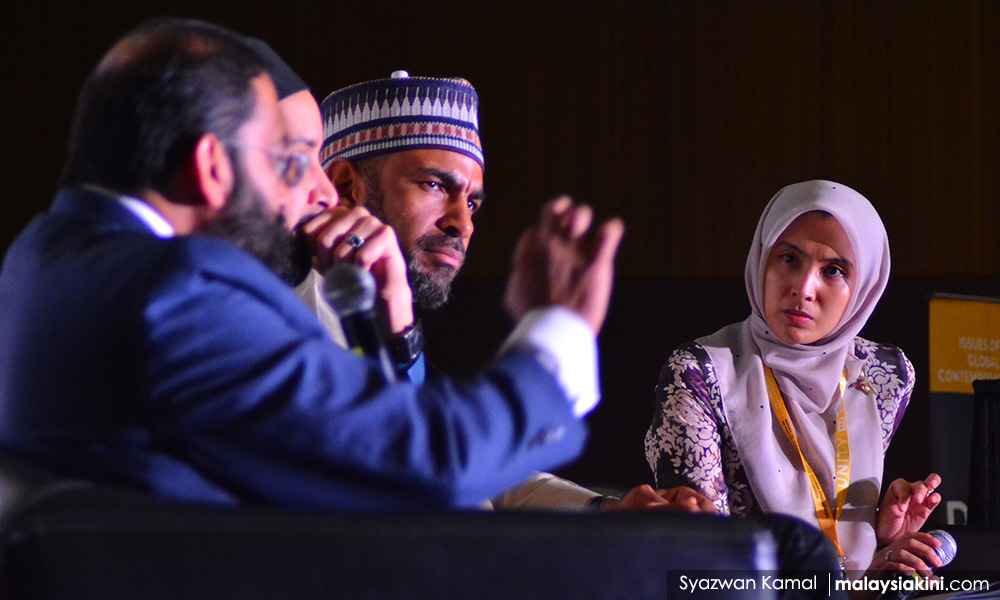
In seeking advice from an Islamic scholar, Lemu (second, right) said it is also important to understand their various fields of specialisations in order to get the right perspective on an issue.
"You don't take your pregnant wife to a dentist just because a dentist is also a doctor," he pointed out.
To resolve new challenges faced by the Muslim community, Lemu said some fatwas have a "shelf life" and Islamic scholars should come up with a new consensus on certain matters.
"When a fatwa creates harm you know there is something wrong with the construction," he stressed.
Meanwhile, American-Muslim scholar Omar Suleiman recalled how Muslims in America were often forced to defend themselves against Islamophobia sparked by acts of terror.
He recalled how the death of boxing legend Muhammad Ali in June 2016 - in the midst of US President Donald Trump's first electoral campaign - had briefly brought together Americans from all backgrounds who viewed him as an idol.
"For the first time, the Quran was recited on Fox News uninterrupted.
"But two days later a terrorist walked into an LGBT nightclub in Orlando, Florida, and killed people... Suddenly we were thrust into the (defensive) game again," he said.
"We didn't even have two days to mourn the greatest Muslim to walk our land," he said in his talk titled "Correcting the Narrative on Islam in the Fast-Changing World of Digital Media."
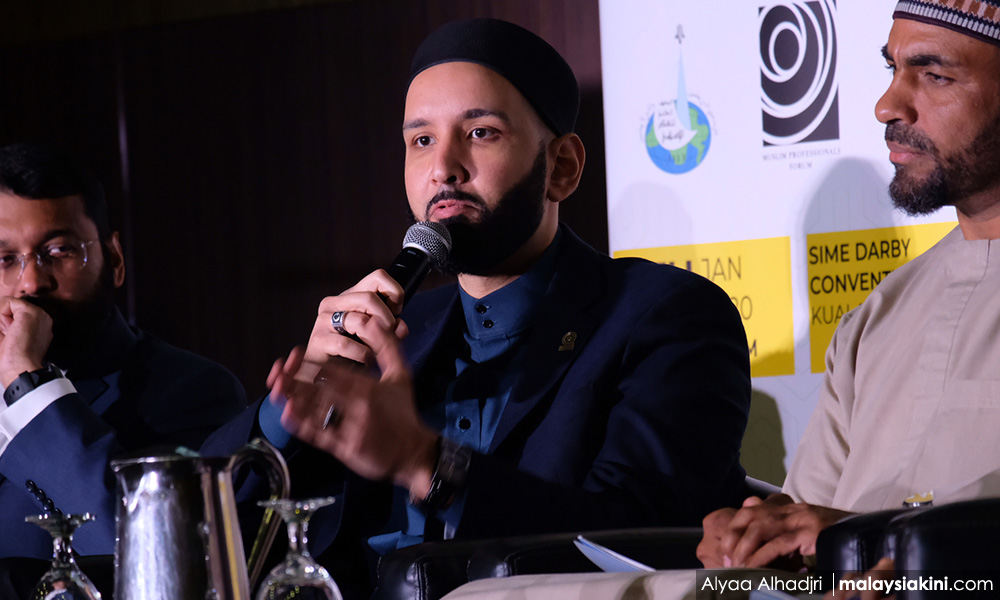
Omar (above) further recounted how he witnessed a similar outpouring of love and support in the aftermath of the Christchurch mosque bombings in March last year.
Omar also said he had led the funeral prayers for Muhammad Haziq Mohd Tarmizi, a Malaysian student in Christchurch, who were among 49 dead in the incident.
As a whole, Omar urged Muslims to portray the beauty of Islam through pushing for more positive representations in media.
The third speaker is Pakistani-American Muslim scholar Yasir Qadhi with the topic "Islamic Discourse — Future Trends and Challenges for the Ummah."
PKR president Anwar Ibrahim delivered the keynote address while his daughter, Nurul Izzah Anwar, moderated a panel session featuring all three speakers.
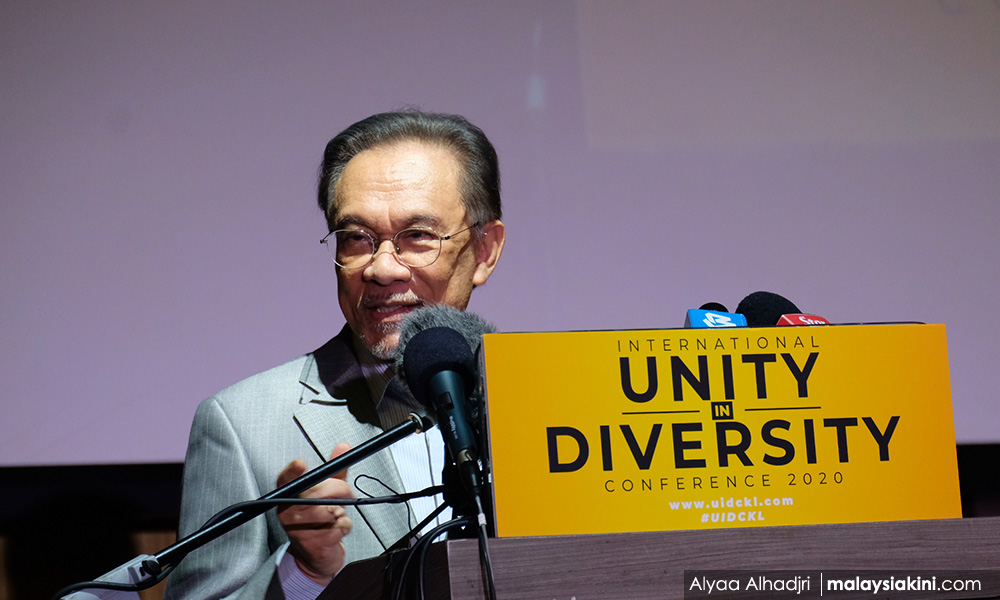
Among others, Anwar (above) said one could not defeat the purveyors of extremism or terror if one was completely ignorant of Islam.
"You become pretentious talking about Islam, rejecting all extremist views, but you know nothing about Islam," he said.
The conference today is jointly organised by the US-based International Institute of Islamic Thought co-founded by Anwar, Muslims Professional Forum and Malaysian Islamic Youth Movement, better known by as Abim.


Are you sure you want to delete this comment?
This action cannot be undone.