




Anwar's case: Apex court declines to rule on constitutionality of NSC
The Federal Court today declined to answer questions posed by Anwar Ibrahim in his challenge over the constitutionality of the National Security Council (NSC) Act 2016.
In a 5-2 ruling delivered by Justice Nallini Pathmanathan, the court said the two questions the plaintiff had sought were abstract, academic and hypothetical...
The Federal Court today declined to answer questions posed by PKR president Anwar Ibrahim in his challenge over the constitutionality of the National Security Council (NSC) Act 2016.
In a 5-2 ruling delivered by Justice Nallini Pathmanathan, the court said the two questions by the plaintiff were abstract, academic and hypothetical.
Anwar had sought the apex court to determine if:
- the NSC Act is unconstitutional, null and void and of no effect on grounds that it became a law pursuant to an unconstitutional amendment, was not enacted in accordance with Article 149 of the Federal Constitution and it violates freedom of movement as guaranteed by Article 9(2) of the Federal Constitution; and
- if specific constitutional amendments in 1983, 1984 and 1994 are unconstitutional, null and void, and of no effect on the ground they violate the basic structure of the Federal Constitution.
“The applicant (Anwar) has not demonstrated that the NSC has interfered with his life,” Nallini said when delivering the judgment at the Palace of Justice this morning.
She added that as there was no controversy, it was not a legitimate case for the court to determine the arising questions of law.
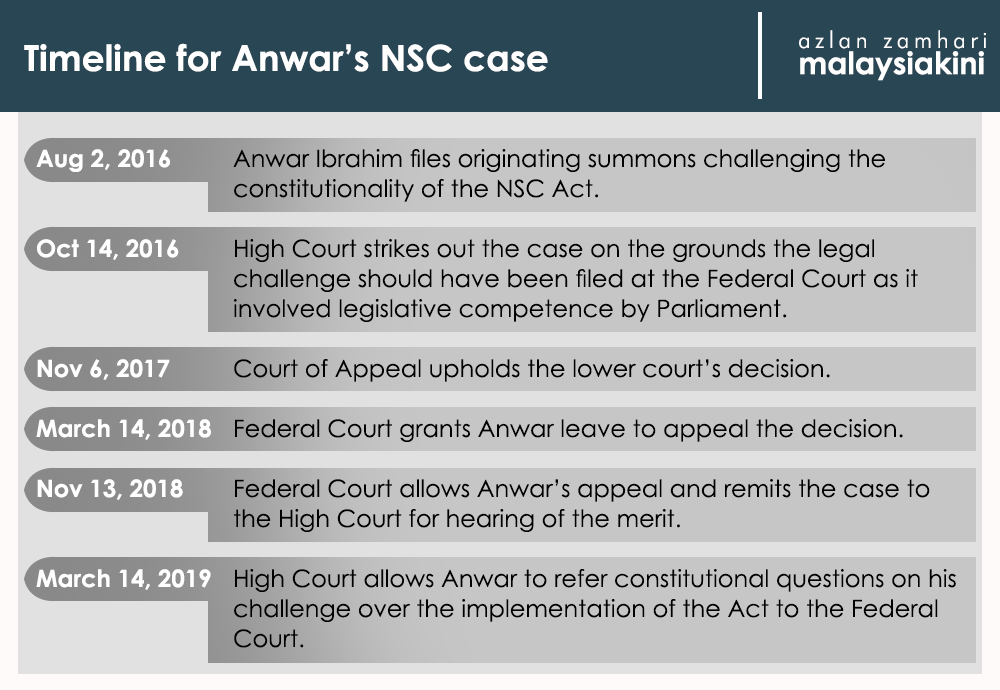
As such, the case is to be remitted back to the High Court “to be struck out”.
The Port Dickson MP is seeking to invalidate the NSC Act in his bid to restore the power of the king on royal assent.
Anwar had filed the originating summons in 2016 challenging the constitutionality of the act which came into force on Aug 1, that year, under Article 66(4A) of the Federal Constitution.
He is also seeking an injunction to prevent the NSC from exercising its powers under the law.
Anwar named the NSC and government as the first and second defendants, respectively.

Aside from Nallini (above), the seven-member panel today also included Chief Judge of Malaya Azahar Mohamed, Federal Court judges Abang Iskandar Abang Hashim, Mohd Zawawi Salleh and Idrus Harun in the majority.
Chief Justice Tengku Maimun Tuan Mat and outgoing Chief Judge of Sabah and Sarawak David Wong Dak Wah dissented.
Both the dissenting judges agreed that the NSC was unconstitutional as it was not enacted in accordance with Article 149 of the constitution which gives power to the Parliament to pass special laws to stop or prevent any action which can or could threaten public order, violence against the people, and dissatisfaction against the Agong or government.
Under the Courts of Judicature Act, the highest court is constitutionally obliged to answer the questions brought by the applicant, Wong said.
He added that the removal of the royal assent in 1983, 1984 and 1994 did not violate the basic structure of the constitution and the council violated freedom of movement under Article 9(2) of the constitution.
In agreeing with Wong, Tengku Maimun said the act is “not an example of judicial supremacy but constitutional supremacy”.
She said Anwar had the locus standi - or right or ability to bring legal action to a court of law - to challenge the NSC Act as it has public interest.
When questioned later, Anwar told reporters that the act should be returned to the Dewan Rakyat to be revised.
“The constitutionality of the NSC Act was questioned by the chief justice of Malaysia and chief judge of Sabah and Sarawak. Hence, it must be referred back to the Parliament to be reviewed,” he said.
His lawyer informed that case mention would take place on Feb 18 at the Kuala Lumpur High Court.





Are you sure you want to delete this comment?
This action cannot be undone.