




Ways to keep the flame alive
Low Chee Chong holds the record at Nanyang Siang Pau for the shortest life span as a columnist. Only two of his opinion pieces were published before his column was axed. This was in May, 2001 when the paper was controversially taken over by Barisan Nasional component party MCA.
Low Chee Chong holds the record at Nanyang Siang Pau for the shortest life span as a columnist. Only two of his opinion pieces were published before his column was axed. This was in May, 2001 when the paper was controversially taken over by Barisan Nasional component party MCA.
This has not deterred him. As an active member of civil society, Low engages with the press freedom movement by supporting events and campaigns.
Currently a supreme council member of Parti Keadilan Rakyat, he identified loose structures, financial difficulties and human resource limitations as the main constraints that civil society groups face in struggling for press freedom. This explains their "inconsistent" performance.
He blamed journalists for not prioritising press freedom, saying there are no signs of solidarity when rivalry and welfare concerns are placed ahead of this cause.
"I'm strongly against laws and actions that prevent the press from accessing their rights...The press should have absolute freedom, but there must also be a proper post-publication review mechanism to enable external scrutiny."
With easy access to information today and greater public awareness and demand, Low is optimistic about the movement for press freedom.
"They (the government) can oppress, they can monopolise, but there is no way for them to hide anything from the people."
Individual action
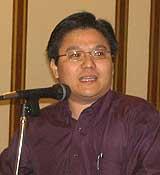 One of those who has taken advantage of the Internet is former
Sin Chew Jit Poh
(now
Sin Chew Daily
) journalist Chang Teck Peng (right).
One of those who has taken advantage of the Internet is former
Sin Chew Jit Poh
(now
Sin Chew Daily
) journalist Chang Teck Peng (right).
Now editor of online Chinese news portal Merdeka Review, he has been actively covering press freedom issues.
"Press freedom is...not only about the media but it is related to the public as well," said Chang who has also authored several books on the Malaysian media.
In 2001, he founded a media course in New Era College, Kajang, and started the World Press Freedom Day National Conference there as well. He has further organised talks for the public to raise awareness of press freedom.
On laws restricting the press, he said: "These should be abolished. The (internal security) minister has so much power and his decisions cannot be challenged in court. Even when a newspaper is closed by the ministry, it cannot sue the minister."
"The opposition parties are not strong enough to watch the government. Every five years, the ruling coalition has maintained its two-thirds majority in Parliament. Power should be balanced," he said.
The media cannot ask for the abolition of the laws on their own, but needs support from society, said Chang, explaining why awareness has to be improved substantially.
"As long as there are people (who speak up), no matter how few, the flame will not die," he added.
Vicious cycle
Journalism tutor Dr Carmen Nge said the main obstacles to press freedom are legal restrictions on the press, including controls over ownership. She believes that people should have the right to start their own press without restriction.
 "The ideal situation is one where the journalists own the press so that there is freedom of expression. In the United States, many small papers provide alternative news in residential and school areas," she said..
She described the situation of press freedom in Malaysia as a vicious cycle.
"If the media is not free, it cannot publish the truth. Without exposure to the truth, the public will remain unaware and will not support campaigns for press freedom. Without public support, the media cannot push through press freedom. Thus, the cycle continues."
As her contribution, Nge is committed to teaching students to gain a critical perspective of the media. It keeps her on her toes.
"If the lecturer messes up, students will mess up as well," she added.


Are you sure you want to delete this comment?
This action cannot be undone.