


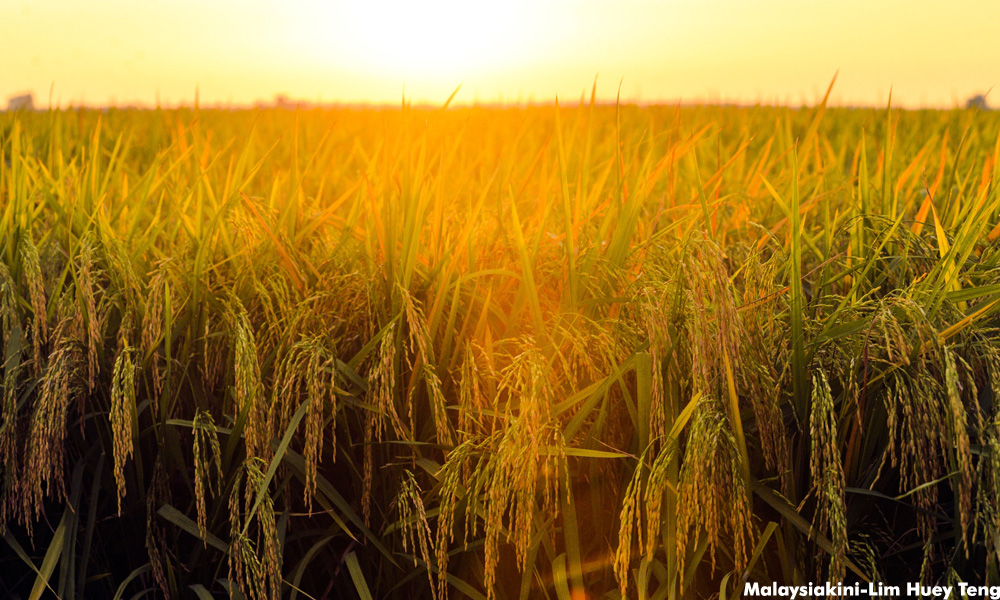

Group urges gov't to retain input subsidies for paddy farmers
A Kedah-based agriculture movement has urged the government to plug leakages in input subsidies that assist paddy farmers rather than replace the scheme with output subsidies based on yield.
Padi Rescue movement coordinator Nurfitri Amir Muhammad in a statement said the shift from input to output based subsidies, as proposed by think-tank Khazanah Research Institute, could lower costs for the government but also have a negative impact on paddy farmers...
A Kedah-based agriculture movement has urged the government to plug leakages in input subsidies that assist paddy farmers rather than replace the scheme with output subsidies based on yield.
Padi Rescue movement coordinator Nurfitri Amir Muhammad in a statement said the shift from input to output based subsidies, as proposed by think-tank Khazanah Research Institute, could lower the costs for the government but also have a negative impact on paddy farmers.
"The biggest issue when input subsidies are abolished would be farmers with fewer resources having no capital to purchase the inputs," said the movement in reference to purchase of seeds, fertilisers and pesticide.
"Agriculture 'loan sharks' will be more rampant to offer loans to farmers.
"Even all this while, there were too many farmers trapped in debt when they could not afford to repay loans as a result of low yields due to weather or disease," he said.
As the farmers failed to settle their debts, Nurfitri noted that many were forced to forgo their land either directly to a new owner or through a third-party.
He said part of the high subsidy costs was also due to an outdated list of recipients, where payments are still being made to deceased landowners or those who have converted their paddy fields for other purposes.
Under the 2020 Budget, the previous Pakatan Harapan government had reportedly approved an increased allocation for paddy inputs from RM796 million in 2019 to RM855 million this year under the Skim Baja Padi Kerajaan Persekutuan (SBPKP) and Skim Insentif Pengeluaran Padi (SIPP).

On measures to lower the government's input subsidies cost, Nurfitri said among steps that could be taken include to abolish the current seed production quota currently held by selected companies, to be replaced with an open system where more licenses are awarded to seed producers.
He argued that more seed producers in a locality will encourage competition, improve production quality and over time address the issue of high seed prices.
"Producers can only claim seed subsidy from the government when the seeds are sold without any quota.
"The quota system is a reason for market exploitation of seeds," said Nurfitri (above).
Rather than the current practice of supplying a standard type of subsidised fertiliser that might not be suitable in all areas, he said the government could look into providing a list of options that could be purchased by farmers with a mechanism to claim their subsidy allocation.
'Research, development and extension must benefit farmers'
The KRI study also said the future of the paddy industry relies not on subsidies, but on impactful research, development and extension (RDE) programmes.
Nurfitri (below), however, reminded the government that technology and innovation through RDE programmes should be designed to directly assist paddy farmers rather than provided by a third-party company.
"Any form of technology and innovation to be introduced must be affordable for farmers and they are able to execute it themselves so they will be not be exploited by suppliers or the technology providers," he said.
As an incentive for paddy farmers, Nurfitri urged the government to consider introducing a three-tiered "grading system" with the highest-ranked yield rewarded with the best price.
"As a result, all farmers who worked their land will be qualified to earn an incentive-based on their own efforts," he added.
KRI in the findings of a study in its latest publication titled "Implications of the Dominant Shift to Industrial Crops in Malaysian Agriculture, Phase 1: System Dynamics Model of the Paddy and Rice Sector" noted that subsidy restructuring and institutional support strengthening are needed to ensure the growth and sustainability of the paddy and rice industry.
It said this was as increasing subsidies and guaranteed minimum prices of paddy since 2005 have done little to significantly increase farmers’ income.


Report this comment
Are you sure you want to delete this comment?
This action cannot be undone.