




Don't backtrack on revising poverty line: MTUC sec-gen
The Malaysian Trades Union Congress (MTUC) has expressed alarm over former United Nations special rapporteur on extreme poverty and human rights Philip Alston’s assertion that the government was performing a “backflip” on the previous administration's commitment to take poverty seriously.
"The MTUC calls on the government not to backtrack on the commitment made by its predecessor to revise the unrealistic national poverty line as it is a key factor to help Putrajaya formulate effective policies to help its growing marginalised population," said MTUC secretary-general J Solomon in a statement today.
The Malaysian Trades Union Congress (MTUC) has expressed alarm over former United Nations special rapporteur on extreme poverty and human rights Philip Alston’s assertion that the government was performing a “backflip” on the previous administration's commitment to take poverty seriously.
"The MTUC calls on the government not to backtrack on the commitment made by its predecessor to revise the unrealistic national poverty line as it is a key factor to help Putrajaya formulate effective policies to help the growing marginalised population," said MTUC secretary-general J Solomon (above) in a statement today.
Solomon said that MTUC's concerns are premised on the fact that most of the B40 (bottom 40 percent income) and M40 (middle 40 percent income) group in the country comprise of blue-collar workers who are represented by MTUC at the International Labour Organisation.
"For decades, they lived in abject poverty, surviving on a meagre salary with little savings for emergencies or old age.
"Many remain unable to afford decent housing, forcing them to live in cramped conditions in poorly maintained rented apartments. The absence of effective policies due to misguided data and now, the economic fallout from Covid-19 have worsened their plight," he added.
Alston last year said that the actual poverty rate in Malaysia is likely to be closer to 15 percent, much higher than the national 0.4 percent rate.
Yesterday, Alston said that Pakatan Harapan under then prime minister Dr Mahathir Mohamad had committed to revising the national poverty rate while the new Perikatan Nasional (PN) administration insisted "it stands by the absolute poverty rate".
International Trade and Industries Minister Azmin Ali, as the then economic affairs minister, defended the 0.4 percent figure and reportedly described Alston's statements as unacceptable and irresponsible.
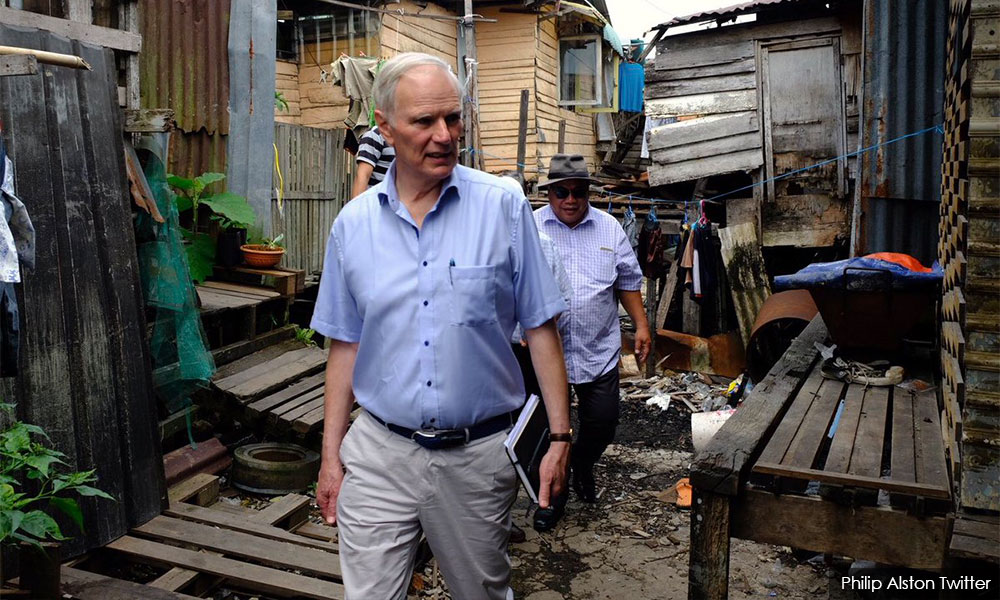
Alston (above) said that PN's response to his final report, which maintained that it stands by the absolute poverty rate, has raised doubts over the implementation of much-needed changes.
"The government's reversal is deeply concerning because the current line is inadequate and almost universally considered to be misleadingly low."
Solomon called on the government to allay any doubts that it would not treat seriously Alston’s findings on poverty in Malaysia after he conducted an in-depth survey here.
"It must be noted that his report, sanctioned by the UN, is based on his extensive visits to several states, including Sabah and Sarawak, as well as meetings with top federal government officials, international agencies, and speaking to people affected by poverty in urban and rural areas.
"The MTUC strongly urges the government to underline its readiness to make the changes needed for the sake of the millions of marginalised people whose plight was ignored, deliberately or otherwise, by successive governments due to bad policies drawn from inaccurate data," Solomon added.
He claimed there is credible evidence to show that the country’s poverty benchmark, used all these years, failed to capture the reality on the ground and as a result, many rakyat-centric policies, especially those meant to provide social protection, failed to help the targeted groups.
"Official statistics claim that the incidence of poverty fell from 37.4 percent of all households in 1979 to 8.5 percent in 1999, further falling to 0.4 percent in 2016.
"Malaysians have long felt a sense of disconnect with official poverty statistics because their income is barely enough to make ends meet and yet, are told that by official count, there is hardly any poverty in the country," he said.

He added that this computation was based on an unrealistic and outdated poverty line measurement of RM980 per month for a household of four that was mainly utilised in the 1970s.
"Any resetting of the poverty line must be based on more realistic criteria which take into account the steep cost of living and stagnant wages of workers."
He said that the government must not be snobbish or arrogant in dealing with Alston’s report but use it as an important base to help redress one of the key problems in the country.



Every week he wants to be in the headlines. He got even more coverage than all Malaysian politicians of Indian ethnicity, from whichever party. Maybe J Solomon can create new party.
Report this comment
Are you sure you want to delete this comment?
This action cannot be undone.