




Migrant workers policy amid Covid-19 a pipe dream nightmare
Abu (pseudonym) is a migrant worker and since the enforcement of the movement control order (MCO) in March, he has found himself struggling to survive in Malaysia due to the government's policy on foreign labour amid the Covid-19 pandemic.
When Malaysiakini spoke to him in June, the well-built Bangladeshi national was wearing a T-shirt much too tight for him.
Abu explained that as he works in a market, he is always in contact with oily substances, therefore his clothes turn into rags quickly and needed to be replaced every month.
“But I don’t have money to buy new clothes, so my friend lent me his, and he is a smaller size than I am,” he said, letting out a nervous laugh.
The migrant worker in his 20s has been working in a community market in Selangor for the past 10 years, but the market was closed down during the MCO.
However, when the state government announced that the market would be reopened in June, migrant workers were not allowed to return to work...
Abu (pseudonym) is a migrant worker and since the enforcement of the movement control order (MCO) in March, he has found himself struggling to survive in Malaysia due to the government's policy on foreign labour amid the Covid-19 pandemic.
When Malaysiakini spoke to him in June, the well-built Bangladeshi national was wearing a T-shirt much too tight for him.
Abu explained that as he works in a market, he is always in contact with oily substances, therefore his clothes turn into rags quickly and needed to be replaced every month.
“But I don’t have money to buy new clothes, so my friend lent me his, and he is a smaller size than I am,” he said, letting out a nervous laugh.
The migrant worker in his 20s has been working in a community market in Selangor for the past 10 years, but the market was closed down during the MCO.
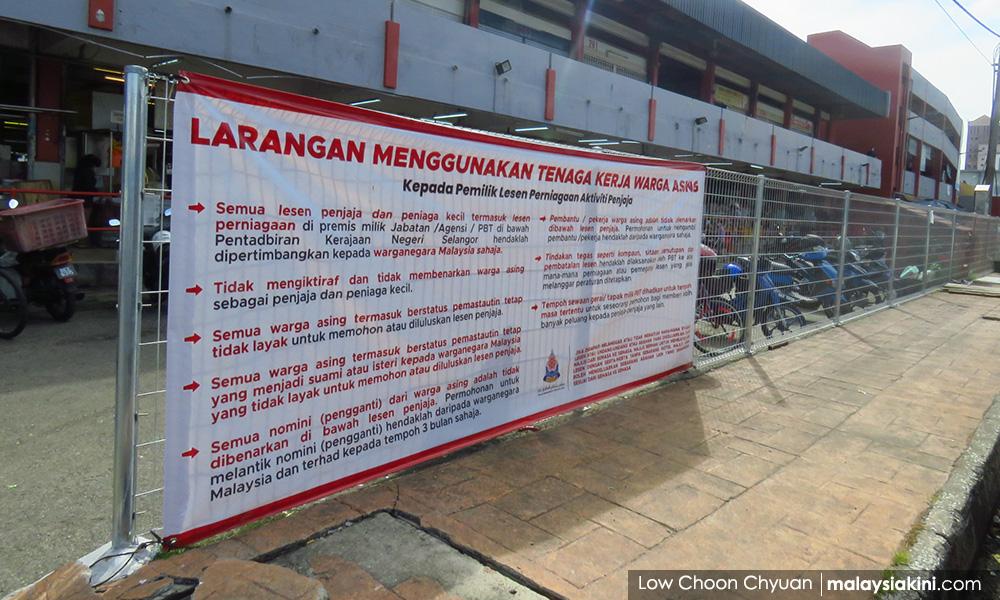
However, when the state government announced that the market would be reopened in June, migrant workers were not allowed to return to work and only locals were permitted for employment there.
Following this, Abu and other migrant workers with legal working permits lost their jobs immediately.

Claiming to prioritise local workers in order to solve the country's unemployment issue and cut dependence on foreign labour, the federal government had tightened up its migrant workers' policy when the MCO was relaxed.
At the end of June, Human Resources Minister M Saravanan announced that the government would freeze the recruitment of migrant workers until the end of the year as locals would be given priority to fill up job vacancies.
"We try to reduce foreign workers in the workforce, besides giving priority to locals to secure jobs," he had said.
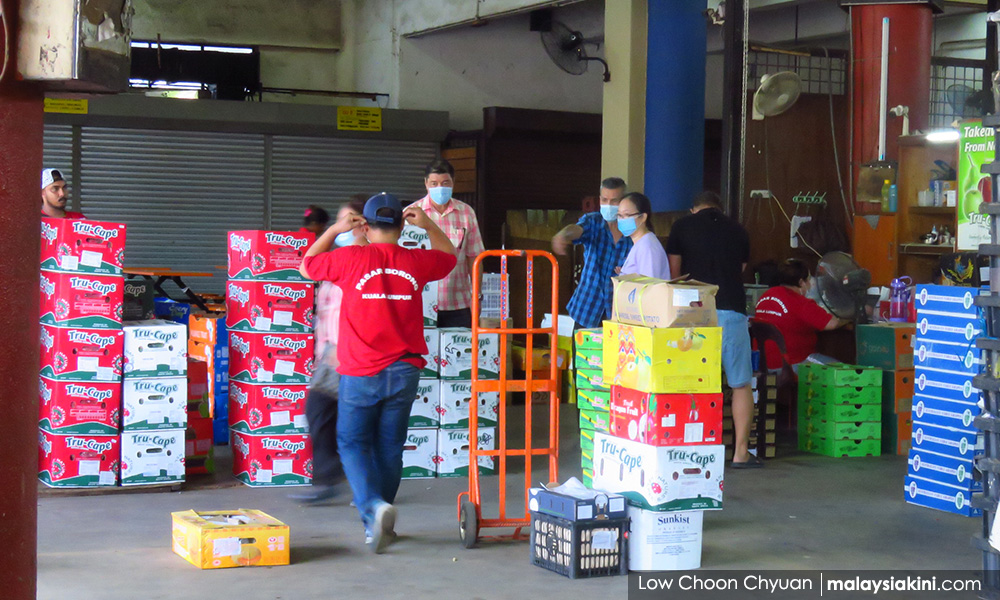
The Kuala Lumpur Wholesale Market was affected by the new policy. However, about 30 documented migrant workers were allowed to return to work there, until their permits expire.
The Covid-19 pandemic was another reason given by the government to bar migrant workers from employment in the market. On July 5, Bernama reported that Petaling Jaya City Council (MBPJ) councillor Ermeemariana Saadon said they decided to enforce existing by-laws and bar foreigners from working at markets after the Covid-19 outbreaks.
She elaborated that migrant workers are considered high risk as they typically live in cramped conditions, with many fitting into one room to save money on rent.
When asked why MBPJ did not enforce these laws previously, Ermeemariana replied: “This is the lesson learned from Covid-19.”
She also blamed the traders for not understanding the conditions under which foreign workers could be employed.
'How do we live?'
Feeling helpless, Abu lamented the plight of migrant workers in Malaysia legally, who were trying to earn a living and survive during these hard times.
“We have legal working permits, and our Covid-19 test is negative. Why can’t we work?
“Our fridge is empty now, there is not enough food. What can we eat? How do we live?”
As he hasn’t paid rent for a few months, the landlord has given Abu an ultimatum - if he can’t pay up by this month, he will be evicted, along with his housemates.
Fortunately, NGOs have distributed food and necessities to avoid these unemployed migrant workers from going hungry.
Although Abu and his compatriot Husen (pseudonym), who is in the same boat, are grateful to NGOs for assisting them, they hope they can be financially independent instead of receiving aid.
Husen, who is in his 40s, said: “We are not looking for food just to fill our stomach... we want to work on our own.
“If only we can earn money, we will be able to buy clothes, pay rent and send remittances back home.”
Local workers unsustainable
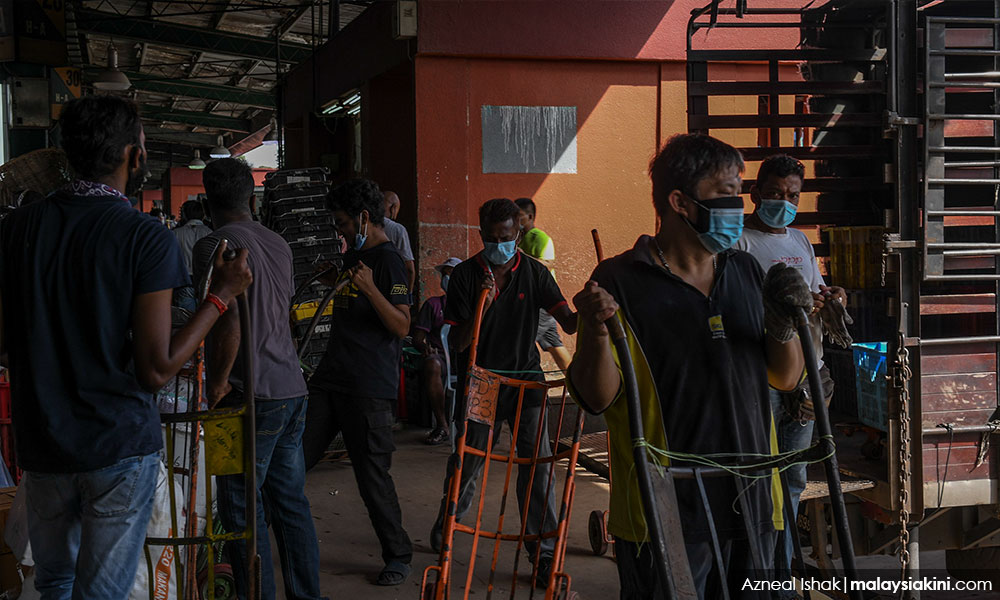
Ever since the government prohibited migrant workers from working in markets, stall owners at the Selayang Wholesale Market began hiring local workers.
However, many of them have complained that the local porter workers are unstable and unable to work long-term.

At the end of June, a vegetable wholesaler, who only wanted to be known as Tan, complained that many local workers are not able to bear the heavy workload, hence most of them only stay in the job for a short time.
“They work for a while and then they leave. I have to keep looking for new workers," he said, adding that the longest period a local person worked for him was only for a month.
Meanwhile, Kuala Lumpur Vegetable Wholesalers' Association president Wong Keng Fatt pointed out that the turnover among local porter workers is very high.
At first, many came in for a job, but as time went by, Wong said, they left and only the young ones would remain.
“Previously, even people who were in their 50s or 60s came to look for a job, but they have slowly been weeded out.
“Locals who come in for a job interview now are younger, mainly in their 20s or 30s,” he added.
In early August, when Malaysiakini interviewed Wong again, he said the above situation was persisting, with some local employees leaving after working for only two to three weeks.

For instance, friends Liow Hong Euan and Ong Leng Seng (not their real names), who are in their 30s, came to work in the KL Wholesale Market in June, but both quit after working for 10 days.
Liow and Ong were tour guides who lost their income when China banned its citizens from booking overseas tours amid the Covid-19 pandemic at the end of January.
Khoo Lie Teck (pseudonym), who is in his 50s, was a salesman. The company he worked for was affected by the MCO, prompting him to seek employment at the wholesale market.
Khoo has been working in the market for two months and is among the few who have stayed in the job for a longer time.
Locals lazy to take up jobs?
From the above cases, it appears that unlike the government’s expectation, removing migrant workers from the labour market does not guarantee that locals will fill the vacancies left behind.
Instead, it has led to the disruption of supply and rising demand for manpower.
There have been claims that the jobs migrant workers are eager to do are the ones locals are unable to stay in for long because the locals are purportedly "lazy".
However, Liow explained that the reason he gave up working as a porter is that the RM80 per day wage was too low and disproportionate to his efforts.
He said that after deducting breakfast, lunch, petrol and parking fees, there was not much money left.
“(The porter job) is really tiring and difficult... work is to earn money, but the wages are incomparable to the work itself.
“Not only difficult, but the wages paid were also not worth it. If it is just about difficulty, we can still handle it,” he added.
For Ong, he said that he was unable to make ends meet working in the market, therefore he would rather put in more effort to look for a different job.
On the other hand, Khoo said that the current economic situation makes it hard to be selective about jobs, hence he was not picky. However, when asked about his future plans, he hoped that when the economy recovers, he can look for better employment.
It appears that when local workers consider employment in the wholesale market, it is not the difficulty of the job that is of concern, but whether the salary can meet their expenses.
However, compared to migrants, even when local workers leave their jobs, they have policies, social and economical resources that can support them in facing the risks of unemployment.
Asked about his plans after quitting the wholesale market job, Liow said: “I am using my savings, I saved some money previously... in our industry, we have to prepare for a crisis. We faced a similar experience during the MH370 incident.”
Social capital to look for better jobs
After Liow and Ong left the wholesale market, they tried to apply for positions such as salesmen, Grab drivers, working at a friend’s shop and even attempted to go into business by opening a durian stall on the street.
Although they had difficulties job hunting, they were still able to try and have no intention of going back to work in the wholesale market.
Liow believes he stands a better chance of earning a living in other industries or setting up a business, compared to staying in the wholesale market job.
“Maybe I do some trading, take some fruits from the wholesale market, then sell it online or to friends. At least I have a chance,” he said.
Meanwhile, Ong said he had to borrow money from his relatives to survive.
Local workers have their social and economical resources, including savings, social networks and job opportunities. Besides that, government policy provides important avenues for them to look for employment.
For instance, Liow and Ong are benefiting from loan payment deferment which gives them breathing space, while the Employees Provident Fund’s (EPF) scheme allows them to withdraw money from their EPF accounts.

The two tour guides also benefit from the government's economic stimulus package by receiving one-off payments of RM600 and RM1,000 from the federal and Selangor governments, respectively.
These resources affect local workers’ judgment on whether a job is “worthy” and help them bear the costs during the job transition period.
Locals have more social capital when choosing a job and are less likely to become a porter in the market. When they do end up having to take such jobs, they will likely leave once a better option is available.
Therefore, the government's policy cannot focus on “how to chase away migrant workers” but to understand the issue from the perspective of labourers and the job market to make appropriate arrangements, so that local workers are more willing to take up the 3D - dirty, difficult and dangerous - jobs.
Changing jobs too 'expensive' for migrant workers
In comparison, migrant workers don’t have much support from policy, social and economic resources. Worse yet, government policy shackles them as they are not allowed to find new jobs.
In the case of the Selangor community market, about 200 migrant workers lost their jobs and are short of money, but they are unable to return to their home countries.
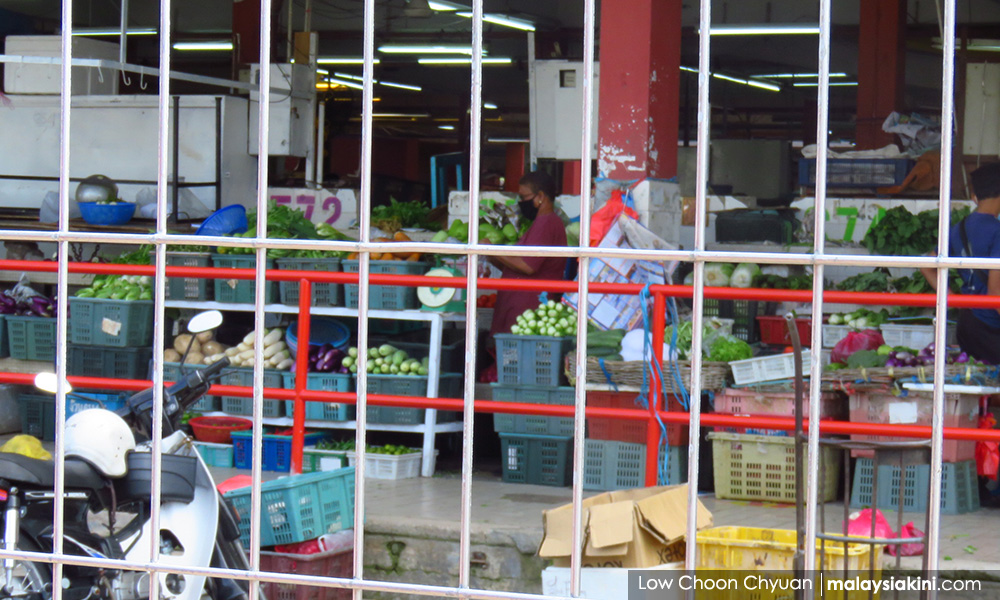
Some of them have resolutely gone out to find different work, while others await a policy U-turn in hopes they can return to their jobs at the market.
Abu left his hometown in Bangladesh a decade ago and came to Malaysia alone. When he faces trouble, he can only rely on himself. Sometimes he will ask for help from fellow Bangladeshi nationals, but most of his friends have lost their jobs too and are unable to lend him money.
Although Abu needs a new job urgently, his work permit specifies that his employer and workplace is the Selangor community market. That is the only place he is allowed to work, and if he finds employment elsewhere, it would be unlawful and a “misuse of work permit”.
“I am afraid of getting caught... if we work somewhere else, we will become illegal workers.”
This shows that migrant workers and local workers are not in the same labour market. Unlike migrant workers, locals are free to job hunt under the law.
Despite this, Abu doesn’t want to leave Malaysia as it means that his five family members will lose their livelihood.
“In Bangladesh, a son needs to raise the whole family, all my family members are waiting for me to earn money. If I give up my job and go back, what about my family?
"There are no job opportunities in Bangladesh, I would rather stay and wait here,” he added.
Cost of waiting for employment
The cost for a migrant worker to wait for work is very high. Abu’s work permit is expiring, if he cannot renew it he will become an “illegal migrant worker”.
“I have a headache and can’t sleep at night. My friends have asked me to pay back their money, my family in Bangladesh has asked me to transfer money... everything is stuck.
“If I am working, I wouldn’t have such problems. Under these circumstances, maybe dying will make things easier. If I am dead, no one will ask me for money anymore,” he lamented.
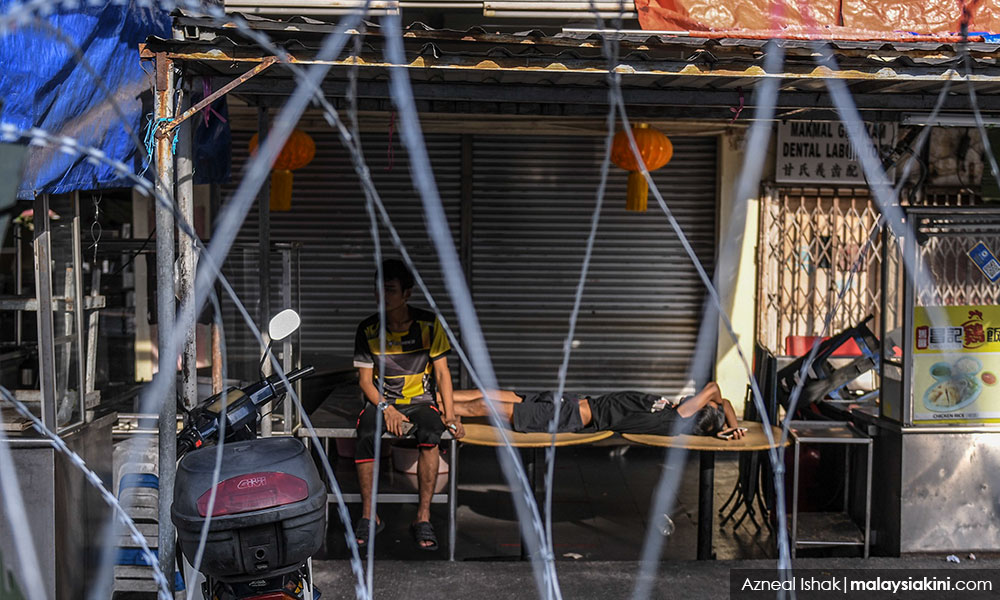
Similarly, Husen said that if he does not work for a day, it is a big loss for him.
“I paid for my permit renewal fees a few months ago, it cost RM4,000, but now I can’t work, that is a loss.”
As the pressure to earn money is higher for migrants with less social and policy support, hence it is not difficult to understand why migrant workers are willing to do jobs with lower wages and bad working conditions.
Competitors outside KL Wholesale Market
The policy to not allow migrant workers to return to work has triggered an unexpected consequence - unemployed migrants have been forced to start small businesses in order to earn a living.
In Selayang, some migrant workers sell vegetables outside the wholesale market, becoming competitors of the local wholesalers inside.
On June 26, Malaysiakini observed many migrants gathered at a roadside outside the market. They were holding packages of vegetables and when cars drove by, they would gather around the vehicles to sell to drivers.
Zulia (not his real name) is one of them. The Bangladeshi national told Malaysiakini that he used to work in the wholesale market, earning RM60 daily.
But since the market barred foreigners from working, he was forced to sell vegetables at the roadside to pay his bills.
“Every day I can earn around RM30 by selling vegetables in this way," he said, adding that since the MCO, he hardly has enough to eat.
When Malaysiakini revisited the area in August, the situation remained the same.
Association head Wong said migrant workers have continued peddling on the streets despite being raided by the enforcement agencies and have come up with a more covert way of doing business.
According to a government census conducted in April, there were some 16,000 foreigners around the wholesale market, with Federal Territories Minister Annuar Musa saying that most of them worked in the wholesale market.
Wong said the issue began in early June and he is worried that the migrants are selling the vegetables at a lower price, which will impact the wholesalers' business.
The mainstream media has said that the migrant vegetable sellers were undercutting and competing with local wholesalers, and some reports said that migrants were not aware of social distancing, sparking concern that Covid-19 would spread among them.
However, these reports seldom mentioned the reasons these migrant workers were willing to risk arrest to conduct their business there.

The hungry will find a way
Vegetable wholesaler Tan pointed out the root problem - after barring the migrant workers from their jobs in the market, the government did not have a plan to manage them and as a result, they are forced to peddle vegetables illegally.
“If you don’t allow them to come into work, you at least have to manage them. You can’t just leave them out there.
“They are human, they will get hungry, and they also have kids to raise. So, of course, they will think of a way to survive. In this case, it's selling vegetables,” he said.
Tan found that the government policy focused on vacating the porter jobs but doesn’t include measures to follow up or support the policy.
“The government did not think about the consequences, other than wanting to hire locals," he said, adding that the people had to deal with other problems that occurred from the policy.
Tan is worried that if a large number of unemployed migrants remained unmanaged, more severe social issues might arise.
“If you don’t want migrant workers here, then you have to handle them well. Either move them somewhere else or send them back home.”
Malaysiakini has reached out to the Home Ministry and Human Resources Ministry for their responses on this matter.
Hawkers 'springing up like mushrooms after the rain'
Doing small business is a common way to make a living, even for Malaysians who are struggling during the pandemic.
After Liow left the wholesale market, he tried to sell fruits in Petaling Jaya. However, he did not have enough money to rent a stall and thus became an unlicensed vendor who has repeatedly been penalised by enforcement officers.
“I sell mangos and durians, but the city council has come to take action. With zero income, how can I rent (proper premises)?” he asked.
Liow said after facing enforcement officers several times, he gave up his small fruit business venture and started looking for office jobs.
On July 22, Bernama reported that as the unemployment rate rose, many people out of jobs turned to the food business to generate income.
In the report, Federal Territory Bumiputera Petty Traders Association president Rosli Sulaiman said that hawkers had been “springing up like mushrooms after the rain” in the city.
Rosli added that the Kuala Lumpur City Hall had given street hawkers the flexibility to apply for a temporary permit so that they can start operating immediately.
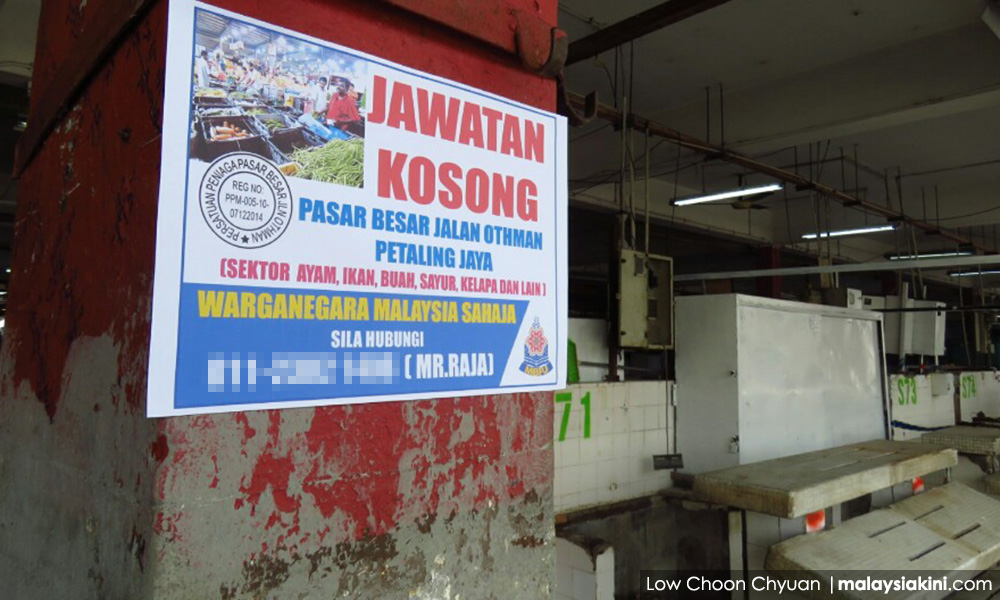
As locals became street vendors, they were seldom accused of being new business competitors or spreaders of Covid-19 as the government and mainstream media are more sympathetic towards them.
Unlike Saravanan’s decision to halt the hiring of new migrant workers for all sectors in June, his deputy Awang Hashim announced that the government plans to limit the participation of foreign workers to just the construction, agricultural, and plantation sectors.
But in other sectors, Awang stressed that the government is looking to arrange local workers to take up job vacancies.
“In other sectors, we want the jobs to be filled by local workers. This will be part of our guidelines to reduce the intake of foreign workers,” he had said.
But from the cases mentioned above - migrant workers Abu and Husen who have lost their jobs, locals Liow and Wong who are looking for a new job, and Khoo who is waiting for a better offer - if the government continues to “chase away migrants and fill up vacancies with locals”, it is quite impossible to reach the intended outcome.
Recently, MTUC secretary-general J Solomon warned that limiting migrant workers without a simultaneous increase in wages for local workers would be a “harakiri” (suicidal) economical move, or “a pipe dream that ignores the reality on the ground”.
The new policy of reducing migrant workers amid the pandemic may be a pipe dream. However, it is certainly a nightmare for the migrant workers with the least resources, who will be the first to be sacrificed with the loss of their jobs and be left in a dilemma.






Are you sure you want to delete this comment?
This action cannot be undone.