




Zaid urges dominant Umno to be more open
A call has been made from within Umno for the party to be more open, particularly in discussing pressing matters such as race issues.
A call has been made from within Umno for the party to be more open, particularly in discussing pressing matters such as race issues.
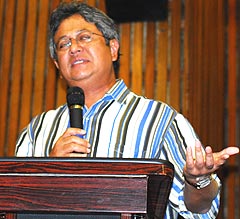
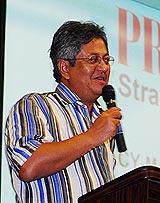
Making the call at a public discourse in Kuala Lumpur last night, Zaid Ibrahim, the party's MP for Kota Baru, said there must be more willingness by Umno to bring pertinent issues out into the open after describing the party as becoming more and more dominant and less a partner within the ruling coalition.
 Stopping short of declaring the
National Economic Policy
(NEP) obsolete, Zaid said there should be more open-ness on the government's part regarding race issues, urging an end to "discrimination".
Stopping short of declaring the
National Economic Policy
(NEP) obsolete, Zaid said there should be more open-ness on the government's part regarding race issues, urging an end to "discrimination".
The two-hour talk last night discussed, among others, inter-ethnic and inter-religious dialogue as well as unfolding national political events.
It was organised by the Public Relations Consultants' Association of Malaysia (PRCAM) and held at the Higher Education Learning Programme (Help) Institute in Damansara Heights. No students were present.
During the talk, Zaid spoke broadly on what he felt was Umno's role in curbing dogmatic policies and a need to re-examine "the implementation" of certain policies provided under the social contract such as Article 153, which provides privileges to the Malay and other indigenous communities.
"When you have one dominant partner, such as in Umno's case, you need to have more willingness to openly discuss issues," said Zaid, a lawyer by profession.
"Umno is becoming less a partner, and this is a danger to the current checks and balances," he said.
Create fear
Zaid, who is chairperson of the Asean Inter-Parliamentary Myanmar Caucus ( AIPMC ), felt that a lack of open-ness to discuss ethnic and religious issues is a problem that affects all component parties within the ruling Barisan Nasional coalition.
"Democracy is an assumption that we are all equal, and in spite of this, we are not ready to say even that openly," he said.
Zaid referred to the Lina Joy case: "Such as in the apostasy case, where does (Article) 153 end and discrimination begin. Again we don't want to discuss this." He said a refusal to openly talk about such issues "would create fear."
He, however, added that accepting groups such as the one that gatecrashed the recent 'Federal Constitution: Protection for All' forum in March as "part of growing up."
 "We cannot achieve an egalitarian society or have that opportunity through racist policies. The heady days of freebies are numbered, as it should be," he said.
Zaid, who is trying revive the Press Council Bill during the current parliamentary sitting, was more vague on his stand on a freer press, although he did say that "any hope of sustaining wealth in this country would involve more open discussions, especially on the media".
The proposed bill was not well received by some quarters.
"It's difficult for them (politicians) to let go (of press control) because the ministers are so used to having so much power. BN parties would have to start learning to adopt to a new world," he said.
Asked if change meant a change in NEP, Zaid said that "there should be a change in aspects of its implementation but there won't be a minister who would make a declaration that it would be dropped."
No inside information
Asked if he felt Parliament should be televised, Zaid replied that several ministers have tried and failed, but he is optimistic that "it might happen, given a year or two."
During the question session, Zaid reiterated his support for Prime Minister Abdullah Ahmad Badawi, despite what he described as misgivings by some members of his own party.
"Our prime minister is our best man. He may be slow, not assertive, but he gave that small window to grow," he said.
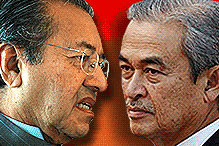 Asked on the falling out between Dr Mahathir Mohamad and Abdullah, Zaid said he knew nothing.
"I don't have inside information," he said.
Pressed further on what he felt the collateral damage was due to the exchanges between two political leaders, Zaid said the country undergoes such feud every 10 years.
"Personally I feel that the most damaging one was in 1987, when Mahathir had to decimate the courts to keep himself in power."
Zaid added that Umno should have a caucus election system such as in Australia and the United Kingdom whereby any challenges to the leadership of a party, and its ensuing election, would be confined to the party's upper echelons, and not involve grassroots support.


Are you sure you want to delete this comment?
This action cannot be undone.