




Bloody nose for all over Kg Medan claims
The higher education authorities have been slammed for using a researcher's "personal opinions" as the basis of contentious assertions on the Kampung Medan conflict, as stated in Universiti Putra Malaysia's 'Ethnic Relations' book.
The higher education authorities have been slammed for using a researcher's "personal opinions" as the basis of contentious assertions on the Kampung Medan conflict, as stated in Universiti Putra Malaysia's 'Ethnic Relations' book.
The facts of the incident in March 2001 are not known as the government has yet to de-classify its investigations, but it saw at least six deaths and injuries to more than 90 persons in areas surrounding the Kg Medan squatter settlement in southern Petaling Jaya.
Of the dead and injured, the overwhelming majority were Indians from the working-class neighbourhood who were attacked while returning home from work.
The book , however, cited the conflict as arising from "the anti-social attitude of groups of Indian youths" with whom the Malay community in the area had lost its patience and therefore "wanted to teach a lesson".
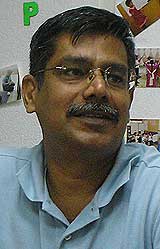 Commenting on this, S Nagarajan who had conducted four years of research into the incident for his PhD thesis, criticised the authors for using the yet unsubstantiated "personal opinion" of a researcher as basis for the assertion.
Higher Education Minister Mustapa Mohamed told Parliament yesterday the blame on Indian youths for causing the Kg Medan incident was according to a seminar paper by Dr Denison Jayasooria, the executive director of the MIC-linked Yayasan Strategik Sosial (YSS).
This triggered an outburst from MIC member SK Devamany (BN-Cameron Highlands), who yelled across the floor: "The Kg Medan incident was not caused by Indians. That's a wrong fact. It is merely a personal view (of Denison), how can it be cited as fact?"
While MIC seems to have sought to distance itself from the book, said Nagarajan, there has yet to emerge research findings in the form of empirical evidence to back what would, until then, remain a personal opinion.
"Since the paper was presented in December 2003, I have sent many emails, a registered letter, and visited the YSS office many times to see the research findings. YSS has yet to respond," he said at a press conference in the Tamil Foundation headquarters in Kuala Lumpur.
"How could they base a serious assertion on what is personal opinion?"
Nagarajan also questioned how Denison could have drawn his conclusions when the outcome of investigations are still a classified secret.
'One of six factors'
In a statement to malaysiakini , meanwhile, Denison said the assertion on the anti-social attitude of Indian youths as contained in his paper was only one of six factors contributing to the Kg Medan conflict.
The other factors, which were included in the book, were the 'activities of outsiders'; the machinations of political parties to weaken the government; unresolved socio-economic issues and the ineffectiveness of government agencies in addressing these; and other issues relating to racial polarisation.
 "Therefore it is of utmost importance that politicians read the full text. If only one of the six points are highlighted, then it is a gross misrepresentation of my views. The analysis on contributing factors must be read in its entire context," said Denison.
"The reference to Indian youths should not be read in isolation of the five other points. Nowhere in my articles on Kg Medan have I ascribed that Indian youths are, or were, the sole cause of Kg Medan tragedy. My position is very clear that there are a multiplicity of factors and these have to be read in relation to one another."
Denison also said the authors had not consulted, discussed, or even informed him about the points that they were to use in the book on race relations.
"If I was informed then, I would have also given many examples of good race relations where Malays and Indians helped each other during the turbulent times," he said.
Earlier, Nagarajan and several other 'concerned citizens' announced that they were preparing to sue the authors unless the book is withdrawn from circulation.
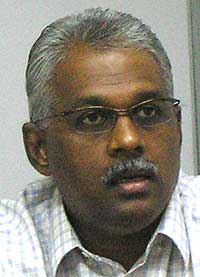 "The book is very offensive to the (memory of the dead) victims of the attacks and ... the more than 90 people who were injured...," said Charles Santiago, a co-ordinator of the group.
The activists, who had worked in the Kg Medan area to de-escalate the conflict and assist victims, said a police report would also be lodged on Friday over the "repulsive contents" of the book.
Santiago also said the book draws an erroneous picture of Malays in the area as there were many who had struggled and risked their lives to protect and help Indians during the incident.
On that point, Santiago noted that the authors had failed to impart to university students the positive lessons of the Kg Medan incident.
"The book does not (celebrate) religious and racial diversity. The book doesn't treat Malaysia as one country but breaks it down into three ... which is very misleading and very dangerous," said Santiago.
Meanwhile, The Star Online reported today that Prime Minister Abdullah Ahmad Badawi has instructed UPM to withdraw the book, which is now being described as a 'guidebook' for lecturers, rather than a textbook for students.


