




Salleh: Reveal truth about judicial crisis
Former Lord President Salleh Abas has voiced support for the Bar Council's proposal to investigate the 1988 judicial crisis which led to his removal from the bench.
Former Lord President Salleh Abas has voiced support for the Bar Council's proposal to investigate the 1988 judicial crisis which led to his removal from the bench.
At a press conference today at the National Heart Institute in Kuala Lumpur, where he has been admitted for an angioplasty, he issued a statement that addressed issues relating to the episode widely seen as having led to curbs on judicial independence.
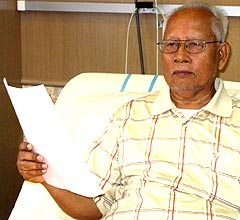 Breaking his silence to respond to the Bar Council
statement
on Aug 17, he also took on
de facto
law minister Nazri Abdul Aziz for dismissing the proposal.
Breaking his silence to respond to the Bar Council
statement
on Aug 17, he also took on
de facto
law minister Nazri Abdul Aziz for dismissing the proposal.
"Reading (Nazri's) statement, I can only conclude it was made impromptu, off the cuff without much study ... I thought it was made in haste," he said in the three-page statement.
"(Nazri) said 'the matter had been investigated and there were no discrepancies'. The question is, when was it investigated and in what aspects of the investigation if it was made, were there no discrepancies? Why did the minister make the statements at all?"
Salleh, 77, stressed that he has no personal interest in the investigation, saying any such decision would be "a political decision ... it would be up to the government".
Truth will come out
What is most important, he said, is to restore a democratic institution and the rule of law.
"My personal interest and that of my colleagues are merely coincidental, as we were once the judges of this country sworn to protect and defend the constitution," he said.
 Asked how he felt when he was sacked, Salleh replied: "I became absolutely disillusioned with the law. So much so that I never even encouraged my children or grandchildren to study law. I took solace in being a simple gardener (in Bukit Payung, Terengganu, where he has a farm).
"The truth is that the dismissal and the suspension of my five colleagues was a great fraud on the judiciary and you cannot cover the truth to something fraudulent. Somehow things will emerge ... It will come out eventually. That is natural."
In 1988, then premier Dr Mahathir Mohamad had Salleh tried by a special tribunal on charges of misconduct, for questioning constitutional amendments that seriously eroded the powers of the judiciary.
Two of five Supreme Court judges - George Seah and Wan Sulaiman - who had ruled that the tribunal was convened unconstitutionally were sacked along with Salleh, after being found guilty of misconduct by a tribunal of six judges, including one each from Singapore and Sri Lanka.
Some have described the dismissal of the top judges from the Supreme Court - then the country's highest court, now renamed as Federal Court - as Malaysia's darkest hours in judicial history.
'Review ministerial powers'
Commenting on the need to revive judicial independence, Salleh called for changes to the Federal Constitution to restore provisions for judicial review of ministerial decisions. These had been removed after the 1988 crisis.
"(The judiciary's) power must not be shackled by numerous legislation (with) provisions such as 'any decision of the minister shall be final and not be questioned in court," he said.
 He also said political parties should not be law unto themselves, in that internal disputes are not the subject of judicial review. This allows parties to become "judges in their own cause, which is a clear violation of the principle of natural justice".
"More than this, the appointment and promotion of judges must be transparent if unhealthy frustration within the judiciary is to be avoided," he said.
"While preparing this statement, I have had an opportunity to read a malaysiakini report which contains support to the Bar Council's call, given by prominent people. I am grateful to them.
"I am sure that there are others who have similar views because of the public perception that my dismissed colleagues and I have had a raw deal."
He added that the council's proposal is for the country's benefit, "which we want to see being governed democratically and in accordance with the rule of law, so that the system will endure for many generations to come".
Q&A: Disillusioned but not bitter
Salleh calls for the following:
- Provisions of the constitution pertaining to the judiciary which were amended following the judicial crisis of 1988 be re-amended so that its powers are not shackled by numerous legislation making provisions such as "any decision of the Minister shall be final and not be questioned in court".


Are you sure you want to delete this comment?
This action cannot be undone.