




BN will not score big in the next polls
In the final part of a three-part interview on the country's economy, analyst Tony Pua shares his views on how Barisan Nasional (BN) will fare in the next general election and the relevancy of the New Economic Policy (NEP).
The 34-year-old Oxford University graduate, who runs an IT company in Cyberjaya, also touches on the implementation of the Goods and Services Tax (GST), the perceived IT gap in the country and explains why he prefers to hire fresh graduates compared to those with experience.
In the final part of a three-part interview on the country's economy, analyst Tony Pua shares his views on how Barisan Nasional (BN) will fare in the next general election and the relevancy of the New Economic Policy (NEP).
The 34-year-old Oxford University graduate, who runs an IT company in Cyberjaya, also touches on the implementation of the Goods and Services Tax (GST), the perceived IT gap in the country and explains why he prefers to hire fresh graduates compared to those with experience.
Malaysiakini: How well will BN (Barisan Nasional) do in the next election?
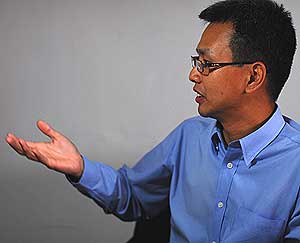 Pua:
They will not do as well as the last one. From an economic perspective, it depends on the RM27 billion construction budget ... for the simple reason that the Malay grassroots support have all been out of work for the past two, three years.
Pua:
They will not do as well as the last one. From an economic perspective, it depends on the RM27 billion construction budget ... for the simple reason that the Malay grassroots support have all been out of work for the past two, three years.
If the (contracts) get distributed properly at the grassroots, then it wouldn't be so bad. But if it doesn't get distributed properly, or if it gets siphoned off by certain major parties and so on, they would be in big trouble.
(But) I don't think they would do any wrong in the sense that there would be a bit of money being filtered down. Yes, there would be money being filtered down...
Would they have money for elections?
I think in the past elections, all the division heads got contracts so that they could finance their own election campaign. If they are going to be a little bit more transparent in their awards process, and we all know that it would never be 100 percent transparent ... but if they are going to be a bit more transparent, say 20 or 30 percent, which seems to be case, then some of their contractors will not get the jobs that they want.
So you will see some strife within Umno and certain divisions, which we are seeing today. I think what we are seeing today is culminating from all these little factors.
'I'm not getting my (share of the) cake, so why should I be obedient?' [laughs]
'Last time I follow what you say because of my bread and butter. Now with Dr M (Mahathir Mohamad) no longer leading the way, I suddenly found my courage.' [laughs]
What do you think of corporate tax cuts?
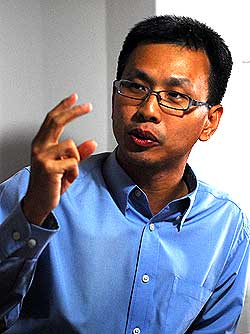 Tax cuts is good. Tax is important in the sense that it is one of the first things that a foreign investor who comes into the country looks at.
Singapore has a corporate tax of 20 percent, while Malaysia is at 28 percent. That's a lot of difference. Eight percent out of a billion dollars is a lot of money. Why should I allow myself to get taxed at 28 percent, especially when other places have better infrastructure.
The only reason why a group would invest in a certain country is because of certain privileges to compensate for the shortcomings. So even with slightly poorer infrastructure, corruption or inefficiency, if I get a tax benefit of one, two percent, from which I make a lot of money, then it makes sense. Only then will I come in.
So tax cut is important, but tax cut needs to be managed. At the moment given that they have expanded the budget, and that they have also cut the tax percentage, they could have cut more if they had not increased expenditure by so much.
I don't think we need to go to the level of Hong Kong or Singapore's level, (although) I think we will see it at some point in time a cut to where we have (corporate tax) of 23 to 25 percent.
Personal income taxes hasn't changed...
The main reason for that is the GST (Goods and Services Tax) hasn't come in. And that would only come in after the election. It will not come in anywhere before the election. They'd be mad to do that [laughs]. From the current perspective, GST is good in the sense that you pay only for what you spend.
So the rich if they buy more, they will pay more tax. The poor don't buy those expensive cars and so on, so they don't pay tax. But of course from a reverse perspective, paying income tax, people are used to it. Suddenly if they were to pay tax for their goods as well, it will be a bit painful. From an efficiency perspective, a GST system is better than an income tax system. Personal income tax has not changed at all...
You said before by virtue of having an income tax system, we should have no problems with a voucher subsidy system. Why?
The removed subsidies (when replaced), be it (by) a voucher-based or grant-based type of system to the person, at first implementation-wise it's a bit more complicated, but the (income) tax system is complicated.
And Singapore has given out cash direct to the individual according to their income. So they have been able to identify all these factors, I'm sure we can do it here.
It's a larger country here, a bigger population, a lot more complicated, but the subsidy system isn't the most straightforward. Remove the regressive taxation relief, make it a grant for people who want to buy computers or need oil subsidy.
What about the issue of NEP (New Economic Policy)?
 Again, personal opinion. I think there needs to be affirmative action. As much as we can say, we want equality for all, there needs to be affirmative action even if it is from a community or racial perspective. Because communities are a fact of life that we have to deal with. So if one particular community is at a particular disadvantage, we need to deal with it.
The question then is that are we having a policy that is benefiting the right segments of society. If the policies of the NEP are only benefiting the rich of the supported community, then the policy has failed.
One simple result, in terms of statistics, is the Gini co-efficient (measurement of income inequality) over the past five years has dropped for every community. But it has dropped the steepest for the Malay community.
Now is the NEP the cause of this? Is the NEP making the rich Malays richer, and the poor Malays poorer. Is the gap increasing with the NEP? If the NEP has failed to address this gap, then it has failed.
But Malaysia has a pretty high Gini co-efficient...
Gini co-efficient is not a good ranking system to measure countries. If I am a poor country, and everyone is poor, then my Gini co-efficient is very low. So my ranking is like within the top 10. You find it in that list, among the top, there are very poor countries. That's because everyone's poor [laughs].
To me that is a misleading concept. Malaysia is ranked 99. Singapore is ranked 76. Some further advanced country is ranked higher. Of course you do not want to be ranked too low, that means there's something wrong in your society.
That ranking needs to be taken from a different perspective. Because in that ranking system, I find that in a lot of the top 30 countries are all very poor countries. So they are all equally poor. Singapore doesn't do very well there as well. It's increasing there (an increasing gap between the higher income group and the lower income group).
But I think with polarised growth, we are bound to face this problem. As long as the poor get better, it doesn't matter if the rich get richer.
So, as long as the poor get better off, then it doesn't matter what happens to the rest of society. The problem for NEP I find is that the people who are able to fully take advantage of NEP are the better off Malays, not the poor Malays.
The question is how do you find your automated mechanism in carrying out or easing off affirmative action?
How about affirmative action in education? The government has enacted the meritocracy system for university entrance, but awards of scholarships is still a grey area...
 Yes, it's okay to have more scholarships, but when do you stop? There must be a line whereby you find the poorer community have caught up and ultimately adjust instead of the current system; of a
quota
of 80 percent for Bumiputeras and 20 percent for non-Bumiputeras. This year, it (scholarship award) is 24 percent for non-bumiputeras. The question is when will this change?
Yes, it's okay to have more scholarships, but when do you stop? There must be a line whereby you find the poorer community have caught up and ultimately adjust instead of the current system; of a
quota
of 80 percent for Bumiputeras and 20 percent for non-Bumiputeras. This year, it (scholarship award) is 24 percent for non-bumiputeras. The question is when will this change?
Instead of a 80-20 rule, there should be a minimum of 30-40 percent rule. Minimum 30-40 percent must be bumiputera. If it is such that 80 percent are non-bumiputera then we will allocate another 20 percent to bumiputera.
If just by merit alone, the bumiputeras form 60 percent, there is no more need to enact affirmative action. So there is an auto-adjustment mechanism, whereby once the objectives of the quota has been achieved, then it automatically regulates itself that social justice is achieved. That element is missing from all aspects of the NEP. It's just a quota, fixed, don't know when it will expire.
I'm sure the Chinese community accept the fact that once people are able to stand on their feet, then there is no more such need for [such assisting quotas].
(The Public Service Department (JPA) has repeatedly denied that government scholarships are awarded based on race).
How about the IT (Information Technology) gap?
Actually it's not so bad. There is a gap. Definitely there is a gap. But in terms of Internet access, computer literacy, Malaysians are not doing so badly among the better developing countries.
Don't even compare to the weaker developing countries, among the better developing countries our statistics aren't that bad. I mean we can do better. Compare a simple thing like the number of blogs. Compared to the number of people writing blogs, our statistics are actually quite high. Our number of blogs in Malaysia, is high, one of the highest.
From that perspective, it shows that the younger generation at least [they have adapted]. The old hats will never pick up. Old dogs are hard to re-train, but the new generation is fairly competent. Even the weaker ones. Especially among the Malays. I don't think we need to be where everyone knows how to programme. It's utilising computers for productive (purposes) that is important. The fact that they can use their phones. The fact that they can use their ICQ or their blogs, it shows the level of literacy and ability to use those items for their work.
Most of these are going to be clerks and secretaries. There's a gap there, it needs to be improved. But it's not so bad.
When hiring, fresh grads or experienced hands?
The way I run the company, I hire a lot of fresh graduates. I usually don't go for experience, unless I really have to for specific reasons. But when I look for fresh graduates, I look for the ones who can grow.
The most important (criteria) is that if your output is not good, no matter how much you retrain, they are not going to be good. They don't need to know all the stuff. To me, computer programming language, whatever language it is, you pick it up if you have wits. Once you have the right training for your brains, you sure change (with new computer languages).
If the output of the quality of their brains is not there, then no matter how much training you do into the basics, you would never get anything out of them. That is the purpose of universities, but a lot of the press statements by the human resource ministers (states that) they try to focus the universities to teach skills.
But skills do not make you smarter. Skills just enables you to do certain things. A lot of university courses, computer science courses for design, they teach you how to use Powerpoint, Adobe Photoshop, and stuff like that. Those are not thinking skills. Yes those are useful skills, but those are skills you can learn on the job.
You don't need a degree to learn how to use Adobe Photoshop or multi media operating and stuff like that. You look at a lot of degrees at local universities, they're designed (for students) to handle multimedia programmes, all about teaching Adobe Photoshop, not about theory, which I disagree. Theory while it's not practical, it trains your brains. If you have the brains, you can do whatever you want in the future.


Are you sure you want to delete this comment?
This action cannot be undone.