




Workers union in huff over news blackout
Alleging that 'certain parties' are behind a news blackout on a trade dispute, the National Union of Telecommunications Employees (Nute) took its complaint to the Human Rights Commission (Suhakam).
Alleging that 'certain parties' are behind a news blackout on a trade dispute, the National Union of Telecommunications Employees (Nute) took its complaint to the Human Rights Commission (Suhakam).
In a memorandum submitted today, it said 22 media organisations had been informed of two pickets held over the past two weeks.
However, Nute said it subsequently learned that the media were told not to cover the events.
The two nationwide pickets were held on Oct 10 and yesterday to protest the transfer of 2,000 Telekom Malaysia staff to Vads Contact Centre Services, and their enforced exit as union members.
"We strongly believe that the company is using the local press not to give any coverage and highlight the issue... the union feels that there is no freedom of the press," it said in the memorandum handed to commissioner N Siva Subramaniam.
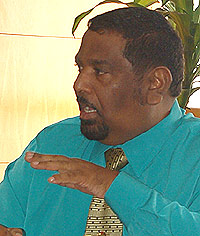 Nute president Mohamed Shafie BP Mammal later told reporters that the press has the right to chose content, but should not be influenced by third parties. He called on Suhakam to resolve the matter.
"We feel that there are unjust elements at work (to prevent us from fulfilling) our wishes (to inform the public of our problems) because the party that is involved in this dispute has stopped (the press) indirectly," he said.
He added that Article 19 of the Universal Declaration of Human Rights provides for freedom of expression and the right to unfettered information through any medium, including the press.
To a question, Shafie said he had contacted a friend in a news organisation yesterday, only to be told that "someone on top" had given instructions not to cover the event.
'Democracy at work'
Siva urged the press to "cooperate" on issues which affect the livelihood of ordinary workers.
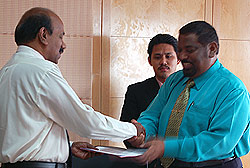 "This won't tarnish the name of the country. Instead, it will show that democracy is practised (here), where workers can picket ... and have the right to make demands," he said.
Shafie, who is also Malaysian Trades Union Congress deputy president, said the umbrella body would seek a meeting with inspector-general of police Musa Hassan to clarify the need for a police permit to organise pickets.
Shafie said the Trade Union Act 1959 allows pickets to be held only outside the workplace, but that the police have rarely issued permits for this.
He claimed there are inconsistencies in police decisions over the permitted duration of the pickets.
"Most of the time, we end up picketing for half an hour, but not before arguing with the police for one hour," added Shafie.


Are you sure you want to delete this comment?
This action cannot be undone.