



Bersih pushes for recall elections at state level
Electoral watchdog Bersih is proposing that a Recall Procedure Law (RPL) be enacted at the state level, following the launch of its latest report on recall elections today.
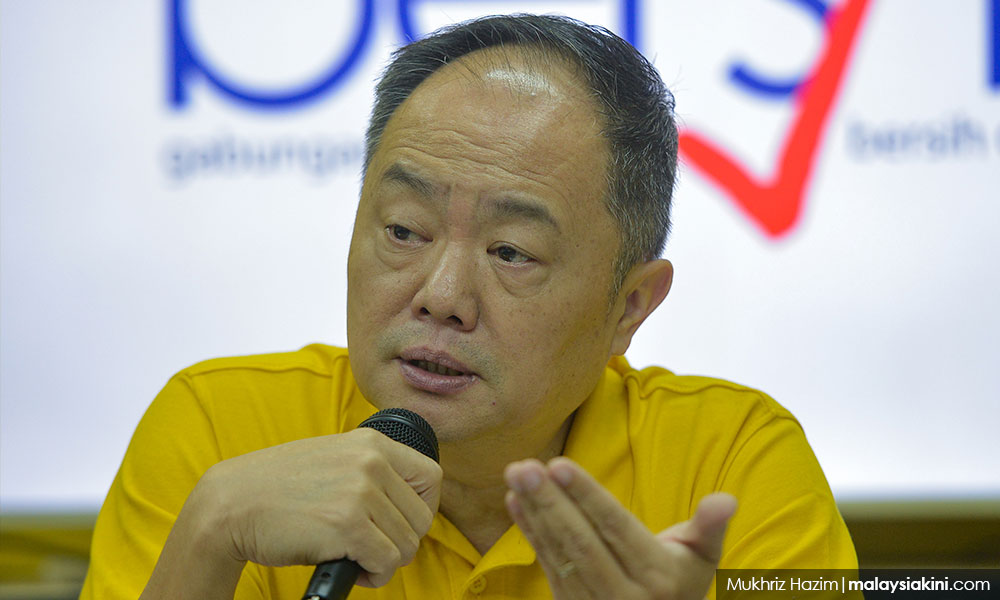
Bersih chairperson Thomas Fann (above) said with the Sheraton Move exposing the weaknesses of the country’s current political system, he hopes the recall procedure law will strengthen Malaysian democracy and stabilise the country’s politics...
Electoral watchdog Bersih is proposing that a Recall Procedure Law (RPL) be enacted at the state level, following the launch of its latest report on recall elections today.
Bersih chairperson Thomas Fann (above) said with the Sheraton Move exposing the weaknesses of the country’s current political system, he hopes the recall procedure law will strengthen Malaysian democracy and stabilise the country’s politics.
“This is part of Bersih’s effort over the last one and half years to look at areas of weaknesses in our political system that allow our elected politicians to hop from their parties which they were elected in, bringing about consequences of the collapse of the government.
“We recognise that party hopping is now a major issue because it is a new normal in our political culture in Malaysia right now.
“It has always been there but the Sheraton Move has really exposed the weakness we have in our system.
“Bersih has over these one and a half years not only looked at anti-party hopping mechanisms but also incentives that encourage politicians to (party) hop,” said Fann in a virtual press conference earlier today.
The press conference was attended by Bersih representatives, Wong Chin Huat, lawyer Edmund Bon Tai Soon, elected representatives from across the political divide, namely Umno representative Shahrir Abdul Samad, Bukit Batu state assemblyperson Jimmy Puah Wee Tse (PKR), and Ketari state assemblyperson Young Syefura Othman (DAP).
Decentralise to stabilise politics
Fann said with the challenges of bringing such legislation to the federal level, Bersih hopes that it will be easier to implement this reform at the state level to allow state voters to exercise their right to recall an elected representative who has defected.

Wong, who presented the findings of the report titled “A Case for State-Level Recall Procedure Law to Remedy Party-Hopping in Malaysia”, said it is important that the reform starts at the state level where it will be more difficult to overturn in the future, as compared to the more volatile federal level of government.
“If we want our politics to stabilise, (our country) needs decentralisation and the introduction of the recall procedure can be seen as an important agenda for decentralisation to show how the state government can play a more positive role in making our politics more rational and professional,” said the political scientist at the same press conference.
Additionally, Wong cited the collapse of six different state governments in five states over the last 60 years from 1961, with the most recent collapse of Perak state government last year due to party hopping.
It is possible that the proposal might be viewed most favourably in state administrations under Pakatan Harapan, especially as Harapan had won several state governments in the last general election that fell through defections, such as Perak, Johor, Malacca and Kedah.
Last month, Bersih launched a test run of the recall election in the constituency of Tebrau where its MP Steven Choong won the seat under the PKR banner in the last general election but later resigned from the party to become an independent MP supporting the Perikatan Nasional (PN) government.
According to Bersih, the recall procedure will be administered by a three-person Recall Board nominated by the chief minister and appointed by the state legislative assembly with it being gender representative and barring the appointment of politicians as members.
With the entire procedure taking no more than 80 days, it will begin with a proposal undersigned by a minimum of one percent of the constituency’s voters.
Following this, a petition will call for signatures requiring a threshold of 40 percent of constituents or half the constituency’s turnout rate at the last elections (whichever is lower).
If this threshold is met, the seat is then declared empty, triggering a by-election.
Disenfranchised electorate
Young Syefura claimed that the culture of party hopping is causing the electorate to feel disenfranchised by the current political system.
“We view what is happening (among the electorate) very seriously because other than betraying the mandate provided by the rakyat, there is something to be said about the integrity and morals of the elected representatives.
“Undeniably, there is a portion of the electorate that has started to feel fed up and bored with the political system, making them less likely to vote after this.
“This is because their vote has been betrayed by those they had elected and they feel that party-hopping has become part of our political culture,” she said.
She stressed that action must be taken to prevent it from continuing in the future.
According to Wong, the recall procedure law will effectively return power to the hands of the electorate, empowering them to hold their elected representatives to power.
A recall election is a process where voters can choose to remove an elected official from office before that individual's term has ended.
Typically, recall elections occur when an elected official has been deemed to have failed in performing their responsibilities, or have betrayed the trust of the public through switching parties and/or coalitions after they are elected, among other things.


Report this comment
Are you sure you want to delete this comment?
This action cannot be undone.