




High time for tobacco turn-offs
The longer the government delays placement of graphic health warnings on cigarette packs, the more room the tobacco industry will have to come up with ways to entice smokers, said tobacco control expert Prof Dr Rahmat Awang.
The longer the government delays placement of graphic health warnings on cigarette packs, the more room the tobacco industry will have to come up with ways to entice smokers, said tobacco control expert Prof Dr Rahmat Awang.
 Rahmat, director of the Clearinghouse for Tobacco Control at the National Poison Centre, told
malaysiakini
that the government is well aware that such labels are effective, but has yet to enforce mandatory graphic labels for tobacco products.
Rahmat, director of the Clearinghouse for Tobacco Control at the National Poison Centre, told
malaysiakini
that the government is well aware that such labels are effective, but has yet to enforce mandatory graphic labels for tobacco products.
"The government shouldn't wait since there is so much evidence to support the use of graphic labels. It should implement this first, then study the impact," said Rahmat on the sidelines of the Malaysian Conference on Tobacco Control in Kuala Lumpur yesterday.
The conference was held to discuss the future of tobacco control in Malaysia in relation to compliance with the World Health Organisation (WHO) Framework Convention on Tobacco Control (FCTC) which Malaysia ratified in September 2005.
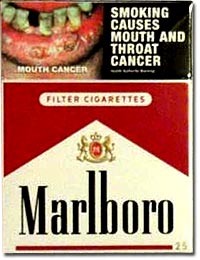 Rahmat explained that the government has for years said it is 'studying' the proposal to force the tobacco industry to place graphic health warnings, as already enforced in Thailand and Singapore.
Graphic warnings that featured in the government's 'Tak Nak' anti-smoking campaign are exactly the type of warnings that should be placed prominently on cigarette packaging, he said.
"Those advertisements should have been placed on tobacco products. That way, the multi-million ringgit 'Tak Nak' campaign could have been conducted for free," he noted.
Attention-grabbing warnings
Ideally, the graphic warnings would cover a major portion of the packaging, and comprise a combination of graphics and text. These should be changed every six months, he said.
 Under the FCTC, the minimum label size for a health warning is 30 percent of the package area. Malaysian cigarettes however, only carry a small text warning on the side of the packaging.
Earlier, Dr Ahmed Ibrahim of the National Poison Centre said studies have shown that warning labels have been somewhat effective in influencing the attitude of Malaysian smokers.
This was the finding of Malaysian researchers who participated in the International Tobacco Control Policy and Evaluation Project, which involved 2,000 local respondents.
In his presentation, Ahmed said a clear concise message is crucial for successful health warnings, adding that major health consequences such as increased risk of impotence must be highlighted.


Are you sure you want to delete this comment?
This action cannot be undone.