


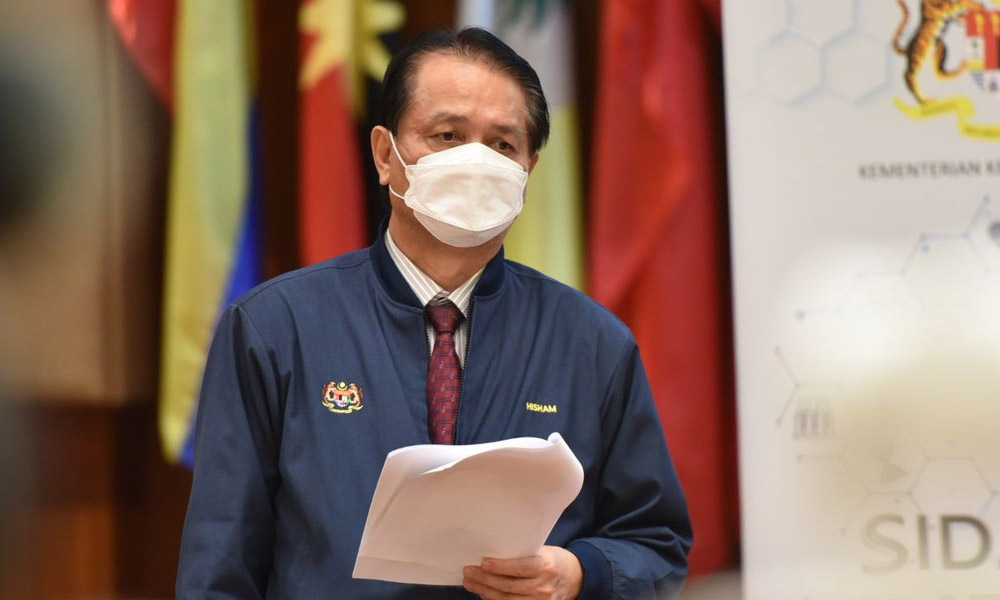

Covid-19: Over 3,000 healthcare workers tested positive last week
More than 7,700 healthcare workers have been tested positive with Covid-19 so far this year, with almost half of the number recorded within last week.
Health director-general Dr Noor Hisham Abdullah said the Health Ministry found the number had increased from only 284 cases in the first epidemic week of 2022 to 3,343 in week six, which is between Feb 6 and Feb 12.
In total, there are...
More than 7,700 healthcare workers have been tested positive with Covid-19 so far this year, with almost half of the number recorded within last week.
Health director-general Dr Noor Hisham Abdullah said the Health Ministry found the number had increased from only 284 cases in the first epidemic week of 2022 to 3,343 in week six, which is between Feb 6 and Feb 12.
In total, there are 7,702 healthcare workers that were found positive as of Feb 15.
"As of Feb 15, 5,063 are absent from work due to positive Covid-19, which constituted about 1.96 percent of the total workforce in the ministry," he said in a text message last night.
Malaysiakini had contacted Noor Hisham after learning that he had issued a new circular on Tuesday, which focuses on the management of healthcare workers who have been identified as close contacts.
He said that they have taken measures to ensure minimal disruption to the Health Ministry service and care of patients when asked about concerns over a high number of healthcare workers being absent from work.
"Necessary steps and adaptive policy were introduced based on currently available data and practices in other countries.
"The ministry is also working with private healthcare facilities to assist in the management of Covid-19 patients," Noor Hisham added.
The circular
The latest circular by Noor Hisham detailed standard operating procedures (SOP) on how to manage the healthcare workers who are exposed to confirmed Covid-19 cases, including their dates of return to work.
According to the document sighted by Malaysiakini, a healthcare worker identified as close contact is to be classified as either low risk (where the worker and source person both were wearing a mask) or high risk.
High-risk close contact is for when a healthcare worker had contact with a confirmed case without wearing proper personal protective equipment according to guidelines or living in the same accommodation with a shared bathroom or kitchen with a positive case.
For those identified as low-risk contact and asymptomatic, the healthcare workers are not required to take the RTK Antigen test and are not restricted from work. They are only required to self-monitor for symptoms for 14 days and get tested if they develop symptoms later.
Those who had low-risk contact but are symptomatic are required to take the RTK Antigen test immediately and are allowed to return to work if the test returns negative.

RTK Antigen test is required immediately for those who are identified as high risk. The asymptomatic ones are allowed to return to work if their result returns negative but they must do the test daily until Day 5 after exposure with a positive person (Day 7 if partially vaccinated or unvaccinated).
While for those who have high-risk close contact and have symptoms of the coronavirus, they can return to work if they test negative on Day 3 and their symptoms have substantially resolved.
They also have to take an RTK Antigen test daily until Day 5 or Day 7 (if unvaccinated/partially vaccinated), and self-monitor for symptoms.
On top of the SOP, the circular also listed a set of practices and restrictions for the close contacts when they return to work.
These include having to wear the appropriate PPE at all clinical areas and strictly adhere to hygiene guidelines, restricted from taking care of immunocompromised patients for the period of monitoring, and not allowed to share the same confined close area while unmasked (like pantry and prayer room when there are other colleagues).
They are also required to undergo a professional RTK Antigen test or supervised saliva test before starting work daily, to wear a well-fitted three-ply surgical mask and face shield when in close contact with other colleagues in case physical distancing is not permissible, and restricted movement while at work and off work.



Are you sure you want to delete this comment?
This action cannot be undone.