




BN 'burnt' by stock market politics
Prime Minister Abdullah Ahmad Badawi cannot be blamed for the sudden and drastic fall of the stock market in recent days because the external or global causes were obviously strong.
Prime Minister Abdullah Ahmad Badawi cannot be blamed for the sudden and drastic fall of the stock market in recent days because the external or global causes were obviously strong.
However, many small and medium speculators who 'got burnt' feel they have reasons to blame Abdullah for painting a glossy picture that had induced them to go into the market without the necessary caution and reservation.
According to Opposition Leader Lim Kit Siang, small investors who acted on Abdullah's Chinese New Year advice to enter the stock market would have borne the brunt of the massive RM70 billion losses in the stock exchange.
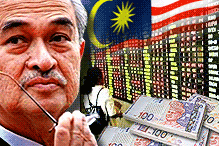 Of course, Abdullah and his advisers could now argue that there was no need to follow the premier's advice as he is not a qualified - or certified - financial consultant and whatever he said was merely a 'personal opinion'.
However, such an argument would be simply unacceptable under the prevailing mood.
For many Malaysian small and medium speculators in the stock market who have long been conditioned psychologically or even culturally to get 'tips' from the politically powerful or well-connected, the recent fall of the market has certainly shattered their faith in the seemingly most powerful and knowledgeable person.
And these thousands of small and medium speculators, given their relatively well-off socio-economic status, are influential makers of public opinion in the civil society and market places and whose mood could be highly contagious as far as the political atmosphere is concerned.
Opposition wind
As it has also already been pointed earlier by some observers, the less-well-off segment of society has been feeling economic and financial pressures as a result of price increases in toll, petrol and other daily necessities as well as business cash-flow and unemployment or underemployment.
Now they are joined by even the relatively better-offs who 'got burnt' in the stock market.
In other words, the rank of the disappointed, disenchanted and frustrated has grown quantitatively, especially in urban and semi-urban areas.
The popular mood, if not effectively neutralised and 'turned over' in the near future, would very probably reinforce the already existing 'opposition wind'.
But then the question of how to effectively neutralise and overcome the negative mood arises because the credibility of both the prime minister - who is also in charge of finance - and the mainstream media, which echoed him in painting the bullish picture not too long before the bear came into the market have also been shattered.
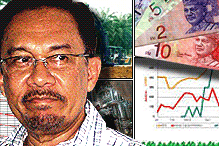 Moreover, unlike before, the opposition has now qualified and socially respectable spokespersons on economy and finance, such as Parti Keadilan Rakyat's Khalid Ibrahim and DAP's Tony Pua, who can put up reasonably intelligent arguments in contradistinction to those advanced by the economic think-tanks of the government and ruling parties.
Of course, no one has forgotten that the most prominent opposition figure, namely Anwar Ibrahim, was himself a former finance minister.
Still a formidable challenge
So, Barisan Nasional (BN) is now not only vulnerable to oppositional attacks on issues like human and civil rights, judicial independence and integrity, police professionalism and media freedom, but also economic and financial management of the country.
Politically, it means the opposition, if it is coordinated and persistent enough, could widen its appeal to include the middle classes in urban and semi-urban areas.
However, even given the prevailing mood which seems to favour the opposition in the coming general elections, it still faces a formidable challenge because the prices of commodities such as rubber and oil palms are currently good and the rural voters are not confronted with the economic pressures faced by their urban or semi-urban compatriots.
After all, as rural voters' mood has never been affected by the ups or downs of the stock markets, they seem to be still contended with the political status quo for the moment.


Are you sure you want to delete this comment?
This action cannot be undone.