




Anonymous allegations - is there more to this?
Immediately following the ill-advice given to small and medium stock market speculators, the credibility and reputation of the Abdullah administration suffered another two severe blows.
Immediately following the ill-advice given to small and medium stock market speculators, the credibility and reputation of the Abdullah administration suffered another two severe blows.
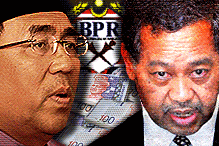 These were the corruption scandals involving Anti-Corruption Agency (ACA) director-general Zulkipli Mat Noor and Deputy Internal Security Minister Mohd Johari Baharum.
The first case is certainly shocking because if the allegation is proven true, it will show that corruption has rotten the system to the core.
Although the matter has not been brought to a court of law, the open allegations and defences have brought it to the court of public opinion with the people on the street as judges.
And their judgments differ: while some vocally argue that Zulkifli is innocent until proven guilty in a competent court of law, others tacitly believe otherwise.
Even among those who strongly opine that a person is always innocent until proven guilty, it is only a matter of upholding a principle of procedural justice.
Serious crisis
So, it seems that there is a serious crisis of public confidence in the vital systems of public integrity, security and justice
Given the recent cases of police special operations personnel arrested and charged for the murder of Mongolian citizen Altantuya Shaaribuu, the public cynicism, right or wrong, is only understandable.
The critical question up to this point is where to go from here: should Prime Minister Abdullah Ahmad Badawi's administration leave the matter publicly controversial for an indefinite period of time hoping it would be forgotten or do something decisive and effective to preserve and restore public confidence?
The second controversy implicating Johari is serious for at least three reasons:
1) Abdullah is himself the immediate superior of Johari since the premier is also the internal security minister.
2) One of the triad kingpins allegedly freed by Johari is said to be the younger brother of another deputy minister with the MCA which is the second largest component party of the ruling coalition.
3) Like the Zulkipli saga, the 'freedom-for-sale' allegation has further strengthened the widespread perception that 'the system is rotten to the core'.
Proxy war?
However, there is an additional feature in the second case and that is the question of why an allegation made in an anonymous website is taken so seriously not only by the media but also ruling politicians, including Abdullah himself.
Haven't ruling politicians not dismissed previous allegations and accusations made against them anonymously in cyberspace as "rubbish" without credibility?
Why is the allegation against Johari an exception?
 Above all, why are the official reactions to the allegation so uncharacteristically serious, passionate and fast-moving even though the accuser is still anonymous?
Is it because the allegation is officially believed to have a prima facie case?
Or is there a belief or suspicion that behind the allegation and accuser, there is a political agenda targeting not so much Johari's alleged corruption but the integrity of Abdullah's political leadership?
In other words, is there shadow boxing or a proxy war between Abdullah and his supporters on one hand and their intra-party nemesis or nemeses on the other, over another more serious matter?
Again, would the 'freedom-for-sale' case be left publicly controversial for an indefinite period or be solved decisively and effectively to satisfy the minimum requirements or definitions of a still functional state.


Are you sure you want to delete this comment?
This action cannot be undone.