


/file/publisher-c1a3f893382d2b2f8a9aa22a654d9c97/2023/01/c7b7e6363d3027445f658c7e41804cce.jpg)

Fahmi dreams of ‘golden digital decade’ for Malaysia
This so-called chasm is not felt solely by Malaysians but elsewhere in the world - as Communications and Digital Minister Fahmi Fadzil cited - in the US, Europe and other parts of Asia - where it appears that “ultra-right” conservative movements are on the rise.
Shortly after the polls, warnings about a repeat of the deadly May 13, 1969 race riots spread like wildfire across the internet, galvanising fear...
INTERVIEW | From the results of the last general election, it would be easy to point to issues of religion, preferential policies and political manipulation that appear to be the root of the cultural chasm that lies between various sections of the population.
This so-called chasm is not felt solely by Malaysians but elsewhere in the world - as Communications and Digital Minister Fahmi Fadzil cited - in the US, Europe and other parts of Asia - where it appears that “ultra-right” conservative movements are on the rise.
Shortly after the polls, warnings about a repeat of the deadly May 13, 1969 race riots spread like wildfire across the internet, galvanising fear.
Talking about how the government can put out a multi-religious, multi-racial narrative in the face of some quarters peddling racial hatred, the minister spoke of the potency of a country’s soft power.
“I like to look back at different times of history, and (what) appeals most to many people would be the 1980s and 1990s. We used to think of the 1990s as being the golden era of the Malaysian economy (and) of arts and culture,” said Fahmi (above), in an interview with Malaysiakini.
He recalled the cultural icons of the 1990s which included local musical legends like Alleycats, Sheila Majid and Ella.
“That was a time when we were known as the Asian Tiger, because of the prosperity, economic progress and development that we were experiencing, so people were happy.”
We were culturally bound, he said, there was no question about this.
According to Fahmi, he is working to reposition some initiatives - in order to remind the ministry that it has a mission of bringing prosperity to the nation through the digital economy.
“We've got to get these things right - infrastructure, secure data, bringing in investments. If we're able to do that, my dream is to have a new golden age of a digital economy, a new golden digital decade for the country.
“We have a lot of potential and many agencies under the ministry are working very hard to bring in investments that are meaningful to the people here. I'd like to bring my experience of handling Lembah Pantai to the Malaysian stage through this ministry,” he said.
Looking back at the boom time of Malaysia in the 1990s, Fahmi said the government perhaps should work on ensuring that the rakyat are happy.
He pointed out: “...Not happy in a distracted kind of way, but happy in a genuine way.”
Online hate speech
With the decentralised nature of the internet, it is easy for pockets of the globally-used service to be occupied by those maliciously targeting a group or an individual based on characteristics - such as gender, race or religion.
When asked if his ministry has plans to curb those peddling anti-government narratives, in particular, the Lembah Pantai MP said that he draws the line at slander and defamation.
“I think it's okay to criticise the government, the prime minister, (and) me, but we draw the line at slander, defamatory remarks (and) remarks that are made without any basis of facts.
“We have to be fair. This administration has no intent to curb freedom of expression and free speech.
“But when people go overboard and make claims that have no basis, then it should not be allowed to be spread because that's spreading disinformation,” said the Harapan leader.
However, Fahmi highlighted the difficulty in dealing with hate speech was what he called “coordinated, inauthentic behaviour”.
“This is what people would ordinarily call trolls and bots,” he explained.
“This kind of activity is slightly different, because it is malicious and coordinated, meaning it is funded by certain people, parties or individuals who may have an agenda.”

Fahmi cited a study by independent security analyst Munira Mustaffa whose social media analysis of the week after the 15th general election found a coordinated disinformation campaign against Prime Minister Anwar Ibrahim.
The security expert found that the campaign, which also featured foreign influences, among others, attempted to paint Anwar as a US proxy and peddled other conspiracy theories.
On that note, Fahmi said the government had problems identifying the perpetrators.
He also said at present, those identified by the police are called in to record statements or brought to court to be charged.
However, Fahmi pointed out that some operators are not real people but fake accounts that are handled through several different layers of protection to hide the identity of the perpetrator.
“To me, the most important thing is we cannot allow a breach of the peace. I think that is very important. We now have political stability.
“We are beginning to make certain initiatives (and) corrections to some of our policies -cost correcting, so that we can revitalise the economy and bring us back up to speed - in terms of growth. (We are) hoping for that at the end of it. That kind of prosperity will fundamentally help ordinary Malaysians,” he said.
Political stability
Following the Sheraton Move - which took place in early 2020 and ousted the first Harapan government led by former prime minister Dr Mahathir Mohamad - Malaysian politics has been defined by its instability.
Muhyiddin Yassin from Bersatu led the nation for one year and five months before being succeeded by Ismail Sabri Yaakob from Umno. The latter held on to the top job for a year and three months.
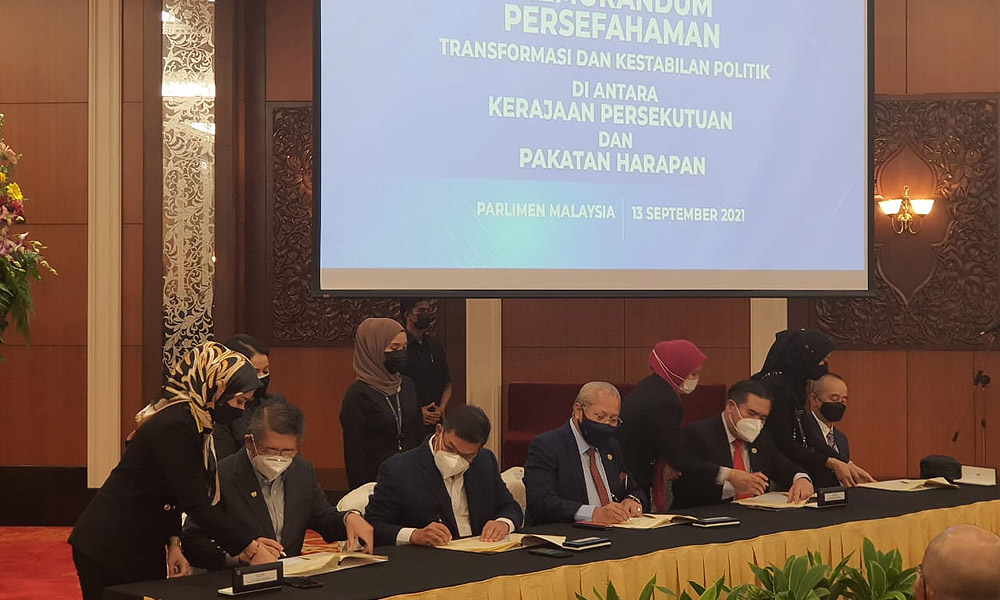
Talking about political stability, Fahmi said the current government has learned a lot from the memorandum of understanding (MOU) signed between Ismail Sabri’s government and Harapan.
“We saw the last three governments bereft with internal schisms and irreconcilable differences.
“For Harapan in 2018, a lot of it pivoted on and rested on the transition to some extent, (and) in a strange form of poetic justice, the transition has taken place. There were people who took advantage of that,” he said.
Fahmi noted that the government that was formed right after the Sheraton Move in 2020 suffered from a trust deficit, as those who formed the government did so by abandoning former colleagues through a new political arrangement - with secret protocols not known to many.
Nevertheless, Fahmi described himself as being consistent in saying that the “old order” has ended - based on events in the country’s political landscape since 2018.
“A new order has not arisen (yet). To form a new political consensus, you cannot rely on administrative means,” he said, citing elections as one form of administrative means.
“It must also be based on a political understanding or consensus. That materialised in the form of the memorandum of understanding between parties that form this unity government,” he said.
Referring to the agreement signed by the parties which form the current coalition government, Fahmi said the stability is in the consensus developed between top leaders - now “materialised and codified”.
Bridging political divide
He added that this must now be effected not only by cabinet members but also at the state level and on the ground.
The two-time Lembah Pantai MP told Malaysiakini that he has gone to meet his BN counterpart in the constituency - Ramlan Askolani, who was his opponent in the recent 15th general election.
“We've sat down, we're even considering a form of MOU for Lembah Pantai because we see that, yes, we used to be opponents for a long time.
“But we’re in a new situation, given the decree of the Yang Di-Pertuan Agong to form a unity government in order to have political stability and get the country out of a pandemic and potential economic malaise.
“We feel that there might be a need to have something similar even at the constituency level, so this political consensus is a solution to that instability,” he mentioned.
The 42-year-old minister added that he has no problems working with his cabinet colleagues.
Changing laws
Touching on the idea of establishing a media council, Fahmi said he has tasked his deputy Teo Nie Ching to work on it.
Previously, Teo had said the government hopes to establish a professional media council to help regulate the media industry and ensure that there is no politically motivated interference.
Malaysiakini also asked if there were any plans within the cabinet to amend or abolish certain laws such as the Printing Presses and Publications Act and the Sedition Act.
To this, Fahmi said: “I can't speak for the cabinet because we have not discussed this in the cabinet, and I may have my own personal views.
“But I understand that it's not something I can comment on, because what I say now, in my capacity as a minister, can be misunderstood as being a government decision.”
READ MORE: If I change as a person, please tell me, says Fahmi
READ MORE: Fahmi: We must bridge connectivity divide between T20 and B40
This is the last of a three-part interview with Communications and Digital Minister Fahmi Fadzil.
/file/publisher-c1a3f893382d2b2f8a9aa22a654d9c97/2023/01/c7b7e6363d3027445f658c7e41804cce.jpg)
/file/publisher-c1a3f893382d2b2f8a9aa22a654d9c97/2022/12/57049cb38361ae14affb238ab0454484.jpg)
/file/publisher-c1a3f893382d2b2f8a9aa22a654d9c97/2023/01/f5c7e622edc5629fe379ff1ba24fbd48.jpg)


Are you sure you want to delete this comment?
This action cannot be undone.