




Gov't defends FTA talks
The government was questioned in the Dewan Rakyat today about its objectives in entering into a Free Trade Agreement (FTA) with a number of countries.
The government was questioned in the Dewan Rakyat today about its objectives in entering into a Free Trade Agreement (FTA) with a number of countries.
Three questions in the Order Paper focused on the progress being made in negotiations with the US among other countries, as well as the benefits or otherwise for Malaysia.
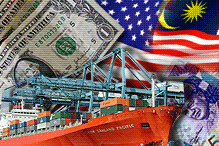 The deadline for US administration's fast-track approval of the proposed FTA with Malaysia
expired
on March 31, but both governments have signalled intent to continue with negotiations.
The deadline for US administration's fast-track approval of the proposed FTA with Malaysia
expired
on March 31, but both governments have signalled intent to continue with negotiations.
Deputy International Trade and Industry Minister Ahmad Husni Mohd Hanadzlah responded to all the questions together, included another scheduled for April 23 which asked how the government intends to enhance its position in negotiations.
He said the government views the FTA as a way of strengthening Malaysia's position as an attractive location for foreign investments, and to promote the manufacturing sector.
In addition to contributing to development, a FTA would pave the way for collaboration of Malaysian investors in economic activities in participating countries, he said.
The government further stands to gain market access for service sectors like education, telecommunication, tourism, health, accountancy and engineering.
Increased trade
To date, Malaysia has signed a bilateral agreement with Japan and the Early Harvest Programme with Pakistan. It is currently negotiating a FTA with the United States, Australia, Pakistan and New Zealand.
 "At regional level, the government, through Asean, has signed a FTA with China in the goods and services sector, and with Korea in the goods sector."
Asean is considering a FTA with Japan, Australia, New Zealand and India.
"These countries are our trading partners or our main source of Foreign Direct Investment," he explained.
"In addition, they too are discussing a FTA with our competitors like China, Thailand, Singapore and India."
 Answering a supplementary question from Fung Lui Kun (DAP-Bukit Bintang), Ahmad Husni said Japanese investment had increased by as much as 20.2 percent to RM4.4 billion in the second half of last year, following the signing of the FTA agreement.
"Exports to Japan are mainly agricultural products, with no change in the import of automotive vehicles," he said.
 To a supplementary question by Md Alwi Che Ahmad (Ketereh-BN), the deputy minister said the reaction to US FTA negotiations with North Korea or Thailand should not be used as benchmark.
"We know of the riots that have occurred (in protest) in those countries," he said.
Ahmad Husni further said the government has taken several steps in explaining the pros and cons of the FTA to the public.
"We will keep on utilising the media to help us to explain all this to the public. We have also organised seminars from time to time to educate (particular groups on related issues)," he added.


