


/file/publisher-c1a3f893382d2b2f8a9aa22a654d9c97/2023/04/c84ebf2371efed1dad05a4826399a163.jpg)

Declassified: No sabotage in Double Six Crash, plane was off-balance
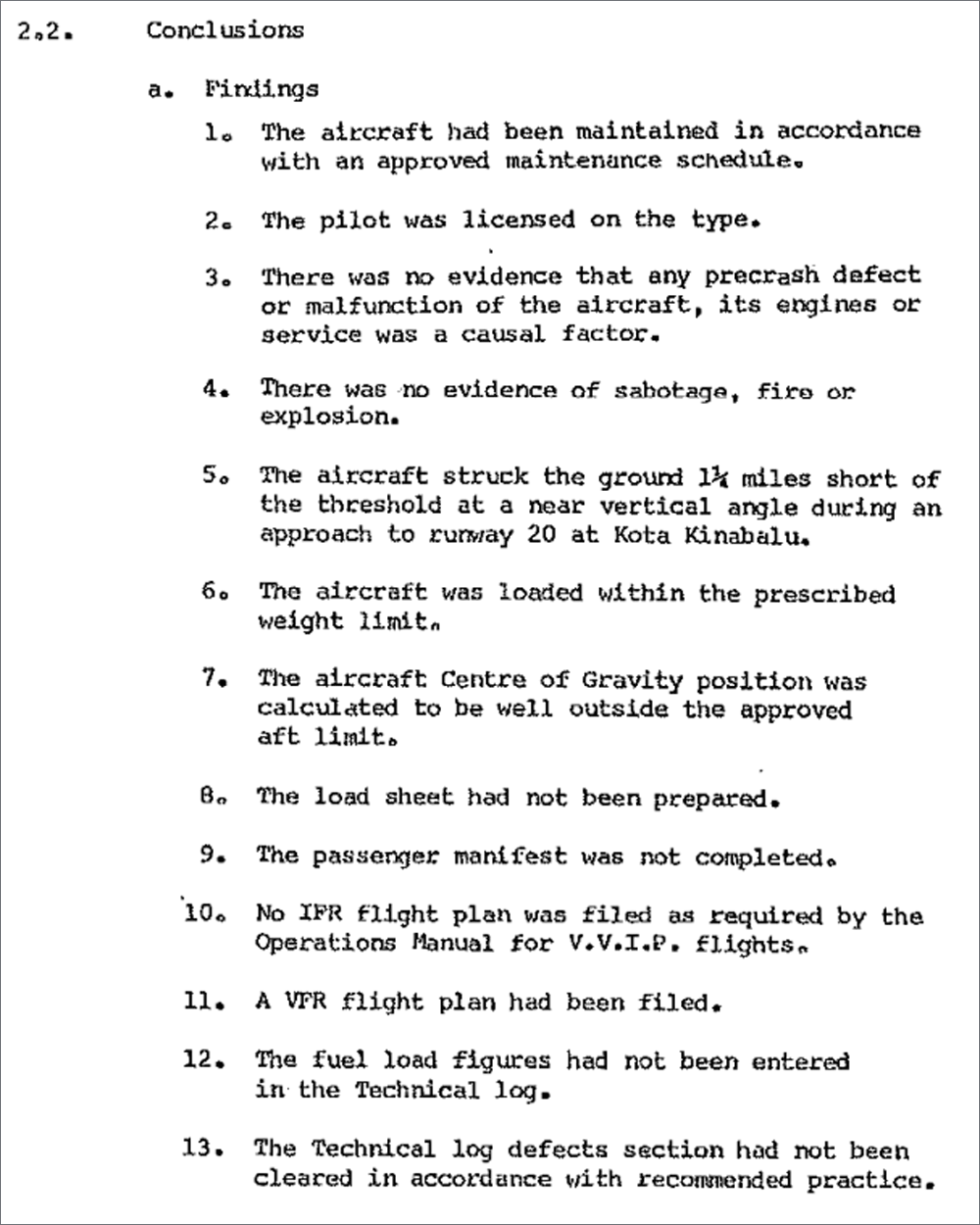
The declassified federal investigation report on the 1976 plane crash that killed 11 people, including the then Sabah chief minister Fuad Stephens, found no element of sabotage.
Instead, the investigating team's conclusion is that the most probable cause of the accident - dubbed the Double Six Crash - was the plane's centre of gravity being off balance.
"The report concludes that the probable cause of the accident was due to a centre of gravity position well outside the aft limit which caused the control column to run out...
The declassified federal investigation report on the 1976 plane crash that killed 11 people, including the then Sabah chief minister Fuad Stephens, found no element of sabotage.
It said an inspection of the wreckage determined that the engine was still running at the time of the crash and the aircraft controls were working. There was also no sign of a fire or explosion.
Instead, the investigating team's conclusion is that the most probable cause of the accident - dubbed the Double Six Crash - was the plane's centre of gravity being off balance.
Based on baggage recovered from the wreckage, the report estimated that there was a load of 325lbs (147.4kg) in the aft baggage compartment, exceeding the permissible load of 198lbs (89.8 kg).
Thus while the plane's calculated take-off weight was 435lbs (197.3kg) below the maximum limit, the centre of gravity was shifted too far to the rear.
This had the tendency to push the aircraft’s nose position upward, which had to be compensated by adjusting the tailplane’s trim setting beyond what is typical, and pushing the flight controls forward.
When the aircraft’s flaps were engaged in preparation for landing at Kota Kinabalu Airport, however, this additional lift could not be compensated because the flight controls were already pushed forward to their limit.
“It is, therefore, apparent that there was insufficient movement left of the control column to prevent the nose from moving further up. This resulted in a loss of airspeed which […] requires an even further forward position of the column to correct the situation.
“Therefore at this stage, it was not possible to retrieve the situation, which deteriorated rapidly into a stall condition,” the report said.
“Stall” refers to a potentially dangerous flight condition where there is no longer sufficient airflow over an aircraft’s wings to generate lift, which can lead to a loss of control.
This “simple” explanation reportedly had Upko deputy president Donald Peter Mojuntin, whose father Peter Mojuntin was killed in the crash, calling for Prime Minister Anwar Ibrahim to set up a committee to investigate why the report was classified in the first place.
“We’re confused as to why the report was classified for so many years. There were government officials and ministers who said the report was classified due to public interest. Some even said it was for national security.
“But they could have told us all of this 47 years ago. (The report) is anticlimactic,” he reportedly told Free Malaysia Today, adding that he accepts the report’s findings.
The report also pointed fingers at the flight's pilot Gandhi Nathan - whom it painted as having a poor track record.
The report noted that the pilot's original flying log book was allegedly burnt in June 1969, and a replacement log book was stolen in November 1975.
It also said that from the records available, the pilot had a "history of poor performance" in flying and that his training record with Sabah Air was marginal.
For his final flight, he failed to prepare the load sheet (paperwork detailing the weight of an aircraft’s passengers, cargo, and distribution), the passenger manifest, and some of his flight plans.
Compounding matters, the report found his employer, Sabah Air, was lax in ensuring that its procedures were followed.
"Thus the scene appears to have been set where this pilot, not in the habit of completing many of the requirements or procedures called for by the company, did no more than a casual walk around of the aircraft at Labuan and sat in the cockpit when the final loading was completed, oblivious to the incorrect distribution of the load," the report said.
The report also stated that the pilot may have lacked sleep, and noted that he had told acquaintances that he was tired and suffering from a mild stomach upset.
It said the company should have recorded and monitored crew rest periods, noting that at the time of the accident, Gandhi was working 67 minutes past his 10-hour duty period.
“Had this (crew rest period) been recorded properly by the company, then this pilot would not have been required to carry out the last flight from Labuan to Kota Kinabalu,” it said.
The report also said that while Gandhi was certified to fly the GAF Nomad N22B aircraft involved in the accident, his employer was not.
“This organisation neither had such approval for the Nomad nor had any application been made for one,” it said.
The investigators recommended that Sabah Air should be restricted to operating aircraft and helicopters up to 6,000 pounds (2,722kg) maximum weight “until such a time as the company operations and engineering procedures together with the management personnel have been improved to the satisfaction of the Civil Aviation Department”.
For context, the manufacturer lists the N22B variant of the Nomad as having a maximum take-off weight of 3,856kg.
The crash on June 6, 1976, had significant ramifications on Sabah politics, in part due to the many high-ranking government officials killed in the crash.
Apart from then chief minister Fuad, others killed in the crash include state ministers Salleh Sulong, Peter Mojuntin, and Chong Thien Vun, as well as Fuad’s eldest son Johari Stephens.
Another factor its timing - Fuad had just replaced the long-time chief minister Mustapha Harun 53 days earlier, prior to the crash.
READ MORE: KINIGUIDE | What is the significance of the Double Six Crash?
The incident sparked many conspiracy theories, including allegations of sabotage and federal interference in state affairs.
In particular, Fuad’s successor - Harris Salleh - was accused of having foreknowledge of the crash, because he purportedly persuaded then finance minister Tengku Razaleigh Hamzah to disembark the ill-fated flight to follow him on another flight.
Harris later said Razaleigh was never scheduled to fly with Fuad to Kota Kinabalu but intended to fly with then Sarawak chief minister Rahman Yaakub to Kudat on a different Nomad plane, and then by helicopter to Banggi.
The mystery and conspiracy theories surrounding the crash is not helped by the secrecy surrounding the investigation report over many decades.
On March 8, the Kota Kinabalu High Court ordered the government to make the report public by June 8, but the issue looked set to drag on further when the government appealed the decision.
However, the situation changed when Prime Minister Anwar Ibrahim announced on April 5 that the report will be declassified.
“The cabinet took into consideration views expressed by Sabahans all these years and also demands by the next-of-kin, in line with the government's principle to uphold transparency.
“Therefore, it has been decided that the final report of the Sabah Air crash on June 6, 1976, will be declassified,” he said.
/file/1158/76c985052cde51bbebfc2838f9dff0f6.jpeg)
/file/publisher-c1a3f893382d2b2f8a9aa22a654d9c97/2023/04/ac58a46a2fa1ff2526e4c003c5cc44a6.jpg)
/file/publisher-c1a3f893382d2b2f8a9aa22a654d9c97/2023/04/68e29f63e5950ffbd711985fb3dd8aab.jpg)
/file/publisher-c1a3f893382d2b2f8a9aa22a654d9c97/2023/04/ebe1f5cedf7295e2097d9f8375b582aa.jpg)
/file/publisher-c1a3f893382d2b2f8a9aa22a654d9c97/2023/04/c84ebf2371efed1dad05a4826399a163.jpg)
/file/publisher-c1a3f893382d2b2f8a9aa22a654d9c97/2022/07/14856f22239497cb4dfb138a7a4cc848.jpg)


Report this comment
Are you sure you want to delete this comment?
This action cannot be undone.