




Highest turnout in by-election history
A steady stream of voters in the Selangor state seat of Ijok are trekking to nine local schools serving as polling centres in the constituency when they opened at 8am today in this closely fought by-election.
A steady stream of voters in the Selangor state seat of Ijok are trekking to nine local schools serving as polling centres in the constituency when they opened at 8am today in this closely fought by-election.
The situation reportedly tense in at least two polling districts - the Malay-majority area of Kampung Ijok and Indian-majority area of Tuan Mee.
 In Kampung Ijok, about 250 Umno Youth's 'Gerak Gempur' members exchanged taunts with 100 PKR supporters with 25 police working overtime to keep them apart. Both groups hurled insults at each other.
At 10am, two trucks of riot police were called in to beef up the police presence. The two groups of supporters were ordered to stay at least 50m away from one another.
Meanwhile, arguments broke out between campaigners from the two contesting parties in Tuan Mee.
 BN supporters outnumbered opposition supporters in most of the polling stations. The police have also set up at least three road blocks in major roads leading into Ijok town.
At 5pm, when polling closed, the Election Commission announced that 83.08 percent or 10,195 voters, had cast their votes - the highest in by-election history.
In the 2004 general election, the voter turnout was a little lower - 76.17 percent, or 9,411 voters.
Vote counting is underway. The result is expected to be known at around 8pm.
Most of the early voters were senior citizens, some of them in wheelchairs. BN workers were seen busily ferrying them to the polling stations using cars and vans.
Fatimah Sulaiman, 84, sitting in a wheelchair, cast her vote and proudly said: "I've voted three times previously. I am happy to cast my vote."
Fatimah voted at the Bukit Gadong primary school in a Malay-majority area, which is used as one of the polling stations.
 The opposition has erected a huge banner outside of town depicting a 'ghost' holding a pen along with the following words, 'We're back for this by-election'.
At the same time, cars with university markings were spotted in the area indicating that the campus authorities are deploying some of its officers to nab those students who are 'illegally' campaigning in the by-election.
Under campus rules, university students are barred from helping in electoral campaigns.

BN has the edge
The keenly fought seat - with top guns from the contesting parties visiting this semi-urban constituency over the past nine days of campaigning - pitted the ruling BN's MIC candidate K Parthiban, 39, against opposition PKR's Abdul Khalid Ibrahim, 61.
 While both candidates hailed from the area, they are not registered voters in the constituency so they didn't vote today. However, the duo are visited all the polling stations throughout the day.
Political observers said that BN has an edge and believe that it will win the seat with a reduced majority of between 500 and 1,500.
When the two parties last fought this seat three years ago, in the 2004 general election, MIC won the seat with a majority of 1,649 the late K Sivalingam (MIC) garnering 5,231 votes while Abdul Rahman Moharam (Keadilan) took 3,564. There was an Independent candidate, Mohd Sharif Nagoorkani, who bagged 313 votes.
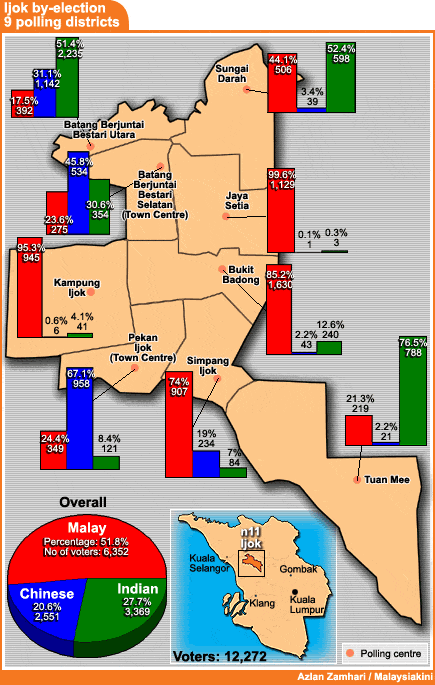
The state seat, about 50km northwest of Kuala Lumpur, has two major town centres Pekan Ijok in the south, and Berjuntai Bestari (formerly known as Batang Berjuntai) in the north [see chart below].
These two towns are surrounded by predominantly Malay kampongs and plantation housing communities made up of mostly Indians.
 Almost all of Chinese voters live in the two major towns, while Malay voters are in areas around Pekan Ijok, Jaya Setia and Bukit Badong. Most of the Indian voters can be found in around the northern part of Berjuntai Bestari and in the districts of Tuan Mee and Sungai Darah.
Swing among Chinese and Malays?
BN took the seat in 2004 by winning in the Chinese/Indian-majority districts of Berjuntai Bestari and Pekan Ijok, and Indian-majority districts of Tuan Mee and Sungai Darah.
Meanwhile, PKR won in the Malay-majority areas of Bukit Badong and Kampong Ijok, and took half of the votes in two other Malay-majority areas Simpang Ijok and Jaya Setia.
 PKR hopes that it will pick up more Chinese voters in the two town centres and at least maintain or better its vote haul in the Malay-majority areas. It does not expect to see a significant swing, if any, among Indian voters.
An overwhelming majority of the Indian voters is expected to back BN's MIC, especially given that the party's campaign workers have cordoned off key housing areas - in particular Tuan Mee - making it difficult for the opposition to visit them.
The Ijok seat fell vacant following the death of incumbent BN assemblyman K Sivalingam, 59, of a heart attack in Chennai, India, on April 4.
Watch below 4-minute video of the situation at Sungai Darah polling station.


Are you sure you want to delete this comment?
This action cannot be undone.