




One more year of house arrest for Suu Kyi
Burma's political icon Aung San Suu Kyi has her house arrest extended for another year by the country's military leaders, ignoring international calls for her freedom.
Police sources told AFP that officials visited the Nobel Peace Prize winner at her lakeside home in Rangoon to inform her, they said. "We issued an order of further detention," one source said.
Burma's political icon Aung San Suu Kyi has her house arrest extended for another year by the country's military leaders, ignoring international calls for her freedom.
Police sources told AFP that officials visited the Nobel Peace Prize winner at her lakeside home in Rangoon to inform her, they said. "We issued an order of further detention," one source said.
Another police source confirmed her latest period of detention, which started in May 2003 and was set to expire this weekend, was extended by a year.
"We informed her about the extension," said the source, who was among the officials who visited Aung San Suu Kyi.
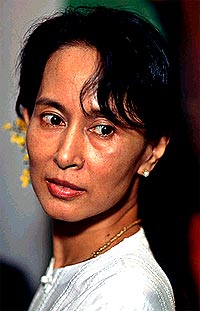 A Western diplomat in Rangoon also said the democracy leader's house arrest was extended "by one year without surprise." The decision attracted condemnation from the international community, with the United States leading the criticism.
17 years under house arrest
Aung San Suu Kyi, 61, has spent most of the past 17 years under house arrest and has little contact with the outside world, apart from her live-in maid and visits from her doctor.
The last time the opposition leader - the only Nobel peace laureate in detention - was able to leave her house was November 2006, when the junta allowed her to meet visiting UN envoy Ibrahim Gambari for one hour.
The extension was widely expected, with observers saying the junta is fearful the hugely popular democracy leader could threaten its rule.
Aung San Suu Kyi's opposition National League for Democracy (NLD), which won a landslide victory in 1990 elections but was never allowed to govern, quickly denounced the extension.
"Our government totally ignored domestic and international calls demanding her freedom," said Myint Thein, an NLD spokesman.
 "We are very disappointed by this. Her detention is not good for the country," he said. Political figures from across the world have ramped up calls for her release, with ex-US president Bill Clinton and 58 other former world leaders sending a joint letter last week to junta head General Than Shwe.
Two other Nobel peace laureates - former US president Jimmy Carter and former South Korean president Kim Dae-Jung - were among those who signed the appeal.
Citing Burma's rights violations, including Aung San Suu Kyi's detention, the United States last week renewed sanctions against the regime for another year, as did the European Union in April.
'Detention must end'
"The United States condemns the generals of the State Peace and Development Council of Burma for the extension of the house arrest of Nobel laureate Aung San Suu Kyi," said White House national security spokesman Gordon Johndroe.
 "The regime's unjustified continued detention of Aung San Suu Kyi and repression of other democratic activists must end," he added. UN chief Ban Ki-moon also expressed concern.
"The secretary general deeply regrets the decision," Ban's spokeswoman Michel Montas said in a statement.
"He strongly believes that the sooner restrictions on Aung San Suu Kyi and other political figures are lifted, the sooner Myanmar will be able to move toward inclusive national reconciliation, the restoration of democracy and full respect for human rights."
In the past week the junta has detained at least 60 pro-democracy activists as they went to pagodas to pray for Aung San Suu Kyi's release, and 45 people, mostly NLD members, still remain in custody.
The United Nations has estimated there are 1,100 political prisoners in the country which has been ruled by the military since 1962.


Are you sure you want to delete this comment?
This action cannot be undone.