


/file/1154/c72de2811f6c4bb552dcde697841c45f.jpeg)

2017 tahfiz fire: Appellate court upholds arsonist's conviction, jail term
A 22-year-old has failed in his appeal to overturn his murder conviction and jail sentence over the 2017 tahfiz fire that killed 23 lives.
A three-person Court of Appeal bench chaired by Abu Bakar Jais this morning unanimously dismissed the man’s appeal over the incident at Pusat Tahfiz Darul Quran Ittifaqiyah, Jalan Keramat Hujung, Kampung Datuk Keramat in Wangsa Maju, on Sept 14, 2017.
A 22-year-old has failed in his appeal to overturn his murder conviction and jail sentence over the 2017 tahfiz fire that killed 23 lives.
A three-person Court of Appeal bench chaired by Abu Bakar Jais this morning unanimously dismissed the man’s appeal over the incident at Pusat Tahfiz Darul Quran Ittifaqiyah, Jalan Keramat Hujung, Kampung Datuk Keramat in Wangsa Maju, on Sept 14, 2017.
The appellant appealed against the Kuala Lumpur High Court verdict in August 2020 that found him guilty of 23 murder charges and ordered him to be detained at the pleasure of the Yang di-Pertuan Agong. The accused was 16 at the time of the incident.
In reading out the judgment on behalf of Abu Bakar and fellow bench member See Mee Chun, Che Mohd Ruzima Ghazali said that the High Court had not erred in its conviction and sentencing.
Ruzima said that the criminal court had correctly found that the various prosecution witnesses' testimony and the closed circuit television (CCTV) footage from four different locations showed that the appellant was involved in intentionally causing the fire.
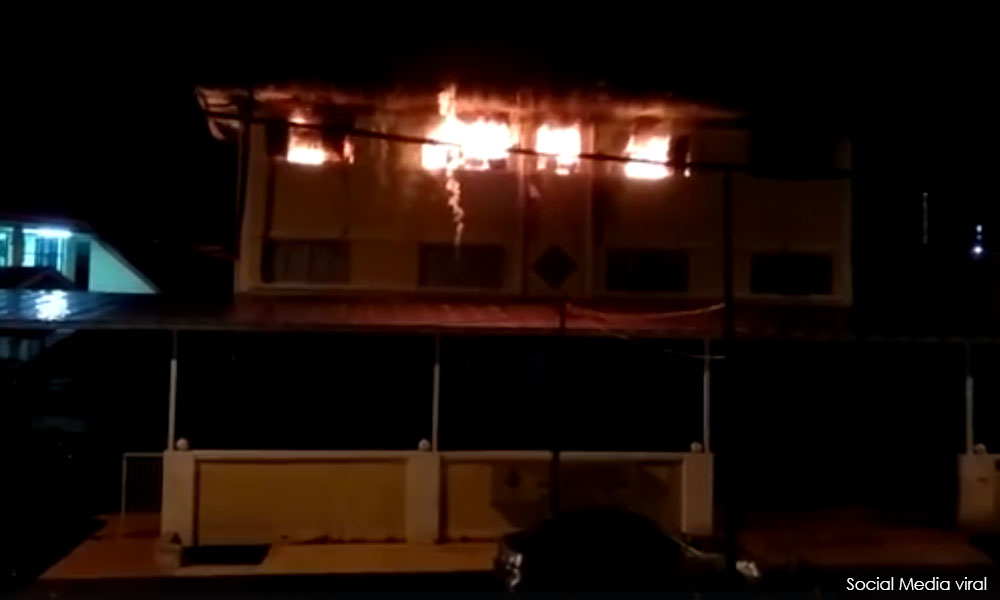
The appellate court pointed out that the CCTV was located at the nearby Muslim Consumers Association of Malaysia (PPIM) as well as at three other nearby locations, namely a snooker centre, a petrol station and the house of the appellant’s neighbour.
Ruzima said the 68th and 69th prosecution witnesses testified seeing the appellant climb over the back gate of the tahfiz and enter the religious school from the back.
The appellate judge noted that CCTV footage showed that the appellant was carrying a plastic water bottle, which was contended to be filled with petrol.
Police testimony showed that after the arrest, the enforcement authorities brought the accused to a room in his house, where he showed the lighter contended to have been used to light the fire, the judge said.
The judge highlighted that despite there being no direct evidence of the 71 prosecution witnesses seeing the accused put the gas canister in front of the third floor of the tahfiz dorm, spill the petrol on the shoe rack, and ignite the fire, the collective circumstantial evidence is strong enough to show it was the appellant who committed the crime.
However, Ruzima said the appellate bench is not allowing the prosecution's cross-appeal over the lower court ruling to acquit the appellant’s co-accused in the murder case.
Ruzima said the High Court's acquittal of the co-accused - who was released without his defence being called in January 2020 - was correct as the prosecution witnesses’ testimonies as well as CCTV recordings failed to ascertain whether the said co-accused was at the scene of the fire at that particular time.
Counsel Haijan Omar appeared for both the accused and co-accused, while the prosecution was represented by deputy public prosecutor How May Ling.
The murder trial
The two were initially jointly charged with the murder, but the charge was later amended following the decision at the end of the prosecution’s case, which saw one of the two being discharged and acquitted without his defence being called.
According to the amended charge, the remainder accused teenager, together with another individual who was not identified, was charged with the murder and causing the death of the 23 occupants - 21 students and two school wardens - at the tahfiz centre, between 4.15am and 6.45am on Sept 14, 2017.
He was charged under Section 302 of the Penal Code, read together with Section 34 of the same law, which specifies the mandatory death sentence.
However, per Section 97(1) of the Child Act 2001, a death sentence shall not be pronounced against a convicted person who was under the age of 18 at the time of the offence.
Section 97(2) of the same Act provides that the court shall order the person instead to be detained at the pleasure of the Agong.
Section 94 of the same law also empowers the court to order the child offender's parents or guardian to pay a fine or compensation.
/file/publisher-c1a3f893382d2b2f8a9aa22a654d9c97/2023/04/de75bedf52fc1d5beb907cc367297397.jpg)
/file/publisher-c1a3f893382d2b2f8a9aa22a654d9c97/2020/06/9f64c965159569fb074b1ce9b6233788.jpg)
/file/publisher-c1a3f893382d2b2f8a9aa22a654d9c97/2023/09/68a0eb636907a8b492cb3a047a227335.jpg)
/file/publisher-c1a3f893382d2b2f8a9aa22a654d9c97/2023/08/9696826bfa1a65ea079f75dc64e2efea.jpg)
/file/publisher-c1a3f893382d2b2f8a9aa22a654d9c97/2021/12/5cd07ebb1d09317c6753e7621e78bafa.jpg)


Are you sure you want to delete this comment?
This action cannot be undone.