




ECs aye to use of indelible ink
The Election Commission (EC) has finally given the nod to the use of indelible ink in elections to prevent multiple voting, a proposal long demanded by the opposition and election watchdogs.
The Election Commission (EC) has finally given the nod to the use of indelible ink in elections to prevent multiple voting, a proposal long demanded by the opposition and election watchdogs.
"In principle, yes, the commission has agreed to the proposal pending further research on two issues," EC chairperson Abdul Rashid Abdul Rahman told malaysiakini this afternoon.
The two issues are whether there is a need to amend the relevant legislation such as the Election (Conduct of Elections) Regulations 1981 and the material (ink) to be used in implementing the proposal.
"We hope we can carry out the proposal in time for the forthcoming general election because there have been a lot of requests on this, especially from the opposition.
"Although the reason they used (to call for indelible ink) was very weak as the alleged electoral fraud was not proven in court, we still agree to do this to satisfy them," said Rashid.
Thumbprint, biometric system
Rashid's statement today came six months after he reportedly shot down the idea of using indelible ink on the ground that the method was 'archaic' .
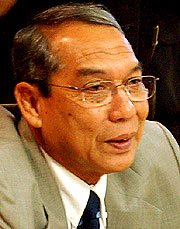 However, he explained today that he had never rejected the idea but only said the proposal needed to be further discussed with commission members.
Elaborating, the EC chief said the green light to use indelible ink was reached at a recent meeting in Penang attended by commission members and state EC chiefs after having deliberated at length on other methods to prevent multiple voting.
Other methods that were discussed include identification of thumbprint and the use of biometric system but Rashid said the EC concluded that using indelible ink is the "cheapest and easiest" way.
"The biometric system is estimated to cost RM30 million and it will only be used every five years and maybe we have to change the system sometime later, while using thumbprint may not be easy as it is difficult to detect the thumbprint if your hand is dirty," he explained.
On the contrary, he said indelible ink has been widely used in other countries.
"But we have to find out what kind of product will be the most reliable that we should use, otherwise it may bring more problems," Rashid pointed out in reference to poor quality of ink that may render the method ineffective.
On the possibility to amend the Act, the EC chief said he has instructed the commission's legal advisor to study the matter.
"If the need to amend the law arises, then it will takes time (to implement the proposal). If we can, we will do it in the coming general election, otherwise it will be later," he replied.
Two-hour meeting with DAP
The EC's agreement on the use of indelible ink was first conveyed to a DAP delegation during a two-hour meeting held at the commission's headquarters in Putrajaya this morning.
The delegation was headed by DAP secretary-general Lim Guan Eng. Others present were the party's parliamentarians Teresa Kok, Tan Kok Wai and Fong Kui Lun.
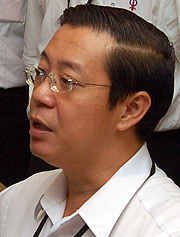 Welcoming the EC's endorsement on the use of indelible ink, Lim said Rashid has also assured that the transparent ballot boxes - a proposal adopted by the EC earlier - will continue to be used in the coming elections.
Contacted by malaysiakini after the meeting, Lim also quoted Rashid as agreeing for an oversight mechanism on the postal voting process but said the jurisdiction to implement the mechanism "is beyond EC".
"We counter propose that interim measures can be carried out such as allowing polling agents to monitor and observe the whole process.
"Such monitoring has been rejected so far on the ground of security (in army bases) but we can see kacang putih or mi rebus sellers going in," argued Lim.
During the meeting, the DAP also submitted a three-page memorandum to Rashid calling for 10 areas of reforms ( see chart below ) in the electoral system to be done before the EC chief's retirement at the end of this year.
"The time has come for Rashid to leave behind his legacy of removing electoral roll irregularities, enforcing the Election Offences Act 1954 and using indelible ink towards establishing a clean, free, fair and impartial elections," said Lim in the memorandum.
Opposition and election watchdogs have been pushing for the use of indelible ink especially in the wake of a series of electoral irregularities reported in the recent Ijok by-election.
Kelantan PAS leader Husam Musa had, in a recent interview , also stressed on the need to use indelible ink, failing which he expressed fears the Islamic party may lose Kelantan in the coming general election.


Are you sure you want to delete this comment?
This action cannot be undone.