


/file/publisher-c1a3f893382d2b2f8a9aa22a654d9c97/2023/11/dd5cbcc53cc976478041eef11f5f2780.jpg)

Baha'is quietly go about their business
INTERVIEW | In a diverse nation, we are taught about the more visible religions like Islam, Christianity, Hinduism, Buddhism, Taoism, Judaism and Sikhism. There are, however, many other forms of worship that go relatively unnoticed.
One that comes to mind is the Baha'i faith, which has at least 50,000 active adherents in Malaysia, according to the group's Office of External Affairs representative Vidyakaran Subramaniam.
Founded in the 19th century, the Baha’i faith teaches...
INTERVIEW | In a diverse nation, we are taught about the more visible religions like Islam, Christianity, Hinduism, Buddhism, Taoism, Judaism and Sikhism. There are, however, many other forms of worship that go relatively unnoticed.
One that comes to mind is the Baha'i faith, which has at least 50,000 active adherents in Malaysia, according to the group's office of external affairs representative Vidyakaran Subramaniam.
Founded in the 19th century, the Baha’i faith teaches the essential worth of all religions and the unity of all people. Established by Bahaʼullah in Persia, it initially developed in Iran and parts of the Middle East. Ironically it is in Iran itself, where the religion has faced persecution.
“Baha'is come from all walks of life and are present in virtually every country in the world. In Malaysia, we have Baha'is from Indian and Chinese ethnic backgrounds, as well as the indigenous population of Peninsular Malaysia, Sabah and Sarawak,” said 32-year-old Vidyakaran (above) who was born into the faith.
While it may not be so well known among Malaysians, the Baha'i faith is officially recognised by the government and as such is a member of the Harmony Committee, the national body recognised and appointed by the National Unity Ministry for religious bodies.
The 30-member Harmony Committee comprises three representatives from the government, 10 representatives of Islam, four representatives each of the Buddhist and Christian faiths, as well as two representatives each of the Hindu and Taoist religions, along with a representative each from the Sikh and Baha'i faiths as well as Sarawak's Unit for Other Religions.
National Unity Minister Aaron Ago Dagang and Minister in the Prime Minister's Department (Religious Affairs) Mohd Na'im Mokhtar chaired Harmony’s meeting on Oct 28.
Oneness of humankind
“The Baha’is are also given rights to hold a marriage and granted burial grounds according to the Baha'i laws,” added Vidyakaran.
“Baha'is continue to face persecution in some countries, notably in Iran where it was founded. Fortunately, we do not face such persecution in Malaysia. Baha'is have been in Malaysia since before Merdeka, as such many of us would be second or third-generation Baha'is.
“As a young and growing religion, we also see many new adherents. However, proselytisation is prohibited in the Baha'i faith and the idea of converting to the Baha'i faith is also foreign to the spirit of fundamental principles in its teachings, namely the independent investigation of truth, and the recognition that religion is unfolding in its nature,” explained Vidyakaran.
Yesterday, the group celebrated its festival of the Twin Holy Birthdays, the birthdays of the faith’s central figures, Bab and Baha’ullah, at the Bahaʼi National Centre in Seputeh.
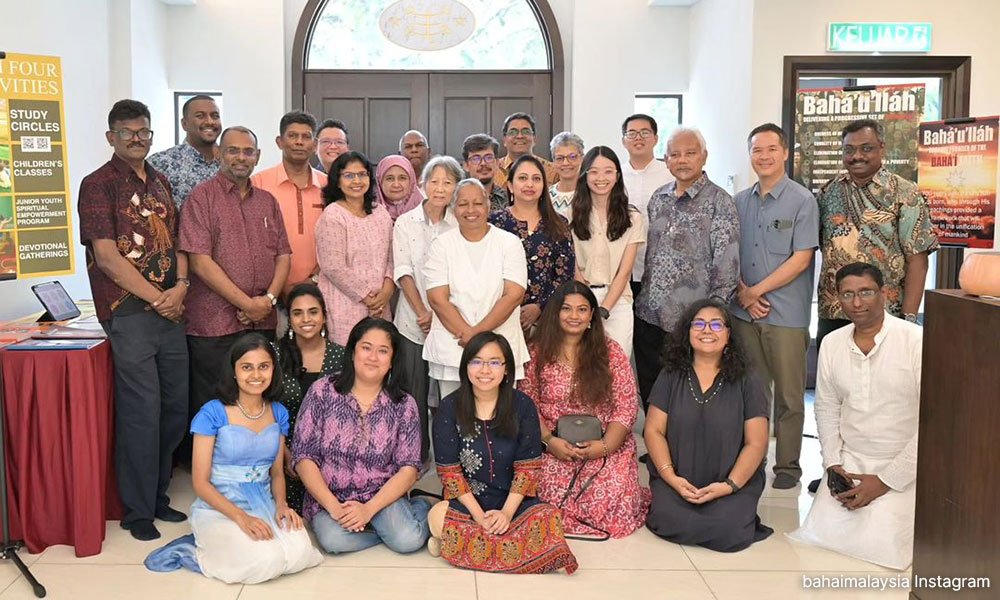
“The pivot of all teachings in the Baha'i faith is the oneness of humankind, which implies that we are all members of one human family. The analogy of the human body is often employed to help us understand this principle and its implications.
“Essentially, to be a Baha'i is to be of service to humankind. Service is viewed not just as an act to achieve personal salvation, but as the arena in which the very purpose of existence can be achieved.
“Service is viewed as intertwined with worship, and the activities promoted by the Baha'i community embody this principle. All activities of the Baha'i community are geared towards the betterment of society, and Baha'is work with their neighbours and friends towards this end,” said Vidyakaran.
Community transformation
Earlier this year, ‘An Expansive Prospect’, a documentary about Baha’is across four communities was produced. According to Vidyakaran, the first 21 minutes show the experience of the Baha'is in Malaysia, contributing to the transformation of their communities.
Being a relatively small faith meant that Baha’is often had to explain who they were to others who were unaware.
“It’s true that when I went to school, most wouldn’t know. We are also not so visibly recognisable in terms of dress or house of worship.
“We do have certain symbols, like the nine-pointed star which is generally used by Baha'is as a symbol of the faith. It is shown on a banner with a white background. The number nine has significance in the Baha'i Revelation.
“In Malaysia, we don't have a Baha’i temple or house of worship. The Baha’i’s house of worship will have nine entrances. A house of worship is not something that needs to be there although we do have community centres for example in Damansara Perdana, Puchong, Bukit Jalil and elsewhere,” explained Vidyakaran.
“I never faced discrimination on religion, but ethnically as an Indian, that was a different story,” he said, adding that while Baha’is have sometimes fled persecution in other countries, there are no Baha’i refugees in Malaysia.
Despite being a minority and knowing that some who are born into the faith do leave it, he said he never feels like giving up.
“We have a particular perspective of history and believe that humanity is advancing towards its maturity. Just like coming out of childhood, there are some crises you face - we see society and humanity going through that right now.
“Unity is very important, the concept of progressive revelation through divine teachings. We view religion as one, a system of knowledge, that guides our spiritual and social reality.
“We try not to focus on rituals, we are not allowed to be involved in partisan politics, because that promotes disunity, but at the same time, we believe in standing up against injustice,” said Vidyakaran.
/file/1306/6acc80f77d48ac6b78f8a9b29d4f769d.jpeg)
/file/publisher-c1a3f893382d2b2f8a9aa22a654d9c97/2023/02/7b25ddcb60e73d646a3e8073983d9314.jpg)
/file/publisher-c1a3f893382d2b2f8a9aa22a654d9c97/2023/10/0d6cfbebe9a46a4c3ef6699011646637.jpg)
/file/publisher-c1a3f893382d2b2f8a9aa22a654d9c97/2023/03/c9c05ac1fe23c0b6959ad6acea060e0e.jpg)
/file/publisher-c1a3f893382d2b2f8a9aa22a654d9c97/2023/06/8e0ddcbb86622606bd87fe432e1e3472.jpg)


Report this comment
Are you sure you want to delete this comment?
This action cannot be undone.