




Cyberspace a breeding ground for defamation
A false sense of security predominates in many people when they are on the Internet, one that has landed the unwary in trouble.
Beware, warned a legal expert, there are many holes to fall into when in cyberspace.
A false sense of security predominates in many people when they are on the Internet, one that has landed the unwary in trouble.
Beware, warned a legal expert, there are many holes to fall into when in cyberspace.
Senior law lecturer at the University of Ulster Venkat Iyer said this "false sense of security" and "false sense of distance" make people slightly more careless when postings things on the Internet than they would when writing, for instance, to newspapers.
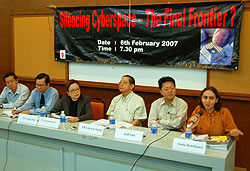
 Those who publish things anonymously are, thus, even more prone to such carelessness in the belief that they are "not likely to be called up", said Iyer in a seminar on Defamation in Cyberspace held this morning by the Kuala Lumpur Bar Continuing Legal Education Committee.
"Anonymity is no ground for immunity from a suit in relation to the use of the Internet," said Iyer, who later in his presentation cited pending court cases in the US involving anonymous postings on blogs and websites that were later traced.
Among them, he cited the case of American golfer "Fuzzy" Zoeller Jr, who sued a Miami firm for allegedly defamatory statements that appeared in a Wikipedia article that originated from the firm.
Openings for trouble
Other than defamation suits resulting from postings on blogs and websites - which make up many legal suits - there are many other possibilities of defamation action for seemingly innocuous material posted on the Internet, said Iyer.
Among them, an abusive e-mail message between two people can turn actionable when it gets into the inbox of a third-party.
While most Commonwealth law systems require an alleged defamatory statement to be received by a third-party before action can be taken, Iyer noted, some jurisdictions do regard as actionable even the publication of an abusive word or statement between two parties.
Along these lines, he said, the 'forwarding' of e-mails can and have landed people in trouble.
"It's a difference between hitting the reply button and hitting the reply all button," said Iyer.
 Defamation suits can also happen as a result of mailing lists within corporations' 'intra-net' systems that escape to people outside the companies, as well as in news groups.
Iyer cited the case of Alan Brown versus Patrick O'Brien in New Zealand, 2001, where postings made on the Internet Society of New Zealand bulletin board became public.
Even when the allegedly abusive statements are confined within the group, matters get blown out of control, said Iyer.
Comments between subscribers of newsgroups might accept the inflammatory messages, but not when these get to the eyes or ears of family members.
"For that reason, flaming (trading insults between subscribers of Internet forums and newsgroups) is not considered as acceptable now as it used to be in the early period (of the Internet)," said Iyer.
Need to balance
Even hyperlinking can be grounds for a suit, he said.
"If it turns out that the hyperlink leads you to material that is defamatory, you might be held liable though you are not yourself connected either with the creation of the material or with its publication except tenuously through the hyperlink," said Iyer.
While some courts in the world have held that it is alright as long as the person posted the hyperlink to another website with defamatory material "acted in good faith" and without knowledge, other courts have not been so generous.
"It doesn't matter whether the person had prior knowledge or not, as long as he posted the hyperlink, and as long as the matter on the other website was defamatory," said Iyer.
 As in 'traditional' media, he said, there is clearly a need to balance the adequate protection for personal reputation with the importance of maintaining freedom of speech.
"But here, the additional factor is that there is a need to protect the freedom of communication via the Internet. The Internet has been called at all times as the medium that gives maximum freedom for expression," said Iyer.
Citing a US-based legal expert Philip Adam Davis, Iyer said "a person does not eat, sleep, and play in cyberspace any more than he eats, sleeps, or plays in the pages of Time magazine."


Are you sure you want to delete this comment?
This action cannot be undone.