




Campus polls: Allegations abound
Once again, students are crying foul over alleged discrimination and irregularities in the run-up to the campus elections.
Once again, students are crying foul over alleged discrimination and irregularities in the run-up to the campus elections.
The students, from the 'anti-establishment' factions, claimed that university authorities are employing unfair election regulations and intimidation tactics to prevent them from winning in the polls.
This year's campus polls will be held on Oct 2 following six days of campaigning, which kicked off on Wednesday.
In Universiti Putra Malaysia (UPM), students complained of the sharp increase in the election deposit from RM30 to RM100.
 The 'anti-establishment' students alleged that this is one
of the measures used to discourage them from contesting, paving the way for the
'pro-government' faction to emerge victorious in the polls.
The 'anti-establishment' students alleged that this is one
of the measures used to discourage them from contesting, paving the way for the
'pro-government' faction to emerge victorious in the polls.
The deposit money will be forfeited if a candidate fails to receive the minimum number of votes.
Apart from the hefty deposit, candidates are also required to sign a pledge to fully support the university's e-voting system. Failing which, they will be disqualified.
Students also cited another rule pertaining to campaigning as being unfair. The rule stipulates that campaigning can only be conducted in certain colleges at time periods permitted by the election committee.
UPM: Five disqualified
In a related development, five 'anti-establishment' candidates from UPM were disqualified today.
Four were disqualified because of 'technical problems'. According to them, the computers used for the e-voting system could not verify their residential addresses.
The election committee must be held responsible for this problem because they failed to update their information when the candidates filled up their forms, said the students, who declined to be named.
As for the other two students disqualified, one was disqualified because his 'agent' or representative had quit while the other was axed because her agent did not answer the phone calls made by the election committee to verify if the student consented to acting as the candidate's agent.
However, Progressive Students Movement (GMM) coordinator Lee Song Yong claimed that in the first case, the agent had quit because he had been 'intimidated'.
Meanwhile, anti-establishment students in the International Islamic University (UIAM) are seeing red over a 'filtering process' implemented for all candidates.
They claimed that the English Proficiency Test, candidate interview sessions and 'socialising' sessions with deputy rectors, rectors and university presidents, are part of an "undemocratic and irrational" filtering process.
The students were also upset with the university's decision to combine the Human Science faculty with the Educational faculty and Ilmu Wahyu faculty.
The students argued that the number of students in all three faculties would amount to 4,000, whereas there are only two seats up for grabs.
It would be impossible for two student leaders to represent such a large number of students, they charged.
Protest at UM
In Universiti Malaya (UM), 'anti-establishment' students protested the nomination of 16 candidates, whom they claimed were 'ineligible' to contest.
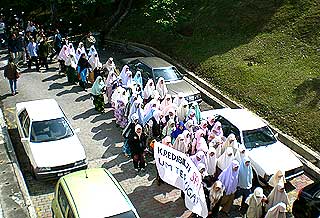 According to them, the 16 were final year students and therefore
could not fulfil their one year term as leaders.
According to them, the 16 were final year students and therefore
could not fulfil their one year term as leaders.
It was alleged that this was a move by the campus authorities to limit the number of seats that would fall into the hands of the 'anti-establishment' faction and deny them the much sought after majority in the Supreme Students Council
The protest ended with the groups' representative meeting with Deputy Vice Chancellor Azarae Idris.
Met later, Azarae declined to comment on the matter.
In 2005, 'anti-establishment' factions in five universities boycotted the campus elections citing similar complaints.
The pro-government faction, on the other hand, have consistently accused their rivals of advocating external agendas on campuses.


Are you sure you want to delete this comment?
This action cannot be undone.