


/file/publisher-c1a3f893382d2b2f8a9aa22a654d9c97/2024/07/57758aeba0e89efed59d725eb247982f.jpg)

CM's claim on Penang reclamation runs contrary to science - NGO
In a statement, Protect Karpal Singh Drive Action Committee chairperson AD Chandrasekaran said the proposed reclamation site is within or adjacent to the sanctuary’s deep channel.
“Assuming that the chief minister’s claim of no physical encroachment is true, he also overlooks...
Summary
An activist says a claim by the Penang chief minister that a proposed reclamation project won’t harm the Middle Bank marine sanctuary is contrary to scientific evidence.
Protect Karpal Singh Drive Action Committee chairperson AD Chandrasekaran says the proposed reclamation site is within or adjacent to the sanctuary’s deep channel.
Reclamation will have indirect and devastating impacts on the ecosystem there, he says.
Penang Chief Minister Chow Kon Yeow’s claim that a proposed reclamation project will not harm the Middle Bank marine sanctuary was said to be contrary to scientific evidence.
In a statement, Protect Karpal Singh Drive Action Committee chairperson AD Chandrasekaran said the proposed reclamation site is within or adjacent to the sanctuary’s deep channel.
“Assuming that the chief minister’s claim of no physical encroachment is true, he also overlooks the indirect, yet devastating impacts reclamation will have on the ecosystem.
“Even without direct overlap, the cascade of indirect impacts - sedimentation, habitat destruction, and disrupted currents - will devastate this fragile ecosystem,” he said.
The Middle Bank is an approximately 10 square km seagrass-rich area located at Penang’s South Channel between the island and mainland.
The sanctuary houses the only seagrass bed in the Straits of Malacca, with previous research reportedly identifying 429 species of marine life in the area.
On March 28, Chow (above) said the proposal to reclaim land off Karpal Singh Drive as part of the Jelutong landfill rehabilitation project will not endanger the Middle Bank.
Two days before that, the Protect Karpal Singh Drive Action Committee urged Chow to reject the project, saying there were concerns based on scientific evidence that the Middle Bank’s marine ecosystem would be harmed.
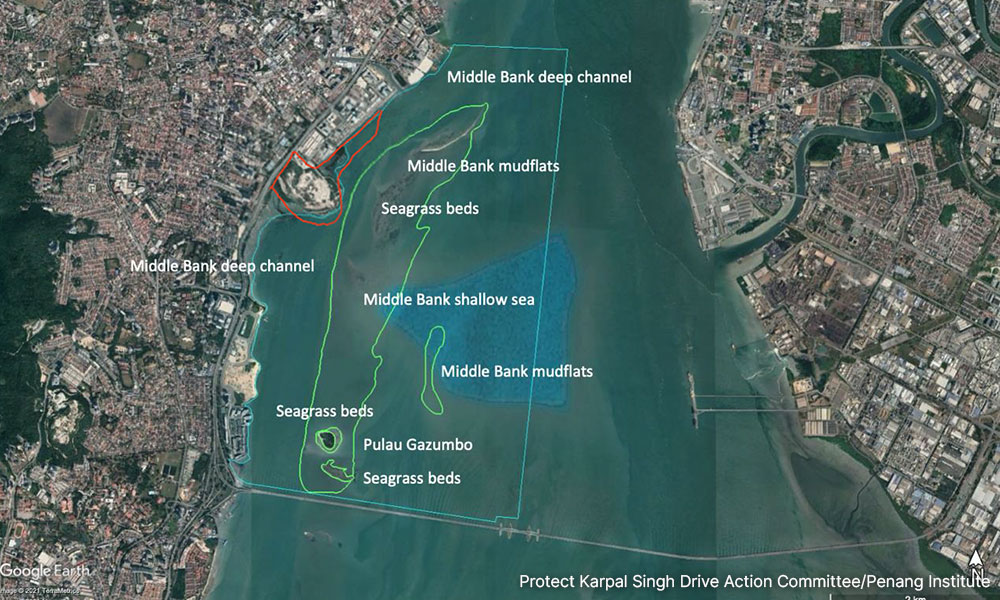
Commenting further, Chandrasekaran called the sanctuary an environmental feature that local communities cannot afford to lose.
“This is not a choice between progress and preservation - urban development and conservation can coexist.
“The Middle Bank sustains our fisheries, shields our shores, and fights climate change,” he said.
He added that the sanctuary is a global asset, highlighting the discovery of two new sea cucumber species there in 2022.
Besides that, he pointed to the Middle Bank’s role as a natural defence system for Penang.
“Its ecosystems - seagrass beds, mudflats, and mangroves - provide coastal protection, stabilise the seabed, and mitigate climate change by sequestering carbon up to 40 times more effectively than forests.
“It supports artisanal fisheries, purifies water, and shields our shores from erosion and tsunamis, as demonstrated during the 2004 disaster,” he said.
Rehabilitate Jelutong landfill
Last year, the Penang state government placed plans to declare the Middle Bank a protected marine sanctuary on hold while awaiting the decision on the development of the nearby landfill.
On March 24, Chow said reclamation is an essential step to dismantle the old Jelutong landfill, which has been in use since the early 1970s and is exceeding its capacity.
In 2020, the state government and government-linked company Penang Development Corporation signed a deal with PLB Engineering Bhd to develop and rehabilitate the Jelutong landfill for RM1 billion.
According to a state assembly reply in November, PLB is to prepare a new site for waste disposal on the rehabilitated site, while the state was also said to be considering building a waste-to-energy plant, where refuse is incinerated and turned into power.
/file/publisher-c1a3f893382d2b2f8a9aa22a654d9c97/2021/01/2d254165c186d0153c908c379fedb7d7.jpg)
/file/publisher-c1a3f893382d2b2f8a9aa22a654d9c97/2024/08/8d50d9d87a6f9fb7f903d3ad75ed2be7.jpg)
/file/publisher-c1a3f893382d2b2f8a9aa22a654d9c97/2021/01/3a0b812279e2bb82b5ef35f930f64c40.jpg)
/file/publisher-c1a3f893382d2b2f8a9aa22a654d9c97/2025/03/3fdeba5de0aa8374df7f7fadc72dda59.jpg)


Are you sure you want to delete this comment?
This action cannot be undone.