
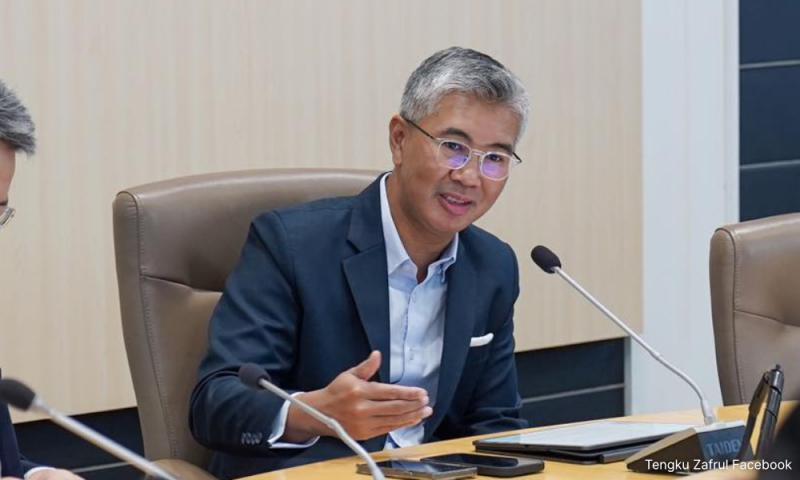
The US tariffs are expected to directly impact Malaysia’s GDP and present challenges to its economic growth, possibly for years to come, said Tengku Zafrul Abdul Aziz.

The investment, trade, and industry minister said Malaysia is likely to feel the impact of the tariffs in the medium to long term.

This is because the country is one of the largest trading partners of the US in Asean and a major destination for US foreign investments.

“This impact is expected to be widespread because tariffs are also being imposed on nearly every trade partner and source of investment for Malaysia.

“If more countries impose retaliatory tariffs, a global-scale trade war could break out, which would undermine global economic growth,” he said in a press conference regarding the US tariffs here, today.

Zafrul (above) said the government has already announced that the GDP growth forecast for 2025, at 4.5-5.5 percent, will be reviewed based on a more comprehensive assessment report on the impact of the US tariffs.

“For now, the government expects economic growth to continue. Our household spending remains resilient; domestic investments are strong; tourism revenues are solid, and national master plans are being implemented.

“InshaAllah, our strong economic fundamentals and the government’s preparedness will enable us to weather these challenges with strength,” he said.

Lower tariff rate than others

However, Zafrul noted that despite the negative impact, there are some direct and indirect effects that can be leveraged.

“Among them, several Malaysian exports are expected to become more competitive in the global market compared to other countries subjected to higher US tariffs.

“The tariff rate on Malaysia at 24 percent is seen as more moderate compared to Cambodia (49 percent), Indonesia (32 percent), Laos (48 percent), Myanmar (45 percent), Thailand (37 percent), Vietnam (46 percent), and China (34 percent),” he added.

Flags of Asean and member states

Zafrul said many analysts believe this makes Malaysia more attractive to importers and US companies seeking inputs or intermediate goods.

Other Asean countries hit by US tariffs included Brunei (24 percent), the Philippines (17 percent), and Singapore (10 percent).

He also explained that the substitution effect is expected to benefit commodities such as palm oil, wherein Malaysia’s palm oil exports have the potential to become more competitive, not only compared to competitor countries but also because demand may shift to Malaysia.

Slower growth, supply chain disruptions

However, Zafrul did not dismiss the possibility that negative direct impacts await, particularly in terms of reduced demand.

“When this happens, revenues will decrease, and employment in the export sector will be affected. When demand decreases, investments and expenditures will also drop.

“All of these factors will result in a decline in Malaysia’s GDP. If many countries face the same situation, global growth will slow down,” he added.

He pointed out that the decrease in demand from the US due to retaliatory tariffs could also result in local industries and markets facing a glut of imports from other countries with excess capacity, which would increase competition with local producers.

US President Donald Trump

Commenting on investors’ reactions to this development, he informed that most domestic and foreign investors believe it is still too early to assess the impact on their operations until the tariffs are implemented on April 9.

“Some investors expect supply chain disruptions, especially involving manufacturing contracts, and there are also Malaysian investors slowing down their business expansion plans, and starting to adopt thrifty measures, while focusing on market expansion in China, India, and Asean,” he said.

Engaging Asean

Meanwhile, Finance Minister II Amir Hamzah Azizan said Malaysia’s GDP will be revised based on the impact analysis by the National Geoeconomic Command Centre (NGCC), with a focus on strengthening resilience within the Asean system.

Speaking to reporters today, he said the NGCC, which will convene soon, will assess the impact of US tariffs on Malaysia.

Finance Minister II Amir Hamzah Azizan

“But more importantly, we are working together with our Asean partners to see how we can build resilience within the system.

“We have recognised that we will have to engage... to achieve better outcomes. That’s the objective, and Miti is taking the lead in terms of approaches on how we are going to deal with the US in this instance,” he said after launching the Malaysia Open House Exhibition @ Asean KL 2025, in Kuala Lumpur.

Meeting with US official

US Treasury Department deputy assistant secretary for Asia Robert Kaproth met with senior Asean officials in Kuala Lumpur today to apprise them of US’ imposition of tariffs on 168 countries.

The US official shared Washington’s policy outlook and discussed the effects of the newly implemented US tariffs on Asean member states during the US Treasury-Asean Finance and Central Bank Deputies Meeting (AFCDM).

In a post on X, Malaysia’s Finance Ministry said the meeting provided an avenue for Asean finance and central bank deputies to directly engage with the US Treasury in a closed-door setting.

However, further details of the hour-long meeting were not disclosed.

Asean members showed they were in unison in adopting a non-retaliatory stance and working towards an amicable solution.

As for Malaysia, the government has refuted the claim by the US authorities that it has imposed a 47 percent tariff on US imports into the country.

Prime Minister Anwar Ibrahim pointed out that the basis for calculating the tariff was fundamentally flawed, which has inaccurately resulted in Malaysia being imposed a reciprocal tariff of 24 percent.

“Yet, our response will be calm, firm, and guided by Malaysia’s strategic interests, and our goal is clear.

“We are fully committed to securing a favourable resolution that preserves vital market access, attracts continued foreign investment, and supports the well-being of Malaysian workers and businesses,” he said in a video addressing the US tariffs yesterday.

- Bernama