


/file/publisher-c1a3f893382d2b2f8a9aa22a654d9c97/2024/07/49d5cd32246ab07a0f5dac92edee11c6.jpg)

No evidence to charge anyone over Beng Hock's death, says AGC
The Attorney-General’s Chambers (AGC) claims that the police investigations into Teoh Beng Hock’s death did not find sufficient evidence to prove wrongdoing by any individuals.
This is why, it said, the case was classified as no further action.
Summary
AGC says renewed probe on Teoh Beng Hock’s death did not turn up any evidence that could result in charges against anyone.
The AGC does not explain why the case was probed for unlawful confinement instead of homicide.
The Attorney-General’s Chambers (AGC) claims that the police investigations into Teoh Beng Hock’s death did not find sufficient evidence to prove wrongdoing by any individuals.
This is why, it said, the case was classified as no further action.
The brief statement is in response to criticism against the authorities for wrapping up Teoh’s probe with nothing to show for it.
READ MORE: Five unsolved mysteries about Teoh Beng Hock’s death
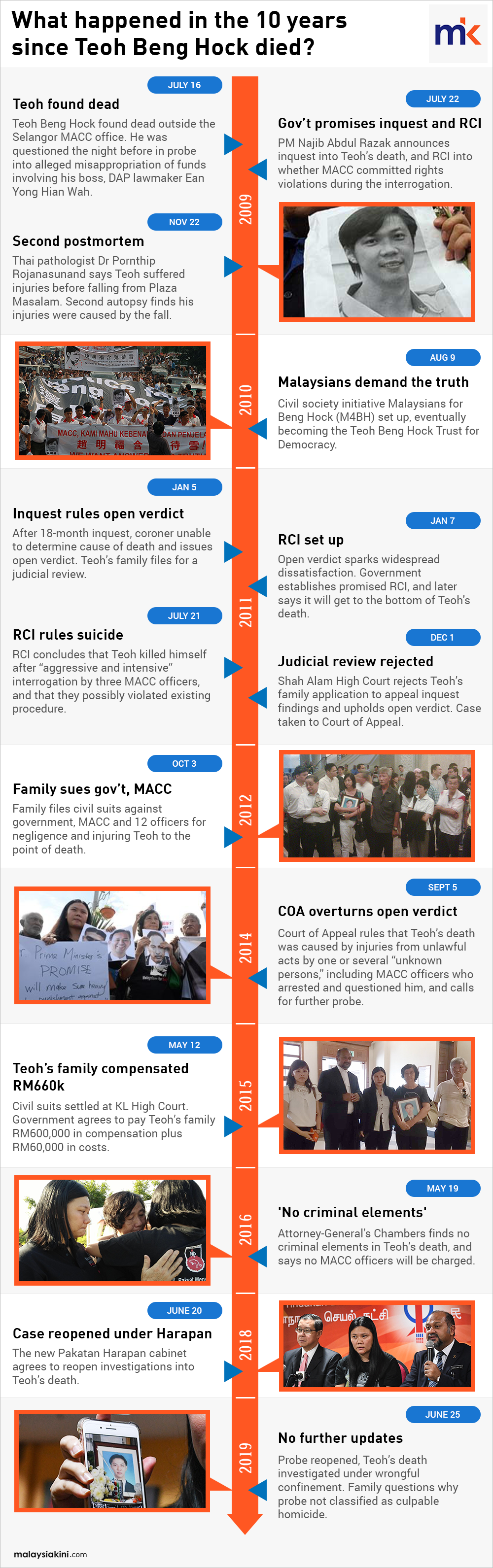
In 2009, Teoh, an aide to then-Seri Kembangan assemblyperson Ean Yong Hian Wah, was found dead after overnight questioning at Selangor MACC, which was then headquartered at Plaza Masalam in Shah Alam.
A 2011 Royal Commission of Inquiry ruled he was driven to suicide due to aggressive interrogation. However, in 2014, the Court of Appeal ruled his death was caused or accelerated by unlawful acts, including those of MACC officers.
On Nov 21 last year, the Kuala Lumpur High Court ordered the police to complete the investigation into his death within six months after appeals court judge Wan Ahmad Farid Wan Salleh allowed a judicial review application by Teoh’s parents.
The family had accused the police of focusing on them instead of going after the MACC officers implicated in Teoh’s death.
READ MORE: Will Teoh Beng Hock's case find closure under Harapan rule?
Police, however, claimed they were hamstrung and had limited evidence to work with on top of some witnesses refusing to come forward.
The AGC statement today did not explain why police investigated Teoh’s case under Section 342 of the Penal Code relating to unlawful confinement instead of homicide.
/file/publisher-c1a3f893382d2b2f8a9aa22a654d9c97/2024/07/dc15101766cb2da804d4ab3188e37a8b.jpg)
/file/publisher-c1a3f893382d2b2f8a9aa22a654d9c97/2025/05/45818952ba8b733bb0b2efd25c6fed2e.jpg)
/file/publisher-c1a3f893382d2b2f8a9aa22a654d9c97/2024/07/49d5cd32246ab07a0f5dac92edee11c6.jpg)
/file/publisher-c1a3f893382d2b2f8a9aa22a654d9c97/2025/02/5d2b7271425741bd439b402503a75d82.jpg)
/file/publisher-c1a3f893382d2b2f8a9aa22a654d9c97/2024/08/79505f9c58d1b5bd5663730adc1b8907.jpg)


Are you sure you want to delete this comment?
This action cannot be undone.