


/file/publisher-c1a3f893382d2b2f8a9aa22a654d9c97/2025/06/bb33bd1ce6d4ec44d291d0aa5ce3836c.jpg)

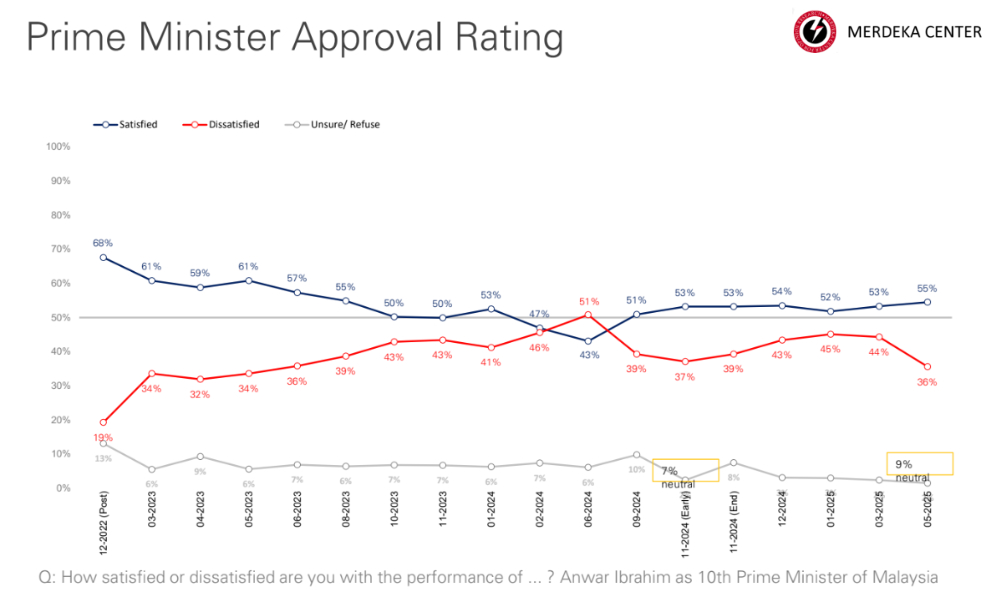
Anwar's mid-term approval rating at 55pct
Prime Minister Anwar Ibrahim has a 55 percent approval rating from voters at the midpoint of his administration’s term, according to a nationwide survey conducted by independent pollster Merdeka Center.
The survey, carried out between May 12 and May 23 this year among 1,208 registered voters, found that Anwar’s relatively stable leadership and perceived economic improvements have contributed to a more favourable outlook among Malaysians.
Summary
Prime Minister Anwar Ibrahim’s mid-term approval rating is at 55 percent, driven by relatively stable leadership and perceived economic improvements.
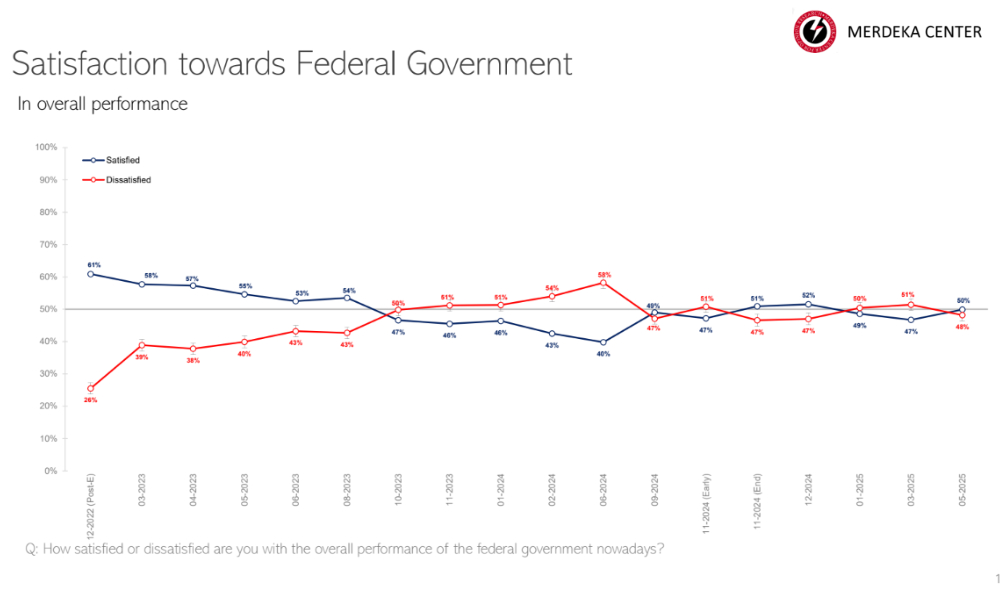
Public approval of the federal government has increased to 50 percent in May 2025, up from 40 percent in June last year.
Despite positive trends, economic concerns remain the top priority for most Malaysians, and the close margin between approval and disapproval reflects continued anxiety over living costs.
Prime Minister Anwar Ibrahim has a 55 percent approval rating from voters at the midpoint of his administration’s term, according to a nationwide survey conducted by independent pollster Merdeka Center.
The survey, carried out between May 12 and May 23 this year among 1,208 registered voters, found that Anwar’s relatively stable leadership and perceived economic improvements have contributed to a more favourable outlook among Malaysians.
“Several factors appear to drive this view - a decline in political instability, the government’s commanding two-thirds majority in Parliament, and the rollout of institutional reforms such as the revived Parliamentary Services Act 2025,” said Merdeka Center.
Economic conditions were also cited as a key reason for Anwar’s current standing.
The pollster cited government data, which showed that inflation fell to 1.4 percent in March 2025, the lowest in three years, while the economy recorded 4.4 percent growth in the first quarter.
“The government’s decision to raise the minimum wage to RM1,700, along with festive aid for civil servants and ongoing fuel subsidies, has likely helped ease public frustrations over the cost of living,” the think-tank added.
Public sentiment was further buoyed by the absence of major price shocks following the withdrawal of diesel subsidies in 2024.
Despite this, economic concerns remain the top priority for most Malaysians, the survey revealed.
Anwar’s efforts on the international stage were also noted, with his leadership during Malaysia’s 2025 Asean chairmanship and the hosting of Chinese President Xi Jinping said to have boosted his image at home.

“While Malaysia’s enhanced diplomatic profile is significant, voters remain more focused on everyday bread-and-butter issues.
“Improvements in job security and stable prices appear to have contributed more directly to the prime minister’s ratings,” said Merdeka Center.
Falling pessimism
Meanwhile, public approval of the federal government stood at 50 percent in May 2025, an increase from 40 percent in June last year. Disapproval ratings dropped to 48 percent compared to 58 percent in the same period.
The think-tank said the close margin between approval and disapproval reflects continued anxiety over living costs and concerns about possible subsidy cuts in the near future.
On the question of the country’s direction, 50 percent of respondents felt Malaysia was on the wrong track - an improvement from 61 percent a year ago - while 43 percent said the country was heading in the right direction, up from 29 percent in June 2024.
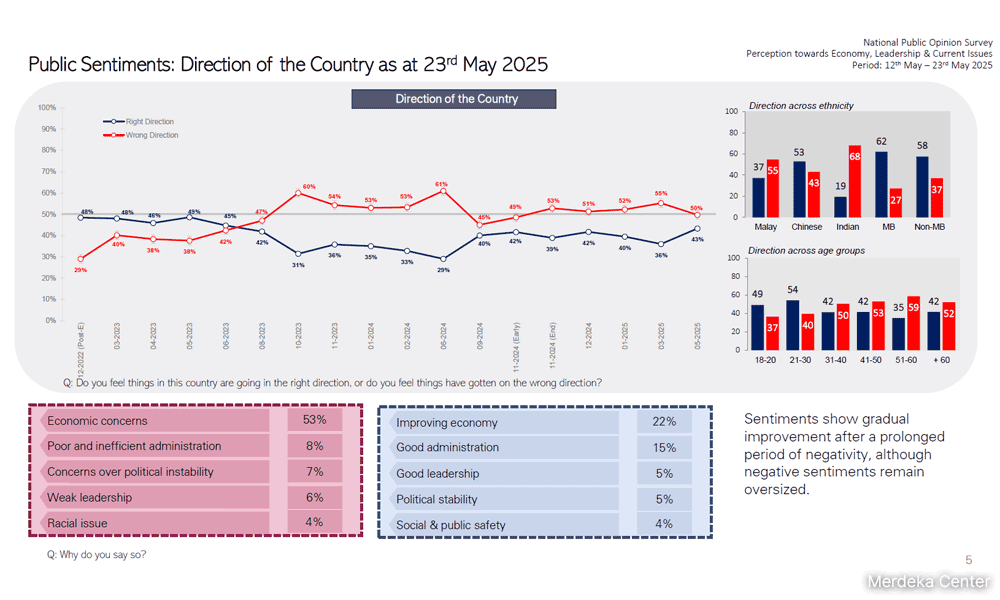
“Those who remain pessimistic continue to cite the national economy and performance of the administration as their main concerns,” said Merdeka Center.
The survey’s sample, contacted via telephone interviews, comprised 52 percent Malay, 29 percent Chinese, seven percent Indian, and 12 percent bumiputera (Muslim and non-Muslim), and was stratified by age, ethnicity, gender, and state constituency to reflect national demographics.
It said the survey has a margin of error of 2.82 percent.
/file/publisher-c1a3f893382d2b2f8a9aa22a654d9c97/2025/05/dbb72580058e130c42a4aedb4e8d8d2c.png)
/file/publisher-c1a3f893382d2b2f8a9aa22a654d9c97/2025/04/a7b68724c3aa42f2dc2cb33ddcbb64cc.jpg)
/file/publisher-c1a3f893382d2b2f8a9aa22a654d9c97/2025/06/a7702e1beb793d4edf5768162e9f7ace.png)
/file/publisher-c1a3f893382d2b2f8a9aa22a654d9c97/2025/06/59ec43764462884c8396208583f2429d.jpg)
/file/publisher-c1a3f893382d2b2f8a9aa22a654d9c97/2025/05/46eb87e427e9c2fedcd0e3a27f846791.jpg)
/file/publisher-c1a3f893382d2b2f8a9aa22a654d9c97/2025/06/7942c681d3f1fb862bd515ed91e3c51f.jpg)


Report this comment
Are you sure you want to delete this comment?
This action cannot be undone.