


/file/publisher-c1a3f893382d2b2f8a9aa22a654d9c97/2025/07/7ef74eb96df51fdcf61b14b6a0deb33f.jpg)

Governance, fiscal reforms to push Malaysia into top 25 CPI rankings
Efforts to enhance governance and strengthen public administration under the 13th Malaysia Plan (13MP) will directly contribute to achieving the Madani government's aspiration of positioning Malaysia among the top 25 countries in the Corruption Perceptions Index (CPI).
According to the 13MP document released by the Economy Ministry today, the focus on strengthening integrity and accountability, improving public service delivery efficiency...
Efforts to enhance governance and strengthen public administration under the 13th Malaysia Plan (13MP) will directly contribute to achieving the Madani government's aspiration of positioning Malaysia among the top 25 countries in the Corruption Perceptions Index (CPI).
According to the 13MP document released by the Economy Ministry today, the focus on strengthening integrity and accountability, improving public service delivery efficiency and enhancing fiscal management also aims to place Malaysia among the top 12 countries in the IMD World Competitiveness Yearbook.
Also, governance reforms are expected to support efforts to reduce the fiscal deficit to below three percent and ensure that the national debt level remains under 60 percent of gross domestic product (GDP).
Among the key initiatives are those outlined under the National Anti-Corruption Strategy 2024–2028, including the strengthening of the CPI Special Task Force to tackle corruption and improve Malaysia’s CPI ranking.
“The role of integrity units will also be strengthened to combat corruption in the public sector, with emphasis on initiatives using behavioural insights to foster a civil service culture of integrity and responsibility,” the document stated.
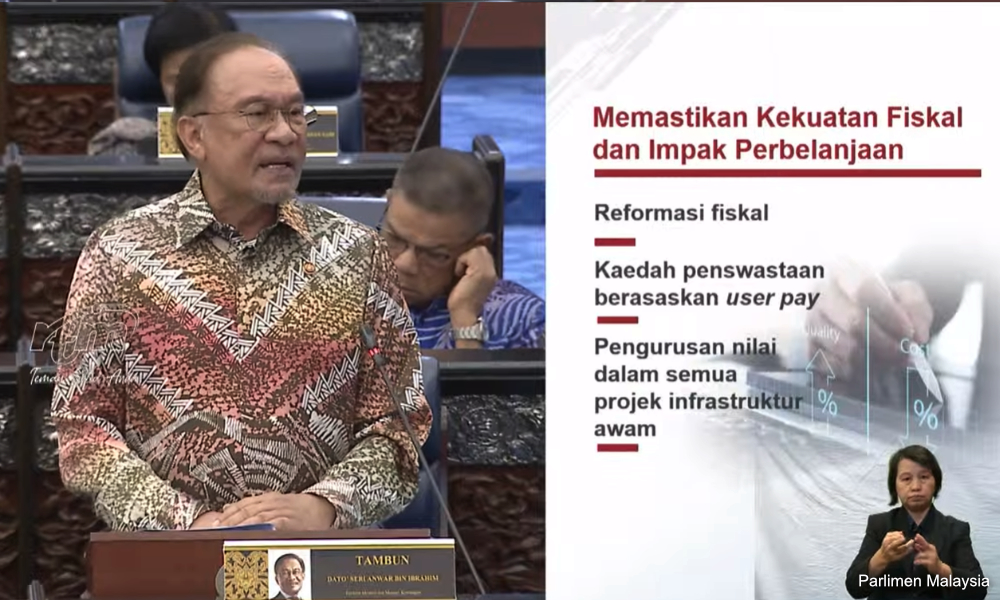
Performance monitoring and evaluation mechanisms across ministries will also be streamlined through the introduction of outcome indicators aligned with selected macroeconomic indicators, and reporting will be done directly to the prime minister.
“The monitoring methodology and overall governance structure of 13MP will be enhanced through the development of the 13MP Policy Implementation Plan Monitoring System or MyRMK.
“This system will be synchronised with other monitoring platforms such as those under the Finance Ministry, the Implementation Coordination Unit (ICU) of the Prime Minister’s Department, the Madani Monitoring Unit (PMU), the Performance Acceleration and Coordination Unit (PACU), and the National SDG Centre (PSN),” it stated.
The performance of 13MP will also be monitored at the highest level, including the cabinet, to ensure accountability and transparency in the implementation of development programmes and projects.
Intensive efforts
To improve the efficiency of public service delivery, the document noted that efforts will be intensified to reduce regulatory burden, strengthen governance and public sector talent capabilities, and restructure institutions under the proposed Public Service Delivery Efficiency Commitment Act 2025.
“A mandatory and periodic review of regulatory instruments, as well as the One-In-One-Out Policy, will be implemented to ensure the continued effectiveness of these instruments.
“The adoption of regulatory burden reduction guidelines will also be encouraged at the state and local authority levels,” the document read.
On fiscal management, the document highlighted that the Public Finance and Fiscal Responsibility Act 2023 (Act 850) will be applied in managing public finances, while government revenue collection will be enhanced through the phased implementation of the electronic invoicing system until 2026 to advance tax digitalisation.

“In addition, revenue base expansion under the Medium-Term Revenue Strategy (MTRS) - such as the introduction of a global minimum tax (GMT) and periodic reviews of the sales and service tax (SST) - will be carried out to support the provision of more public amenities and assistance for the people’s wellbeing,” it stated.
Among others, spending efficiency will be improved through more targeted subsidies and assistance, prudent debt management, and enhanced cost-control mechanisms that incorporate key elements such as life cycle cost in expenditure calculations.
- Bernama
/file/publisher-c1a3f893382d2b2f8a9aa22a654d9c97/2024/09/7f5a08ba0605731843260f49a09883cd.jpg)
/file/publisher-c1a3f893382d2b2f8a9aa22a654d9c97/2025/07/65ce6b23b0790307524b0b8eb20f2e26.jpg)
/file/publisher-c1a3f893382d2b2f8a9aa22a654d9c97/2021/10/260eb8e7bd9848c2d7cf109ef78e27ec.jpg)
/file/publisher-c1a3f893382d2b2f8a9aa22a654d9c97/2025/07/fa051093d3d35c3164bb2a8bf4e8ff67.jpg)
/file/publisher-c1a3f893382d2b2f8a9aa22a654d9c97/2023/12/2c217bd29384ed602588bba36b6d6d45.jpg)
/file/publisher-c1a3f893382d2b2f8a9aa22a654d9c97/2025/07/5d598e7c2afe10f2aca6721665db492c.jpg)


Are you sure you want to delete this comment?
This action cannot be undone.