


/file/publisher-c1a3f893382d2b2f8a9aa22a654d9c97/2025/09/ab6cc1ab589e06bd92c5fb0bf57ba886.jpg)

No house arrest for Najib
The Kuala Lumpur High Court has dismissed former prime minister Najib Abdul Razak’s house arrest bid.
Judge Alice Loke, in rejecting Najib’s judicial review this morning, found that the 16th Yang di-Pertuan Agong’s royal decree was invalid under the law.
“In the circumstances...
The Kuala Lumpur High Court has dismissed former prime minister Najib Abdul Razak’s house arrest bid.
Judge Alice Loke, in rejecting Najib’s judicial review this morning, found that the 16th Yang di-Pertuan Agong’s royal decree was invalid under the law.
“In the circumstances, premised on my reasoning, the addendum order is not a valid order made in the exercise of the prerogative of mercy.
“I’m of the view that a house arrest order is not capable of execution, no legal provision for such a mechanism in Malaysia,” the judge said.
Najib’s family was visibly distraught after the verdict in court, with his wife, Rosmah Mansor, heard speaking to lawyers over her dissatisfaction with the judgment.
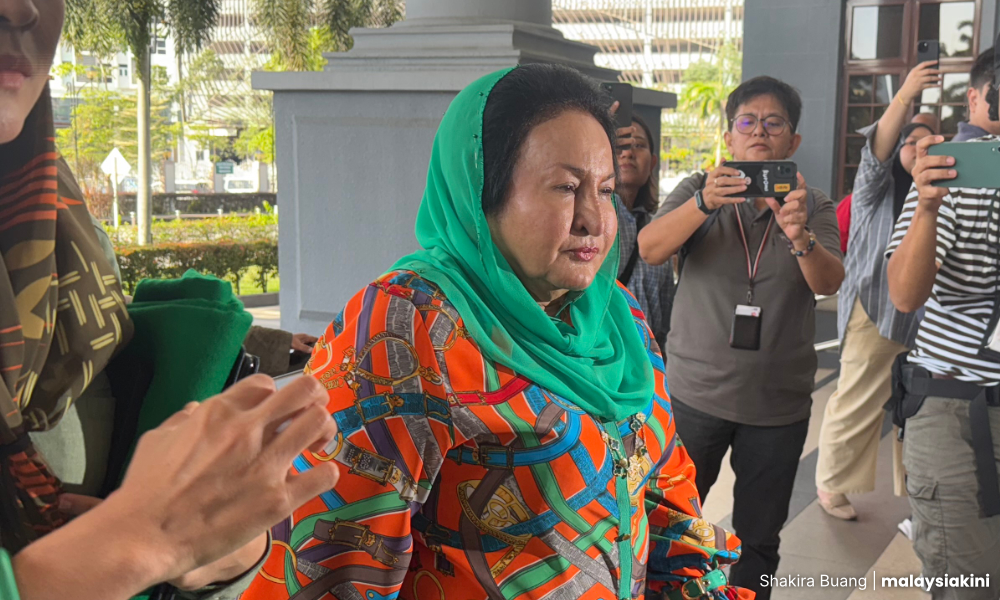
A teary-eyed Rosmah was also seen grasping Najib’s hand and refusing to let go.
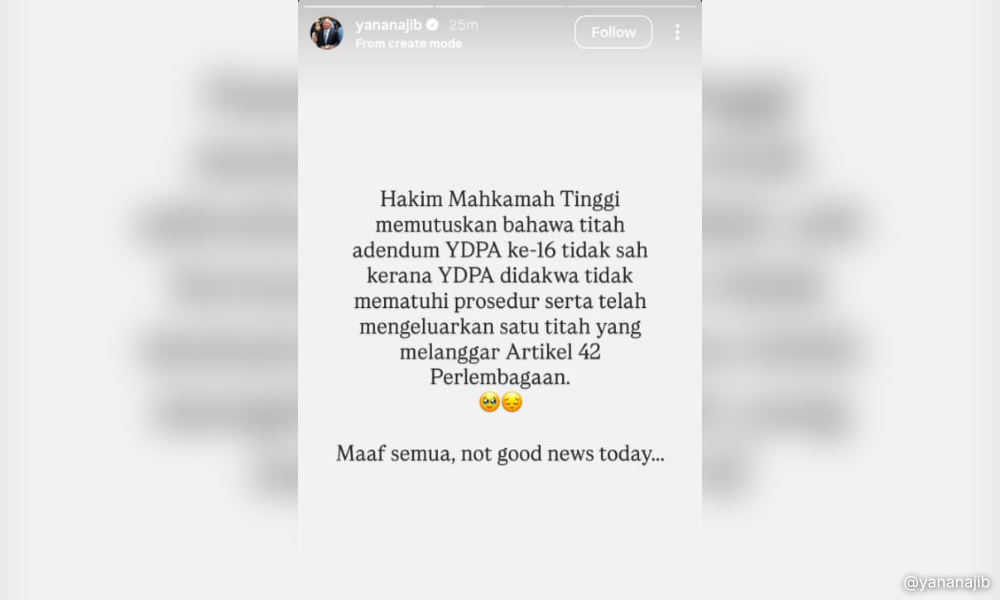
On Instagram stories, the couple’s daughter, Nooryana Najwa, expressed grief over the outcome.
“So, so sorry, daddy. I can’t imagine how you’re feeling at this moment. Please stay patient, ok. We live to fight another day as always.
“Take care of your health, daddy, that’s the most important thing,” she said.
Addendum order didn’t follow procedure
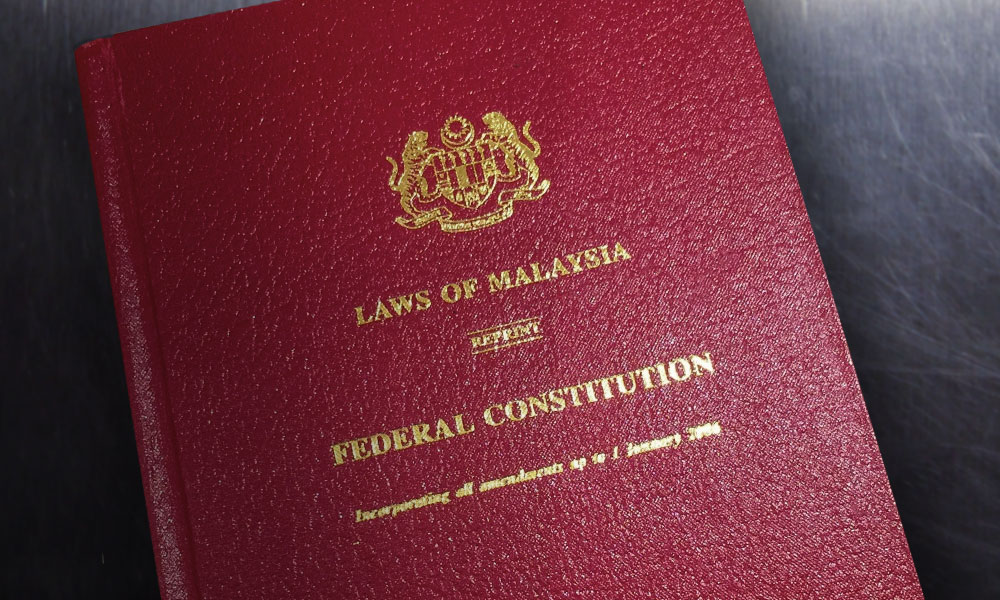
Loke, in her judgment, said the addendum order did not comply with the procedures in Article 42 of the Federal Constitution, which clearly sets out the decision-making process for the powers of pardon to be exercised.
The exercise of the prerogative of mercy under Article 42 must be made by adhering to the procedures stipulated, she added.
“It is indisputable that the house arrest was not deliberated at the Pardons Board meeting.
“The fact that it was referred to as a supplementary order confirms it,” she told the court.
Whilst the power of clemency is a royal prerogative, the judge said the Constitution has provided for it to be exercised within its framework.
“The Pardons Board, as a constitutional body, has an important function of advising the Yang di-Pertuan Agong before a decision is made.
“The attorney-general (AG), who is a principal legal adviser to the government, is a member of the Pardons Board; it is mandatory for the Pardons Board to consider his views.
“All these requirements taken cumulatively do not envisage a decision of the Yang di-Pertuan Agong outside the Pardons Board meeting.
“In other words, the Yang di-Pertuan Agong cannot decide independently of the Pardons Board,” Loke said.
No urgent relief found
The judge also noted there was nothing in the order suggesting an urgent relief that required it to be done outside the Pardons Board’s meeting.
“The addendum order was a supplementary order to an early release order. If the reduction in imprisonment term is contained in the early release order, (which) was proposed and deliberated at the Pardons Board’s meeting, (then) there was no reason not to do the same with the house arrest order.
“As it was not, the Pardons Board did not have the opportunity to tender advice on the matter. Whilst I agree that pardons, reprieve, and respite are three separate powers of clemency, the Constitution does not make any exemption for a Pardons Board meeting before an order of reprieve and respite is made.
“It is unnecessary to even decide if the addendum order is in the essence of respite, because I am of the view that pardon, reprieve, and respite fall under the purview and procedures laid down in Article 42 and all the provisions therein apply regardless of the specific order made,” Loke said.
She added that should the Yang di-Pertuan Agong be allowed to make prerogative decisions outside the Pardons Board’s meeting, it would invite arbitrary decisions.
“(These) would not accord with the principle enunciated in (previous case laws) that even discretionary powers are to be exercised judiciously.
“To reiterate, the Yang di-Pertuan Agong is a constitutional monarch, and he exercises powers and functions in accordance with the provisions of the Constitution.
“The exercise of a prerogative, (the) power of mercy is no exception; it must be exercised within the legal framework providing for safeguards and limits in the Constitution; the addendum order was not deliberated nor decided at the 61st Pardons Board meeting.”
In dismissing the judicial review application with no costs, Loke reiterated that the addendum order was invalid and therefore the respondents have no duty or power to obey or enforce it.
Najib to appeal
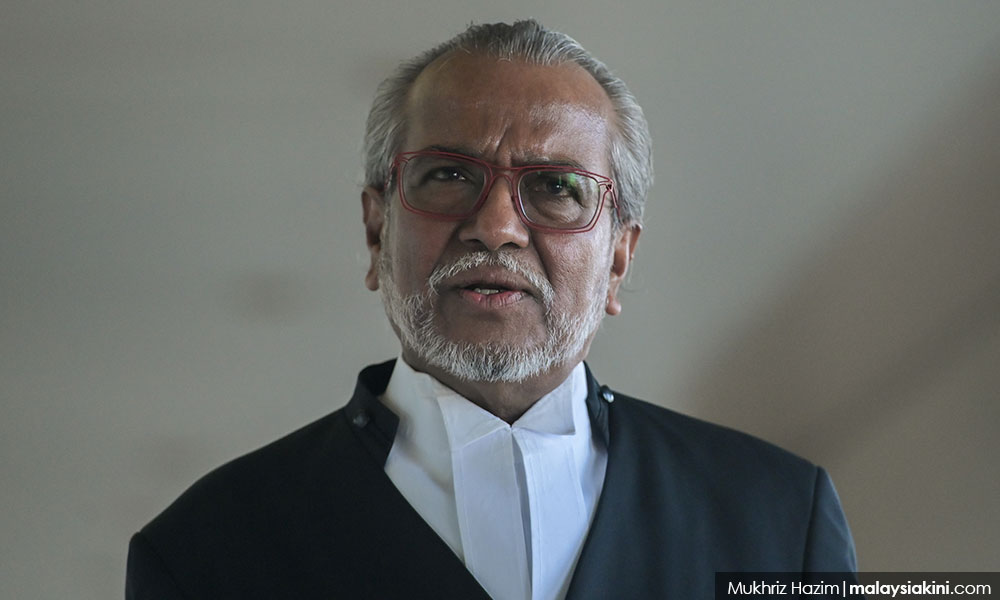
Najib’s lawyer, Shafee Abdullah, informed the court that they would be filing an appeal against the verdict as soon as possible.
READ MORE: Shafee: Ruling against Najib reduces Malay rulers' powers, to file appeal
The former Pekan MP’s house arrest bid began last year, following his judicial review application filed on April 1, 2024.
This came after the Pardons Board’s decision announced in February that year, which halved his 12-year SRC International sentence and reduced his RM210 million fine to RM50 million.
The sentence stems from convictions for abuse of power, criminal breach of trust (CBT), and money laundering involving RM42 million from SRC International.
Najib, in his application, claimed that there was a supplementary royal decree, dated Jan 29, 2024, that allowed him to serve the remainder of his sentence under house arrest.
He had named seven respondents in his application, including the government, Pardons Board, and former AG Ahmad Terrirudin Salleh, where he wanted them to confirm the existence of the order, to produce its original copy and enforce it.
This encountered a roadblock in the Kuala Lumpur High Court when judge Amarjeet Singh dismissed his leave application to pursue the case on July 3, 2024.
The decision was overturned by the Court of Appeal on Jan 6 this year, and the appeals court’s ruling was upheld by the Federal Court on Aug 13.

AG Dusuki Mokhtar had confirmed that the addendum order existed during their appeal hearing at the Federal Court.
With today’s dismissal, Najib will remain in Kajang Prison to serve the rest of his sentence pending his appeal.
With his reduced jail time of six years, Najib’s sentence ends in August 2028. However, he may be released on good behaviour in August next year after serving two-thirds of his revised sentence.
/file/publisher-c1a3f893382d2b2f8a9aa22a654d9c97/2025/01/b4e6fc9527f31491f144552739f8cc26.jpg)
/file/publisher-c1a3f893382d2b2f8a9aa22a654d9c97/2025/01/56181582d686d5edf3cd63416a7e0516.jpg)
/file/publisher-c1a3f893382d2b2f8a9aa22a654d9c97/2025/09/ab6cc1ab589e06bd92c5fb0bf57ba886.jpg)
/file/publisher-c1a3f893382d2b2f8a9aa22a654d9c97/2025/07/9ac34ef3e7aff02afd7a9eaac6b44119.jpg)


Report this comment
Are you sure you want to delete this comment?
This action cannot be undone.