


/file/publisher-c1a3f893382d2b2f8a9aa22a654d9c97/2020/11/43be2bda01eb53b3bf3ace696449ec70.jpg)

YOURSAY | Malaysia needs competent leadership in agriculture
YOURSAY | “Most developed countries and semi-developed countries are worried about food self-sufficiency.”
COMMENT | Warming seas, failing harvests: Climate threat to M’sia food
Where is home: I was a part of the agricultural industry until a few years ago, when I had to leave it due to health concerns.
The agriculture sector of a country is so important that many great countries have their own large food basket.
But alas, over the years, our food basket is haemorrhaging rapidly.
Over the years, we haven’t had the right person to head the Agriculture and Food Security Ministry or the relevant department to progress.

We need to change the mentality of depending on imported food, especially fish or meat.
If we go to the fish market for seafood, there are so many juvenile or undersized fish being caught. Where are the enforcement officers?
Don’t blame climate change. What we need is to change our mentality in food production first, starting with the government of the day.
This is a blessed land where some plants, like tapioca or banana, you need to plant once, and you will be enjoying years of harvest.
Observer from space: @Where is home, sadly, when did we ever have the right man for the right job?
We have the right race and religion for the top-level jobs. Whether he is right or not, nobody cares. This is the Malaysian way.
Baba Quay: A very good and timely article from marine scientist Alvin Chelliah. But it will, as usual, fall on deaf ears.
We have an ethnocentric civil service that is exclusive, inept, and uncompetitive, guided by a lacklustre leadership who think they know what is best for the population.
Made worse by continuous politicking and first-class apple polishing of their political masters, who are equally to be blamed for the current pathetic situation the country is in.
Apanama is back: The real issue with any administration, past or present, is that it is ashamed of agriculture.
For example, even the “P” in UPM was changed from “Pertanian” to “Putra”.
About 40 years ago, there were a few vegetable farms near my house where I could get fresh vegetables directly.
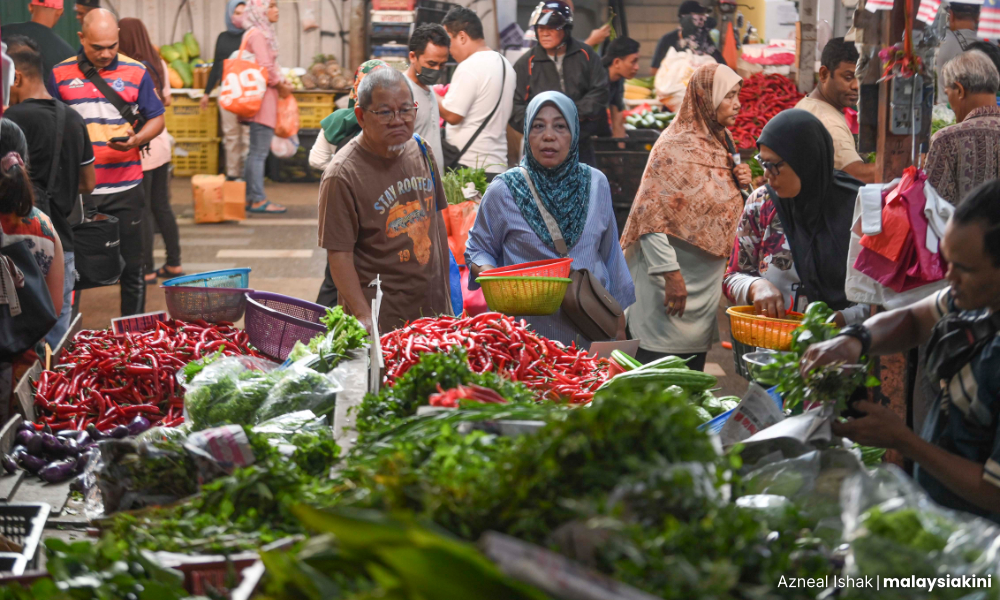
But now I can just see only apartments and flats where these farms once stood.
Malaysia seems ashamed of being called an agricultural country and feels better if it is called an industrial and modern country.
Never mind if we are not self-sufficient in our food cycle, “mesti ada gaya” (must have style). That is the mentality.
India places strong emphasis on agriculture, which serves as the backbone of the economy, providing livelihoods for nearly 55 percent of the population and contributing approximately 17-18 percent of gross domestic product (GDP).
The government’s focus is on increasing productivity, enhancing farmers’ incomes, adopting technology, and ensuring food security, with a significant budgetary shift, including a reported five-fold increase in allocations from 2013-2014 to 2024-2025.
What is the Malaysian government doing?
Doc: Most developed countries and semi-developed countries are worried about food self-sufficiency.
Countries that have large populations like Japan, China, and India, which are concerned with feeding their massive population, are trying to boost output using technology in this time when climate change is eroding food production.
Most developed nations like Israel, Scandinavian countries, and Australia, which have extreme climates, have also embraced technology in farming.
But in Malaysia, all these worries do not exist. In Malaysia, food self-sufficiency is not as important as preserving cronyism and racism in the food sector. Despite having the Kedah rice bowl, Malaysia remains dependent on rice imports to meet domestic demand.
The reason is cronies need to be fed when it comes to rice distribution, and much of the fertile land in Kedah, Kelantan, and Terengganu is operated by smallholder farmers, where fragmented land ownership and higher production costs affect profitability and income sustainability.
This is compared to more mechanised and commercially oriented farming practices in the Sekinchan area, which have resulted in higher yields per hectare and relatively lower production costs.
But there is no way that, for the sake of food security or lower rice prices, the local or federal governments are going to allow Chinese farmers to purchase land owned by Malays to farm rice.
HJ Angus: Despite this, the Selangor government sees fit to start the banning of the pigs!
Now, if all the pork eaters convert to other meats, you can be sure the price of chicken and beef will rise - that’s basic economics.
Some years ago, some farmers were producing record-breaking rice harvests in the Sekinchan area, but they were moved off as they didn’t have the proper approvals - it would be interesting to learn about the yield now?
Winning scarecrow: We can always import food, just like Selangor will have to learn to import pork very soon.
The government encourages Malaysians to import food, especially non-halal food, because the stench from their farms brings greater harm to the environment and makes the consequences of climate change even worse.
So kudos to Madani for making Selangor the first environmentally friendly state in Malaysia and more ready to face climate change.
The above is a selection of comments posted by Malaysiakini subscribers. Only paying subscribers can post comments. In the past year, Malaysiakinians have posted over 100,000 comments. Join the Malaysiakini community and help set the news agenda. Subscribe now.
These comments are compiled to reflect the views of Malaysiakini subscribers on matters of public interest. Malaysiakini does not intend to represent these views as fact.
/file/publisher-c1a3f893382d2b2f8a9aa22a654d9c97/2026/02/18c1db14ad0c9ab79c9470bdda3042b3.jpg)
/file/publisher-c1a3f893382d2b2f8a9aa22a654d9c97/2025/10/3772e08d02c061c6299363fedb19de55.jpg)
/file/publisher-c1a3f893382d2b2f8a9aa22a654d9c97/2026/01/3449ad486f8afa1aca87fb7c2884de3d.jpg)
/file/publisher-c1a3f893382d2b2f8a9aa22a654d9c97/2025/04/04e14690219cf180f049726fa96ed226.jpg)


Report this comment
Are you sure you want to delete this comment?
This action cannot be undone.