


/file/publisher-c1a3f893382d2b2f8a9aa22a654d9c97/2024/10/d50410e060c8f8383cdecd62356c0688.jpg)

Court orders Rosmah to pay Lebanese jeweller RM67.46m
The Kuala Lumpur High Court has ordered Rosmah Mansor to pay RM67.46 million to Lebanese jeweller Global Royalty Trading SAL (GRTS) within a month over her failure to return 43 pieces of jewellery cosigned to her in 2018.
Judge Quay Chew Soon, in allowing GRTS' claim today, also directed the wife of former prime minister Najib Abdul Razak to pay RM75,000 in costs to the plaintiff.
The Kuala Lumpur High Court has ordered Rosmah Mansor to pay RM67.46 million to Lebanese jeweller Global Royalty Trading SAL (GRTS) within a month over her failure to return 43 pieces of jewellery cosigned to her in 2018.
Judge Quay Chew Soon, in allowing GRTS' claim today, also directed the wife of former prime minister Najib Abdul Razak to pay RM75,000 in costs to the plaintiff.
Rosmah was further ordered to pay RM75,000 in costs to the government and police, who were named as third parties in the civil suit.
The ruling followed a full trial over 43 pieces of jewellery consigned by GRTS to Rosmah for viewing but never returned.
Speaking to reporters after proceedings, Rosmah's lawyer Rajivan Nambiar said the defence would apply for a stay of execution and file an appeal against the judgment.
Jewellery never returned
In his grounds, Quay found that Rosmah had received the jewellery but never paid for it, thus ownership remained with GRTS.
"The non-return of the jewellery by the defendant constitutes prima facie evidence of negligence," he said.
The judge rejected Rosmah's defence that the jewellery had been seized by police during a raid on a Pavilion Residences unit on May 17, 2018, finding that she failed to prove the claim.
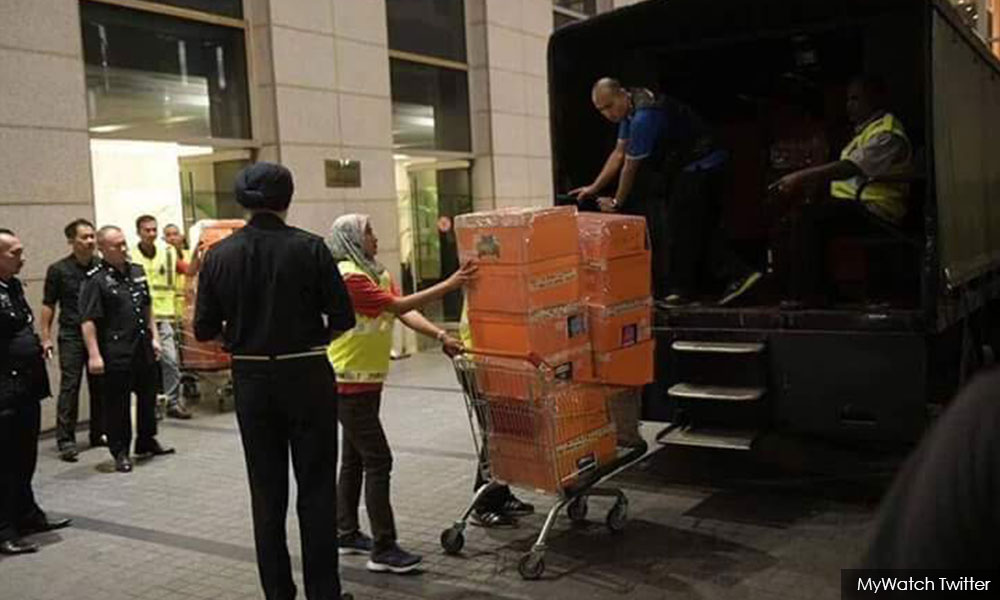
Quay noted that after years of proceedings, inspections of items police seized and forfeiture hearings involving Rosmah, only one item was identified as belonging to GRTS rather than all 44 pieces originally claimed.
"Beyond that single item, there is no evidence proving that police ever seized the remaining 43 pieces of jewellery.
"The defendant's allegation that the police seized the jewellery is a positive defence raised to answer her failure to return the jewellery.
"Accordingly, the burden lies upon the defendant to prove it pursuant to Sections 101, 102 and 103 of the Evidence Act 1950… The law requires proof, and the defendant has failed to prove it," he said.
The judge added that the facts concerning the movement and handling of the jewellery were matters within Rosmah's knowledge.
As such, he said, she could not simply point to the police raid and invite the court to assume the jewellery had been seized.
Consignment note validity
The court agreed with Rosmah’s contention that the final page of the consignment note, containing terms and conditions, was inserted after she had signed the document.
"The consignment notes consisted of six pages. The defendant does not deny signing the first five pages and asserts that the final page was inserted after she had signed it.
"On this aspect, I agree with the defendant," Quay said.
He ruled that the sixth page did not form part of the document signed by Rosmah and therefore rejected it as evidence.
However, Quay said this did not invalidate the consignment note because the first five pages were genuine, admitted and signed by Rosmah.
He noted that Rosmah herself pleaded that the document contained a clause relating to delivery of the jewellery for examination and inspection.
Quay said that the single clause is sufficient to legalise the consignment between the parties.
The judge added that even without the consignment note, GRTS' claim based on bailment remained valid because Rosmah had admitted receiving and possessing the jewellery.
Third-party claim dismissed
The court also dismissed Rosmah's third-party claim seeking indemnity from the government and police.
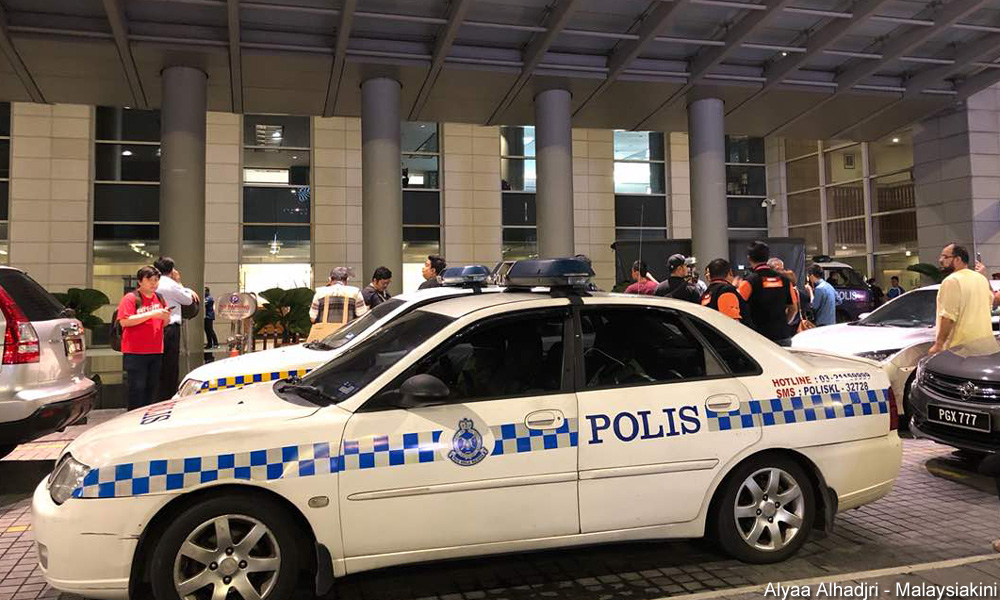
Rosmah had argued that the authorities should indemnify her if she was found liable to compensate GRTS.
The judge ruled that she failed to prove the jewellery had been seized or was under the custody or control of the authorities.
Quay said Rosmah's own testimony undermined her assertion that she had exclusive knowledge of the Pavilion residence where the jewellery was allegedly stored before the raid.
He cited Rosmah's evidence under cross-examination in which she repeatedly said she did not know how items were moved from the residence.
"Simply put, the defendant admitted under cross-examination that she has no personal knowledge about the so-called exclusive access or control of the Pavilion residence.
"In fact, this evidence indicates that multiple individuals had access to and entered the residence before the police raid," he said.
The court also awarded interest of five percent per annum on the judgment sum from today until full settlement.

GRTS filed the suit against Rosmah in 2018, over 44 pieces of jewellery to be returned, but later withdrew it and refiled the case in 2023.
The jeweller sought a declaration that it was the rightful owner of the jewellery, which included diamond necklaces, earrings, rings, bracelets and tiaras, and an order for the items to be returned or, failing that, for Rosmah to pay their value.
/file/publisher-c1a3f893382d2b2f8a9aa22a654d9c97/2023/08/ae58ef19fc51f055b0529f7ce1eb38de.jpg)
/file/1269/0dc1f3b3e14f0abb7b4707f4d74e1322.jpeg)
/file/publisher-c1a3f893382d2b2f8a9aa22a654d9c97/2024/10/d50410e060c8f8383cdecd62356c0688.jpg)


Are you sure you want to delete this comment?
This action cannot be undone.