




Anonymous letter emerges in the House
A mysterious letter centering on the constitutional provisions that come into play in the event the prime minister "ceases to command the confidence of the Dewan Rakyat" and the possibilities of an anti- party hopping legislation has gotten reporters in Parliament guessing.
A mysterious letter centering on the constitutional provisions that come into play in the event the prime minister "ceases to command the confidence of the Dewan Rakyat" and the possibilities of an anti- party hopping legislation has gotten reporters in Parliament guessing.
he one-page letter was anonymously placed in the pigeon-holes of Parliament's press room early this morning, and gave no clues whatsoever as to its author or objectives.
 It had even pricked the curiosity of DPM Najib Abdul Razak: "Dismissal? Who did it?" he said when asked about the document during a press conference after chairing a meeting of the National Mineral Council at the Parliament building this afternoon.
The paper touches briefly on constitutional provisions surrounding the position of the PM in the event he "ceases to command the confidence of the Dewan Rakyat".
Citing Article 43(5) of the Federal Constitution, the document states at the outset that the king has no power to dismiss the PM without a vote of no confidence by the Dewan Rakyat, while the 1966 case of Stephen Kalong Ningkan vs Tun Abang Haji Openg confirms this position.
In the event the PM ceases to command the confidence of the Dewan Rakyat, he can either tender the resignation of his entire government or advise the king to dissolve Dewan Rakyat and call for a new election, it said further.
The king's discretion
Even in such an event, said the document, the king has the discretion to refuse the advice to dissolve Dewan Rakyat.
Following that, the king has the discretion to choose anybody he believes is able to command the confidence of the Lower House, including the PM if the latter lost a 'snap vote' but is able to 'regroup' his supporters and rebuild a majority.
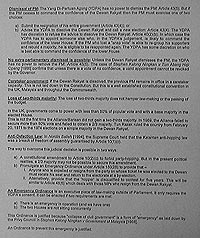 The document touches briefly on the fact that while it is not written into the Constitution that the PM remains in office as head of the caretaker government upon dissolution of the Dewan Rakyat, it is a "well-established" convention in Commonwealth countries for him to do so.
The document then goes into the possibilities of an anti-party hopping law.
From one aspect, such a law would not be possible as the government does not enjoy the two-third majority needed to amend the constitutional protection of the right to assembly and association.
The Supreme Court case of the Kelantan State Legislative Assembly v Nordin Salleh also confirms this, said the document.
Another way to 'overcome' this obstacle, however, is to promulgate through the Emergency Ordinance under Article 150 (2B) a law that:
- anyone who is expelled or resigns from the party on whose ticket he was elected to the Dewan Rakyat must vacate his seat and return to the electorate through a by-election or
- disqualifies a 'hopper' from contesting for five years.
The document also noted that the requirements of such a law to be passed under the Emergency Ordinance - that there is an emergency in operation and the two Houses (of representatives and senators) are not sitting concurrently - are currently fulfilled.
"An ordinance to prevent this emergency is justified," the document concludes.
When approached, MPs on both sides denied any knowledge of the said letter.


Are you sure you want to delete this comment?
This action cannot be undone.