




Zaid: Both sides want me to resign
For a politician who is widely regarded as a maverick, Zaid Ibrahim knows the consequences of being ‘politically incorrect’ on issues which do not go down well with those within his own party.
For a politician who is widely regarded as a maverick, Zaid Ibrahim knows the consequences of being 'politically incorrect' on issues which do not go down well with those within his own party.
"I have been a minister for just about three months and in that time I have talked about various issues - the need to review legislation such as the Internal Security Act, judicial reform, granting wider public access to justice through legal aid, tackling the backlog of cases, the case for greater press freedoms," said the minister in the Prime Minister's Department at a dinner function last night.
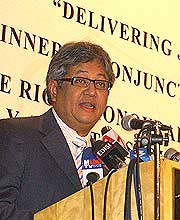 "Such talk has caused consternation to some elements within my own party, to the point that I am accused of espousing opposition policies, and thus I should resign."
However, Zaid told the delegates at the Asia-Pacific Forum of National Human Rights Institutions at a hotel in Kuala Lumpur that he would not be deterred by calls for him to quit as "these are issues that the people want."
The minister lamented that he was caught between the proverbial rock and a hard place as the criticism did not only come from those in Umno.
"The opposition has also called for my resignation on grounds that I have not done enough to bring about the promised changes."
Nevertheless, Zaid told the dinner audience that while politicians will have to grapple with political correctness, human rights advocates are made of "sterner, stronger stuff" who should speak their mind.
He said that governments can no longer say they subscribe to the rule of law and yet compromise on the issues of human rights.
"Equally they cannot say they believe in the rule of law and yet practice arbitrary detention without regard for oversights and adequate review process.
"It is the recognition of human rights that we then embrace the rule of law, the right to equality, right to fair trial, right to information and so on and so forth."
Zaid said governments should realise that human rights can no longer be "discounted as an inconvenient truth."
"Today, it has the power to determine the outcome of elections."
Suhakam should develop a spine
He then advised Suhakam, the Malaysian member of the Asia-Pacific Forum of National Human Rights Institutions, to develop a spine.
"It should be able to provide the impetus to change without fear or favour - without being accused of propagating opposition policies or being anti-government.
"It should take a more vigorous stand to have the Suhakam reports discussed and debated in Parliament. Suhakam should not feel defensive or be apologetic for any criticism laid on its doors."
Zaid also referred to the criticism from NGOs that Suhakam's status be downgraded from Grade A to B due to the body's perceived lack of independence, among others.
"Suhakam like any public service body, must understand that being held to account is no longer uncommon. Calls for it to strengthen its independence by practicing a clear and transparent appointments process and for the make-up of its commissioners to reflect Malaysian plurality are not necessarily bad ones."
The minister also said that the government can no longer continue to be in denial mode or it will have to pay the "heavy price for holding on to this delusion."
For Zaid, reform is the only choice.
"What is it that the younger generation of this country so desperately wants? I believe they want justice and fairness. They want the institutions of governments to be credible, to reflect integrity, they want an independent judiciary where if all else fails them, the final bulwark of justice will step in to keep the powers-that-be on the straight and narrow.
"They want space to voice their dissatisfaction; they want room to exercise their right to assemble, to expression, to livelihood, education, the right to know and be informed. They want transparent and accountable use of power by the authorities and they want a government that is corrupt free."
Zaid said he has faith in Prime Minister Abdullah Ahmad Badawi - the man who appointed him minister after the electoral setback in the March general election - in bringing much-needed reforms in Malaysia.


Are you sure you want to delete this comment?
This action cannot be undone.