




Nike raising the bar? Don't hold your breath, says MTUC
Don’t put your hopes on multinational corporations (MNC) improving factory conditions by applying codes of conduct, said Malaysian Trade Union Congress (MTUC) secretary-general G Rajasekaran.
Don’t put your hopes on multinational corporations (MNC) improving factory conditions by applying codes of conduct, said Malaysian Trade Union Congress (MTUC) secretary-general G Rajasekaran.
The lesson to be learnt from the recent case of US apparels giant Nike Inc is that our government must be the catalyst of change, and not wait for the MNCs to lead it, said Rajasekaran.
Considering the reticence of the Malaysian government, labour laws are not expected to change or improve in the near future, he added.
 "Nike is not known as an exemplary employer. And the Malaysian government? Thousands of workers have been exploited, cheated, stepped on and abused and the government has not been bothered," Rajasekaran told
Malaysiakini
in a telephone interview.
"Nike is not known as an exemplary employer. And the Malaysian government? Thousands of workers have been exploited, cheated, stepped on and abused and the government has not been bothered," Rajasekaran told
Malaysiakini
in a telephone interview.
"It was the environmentalists, the animal rights activists, the human rights groups, the consumer movements, the unionists and other labour activists who put their cases together and forced the creation of such codes.
"But ultimately, even such codes will not solve the problems faced by workers in this country until the government changes its attitude towards workers, changes the laws and fixes all the loopholes that allow such problems to continue," said Rajasekaran.
Earlier this month, Nike put one of its 37 contract manufacturers in Malaysia on ‘red alert’ after Australia’s Channel 7 reported alleged violations by the factory of Nike’s own Code of Conduct.
Defensive minister?
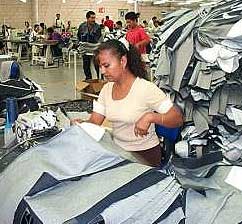
Kuala Lumpur-based garments manufacturer Hytex Integrated Bhd apparently ‘garnished’ foreign employee wages, housed them in squalid conditions and withheld passports.
Nike is going to - according to reports - end its relationship with Hytex unless the alleged abuses are remedied.
Some see this as a big step to the improvement of working conditions - with MNCs requiring local firms to meet their standards through their codes of conduct, disregarding less demanding local labour standards.
This is especially important as the Human Resource Ministry rejected the Nike factory abuse claims off-hand, Rajasekaran observed.
"If he had first ordered investigations and then came out to reject the reported abuses, at least we could respect his effort to verify. But without doing so, he’s just appeared defensive and reactionary (just like his predecessors)."
Other industries like garments, electronics, palm oil and seafarers have their own codes of conduct, said Pathma Krishnan, who runs the Malaysian chapter of the US-based labour rights NGO Verite.
Codes address compliance for worker compensation and conditions, environment, anti-corruption and health and safety issue, she explained.
 They are based on international treaties such as the United Nations’ 'Global Compact', the labour standards of the International Labour Organisation and the Organisation for Economic Co-operation and Development (OECD), and other ‘multilateral guidelines’ for the conduct of ethical business and trade.
"Verite prepares social compliance audits for clients, determining industry code infringements," said Pathma.
"Recommendations are made with specific execution timelines. If factories choose to ignore the recommendations, they risk losing the client.
"MNCs would rather pull out than stay with a factory whose poor working conditions would eventually appear in the media. They would prefer to resolve it before the press is involved," she said.
Malaysian laws must be changed
Despite some successes, Pathma contends that this approach does not guarantee benevolence from MNCs, their contract manufacturers or the government.
"In the end, the ball is in the hands of the government," she said.
Pathma stressed that Malaysian labour standards and laws lagged behind other countries in legal working hours, housing, the practice of withholding passports, low wages, and deduction of wages by companies.
This is compounded by present laws not covering outsourced foreign workers - which leads to more abuse- as opposed to directly-employed foreign workers, she added.
Outsourced workers are those under the care of licensed outsourcing companies offering labour to factories. The outsourcing companies receive payments not the workers - and they distribute payments and benefits to the said workers.
Because they are technically employees of the outsourcing companies, factories expect them to manage wage payment, discipline, termination and discipline, said Pathma.
"Companies take the easy way out. They do not regard them as employees despite them wearing the company uniform and working on their premises.
"The laws have to be changed to address this. Companies have to be made to treat all their employees fairly and give them proper benefits," she said.


Are you sure you want to delete this comment?
This action cannot be undone.